
BeyondSpring Delivers Oral Presentation at ISLAC 2024 World Conference on Lung Cancer of its Lead Anti-Cancer Asset Plinabulin Showcasing Positive Final Phase 3 Data in 2L/3L NSCLC EGFR Wild-Type with Concurrent Publication in the Lancet Respiratory Medicine
BeyondSpring Inc. (NASDAQ: BYSI) presented final Phase 3 data of its lead anti-cancer asset Plinabulin at ISLAC 2024 World Conference on Lung Cancer.
Sentiment and the balance of points
Rhea-AI Sentiment reads the wording of the document, how positive or negative its language is on a 1 to 5 scale. The balance of points shown with the takes weighs what the document actually discloses, so the two can disagree, for example when a trial that missed its main goal is described in upbeat language.
Rhea-AI Summary
BeyondSpring Inc. (NASDAQ: BYSI) presented final Phase 3 data of its lead anti-cancer asset Plinabulin at ISLAC 2024 World Conference on Lung Cancer. The DUBLIN-3 study showed statistically significant and clinically meaningful efficacy data for Plinabulin plus Docetaxel vs. Docetaxel alone in EGFR wild-type NSCLC patients after progression on platinum-based therapy. Key findings include:
- Improved overall survival (OS) with HR=0.82
- Better progression-free survival (PFS) with HR=0.79
- Nearly doubled objective response rate (ORR)
- Doubled 24-month and 36-month OS rates
- 82% reduction in Grade 4 neutropenia
The combination showed a favorable benefit/risk ratio and could be considered as a new treatment option for this population with high unmet medical needs.
Positive
- Statistically significant improvement in overall survival (OS) with HR=0.82
- Better progression-free survival (PFS) with HR=0.79
- Nearly doubled objective response rate (ORR)
- Doubled 24-month and 36-month OS rates
- 82% reduction in Grade 4 neutropenia
- Consistent OS benefit in 24-month follow-up after database lock
- Improved OS benefit with more cycles of treatment (HR=0.64 for ≥4 cycles)
- Well-tolerated combination therapy
Negative
- Higher incidences of Grade 3/4 gastrointestinal disorders in Plinabulin group (16.8% vs 2.9%)
- Increased Grade 3 hypertension in Plinabulin group (18.2% vs 2.9%)
Details
News Market Reaction – BYSI
The recorded move for BYSI in the trading session of this news was +3.21%.
Data tracked by StockTitan Argus. Session date unavailable.
AI-generated analysis. How Rhea-AI works. Not financial advice.




- Statistically Significant and Clinically Meaningful Efficacy Data with Favorable Benefit/Risk ratio from DUBLIN-3 Phase 3 Study of Plinabulin plus Docetaxel vs. Docetaxel in EGFR Wild-Type NSCLC after Progression on Platinum-based Therapy
- Plinabulin/Docetaxel Combination Significantly Improved Overall Survival (OS), Progression Free Survival (PFS), Objective Response Rate (ORR), 2- and 3-year OS Rates and Significantly Reduced Grade 4 Neutropenia vs. Docetaxel
FLORHAM PARK, N.J., Sept. 10, 2024 (GLOBE NEWSWIRE) -- BeyondSpring Inc. (NASDAQ: BYSI) (“BeyondSpring” or the “Company”), a clinical-stage global biopharmaceutical company focused on developing innovative cancer therapies, today announces Dublin-3 final phase 3 efficacy data of its late clinical-stage agent Plinabulin in combination with docetaxel in second/third line (2L/3L) advanced and metastatic non-small cell lung cancer (NSCLC) with epidermal growth factor receptor (EGFR) wild-type. The lead principal investigator, Dr. Trevor Feinstein from Piedmont Cancer Institute, presented the data in an oral presentation (OA08.04) at ISLAC 2024 World Conference on Lung Cancer on September 9th 2024 in San Diego, CA. Concurrently, Dublin-3 study was published in the Lancet Respiratory Medicine (https://doi.org/10.1016/S2213-2600(24)00178-4).
Docetaxel remains the standard of care for patients with 2L/3L NSCLC without targetable alterations despite severe neutropenia (>
The DUBLIN-3 study was a multicenter, randomized, single-blind, placebo-controlled trial that enrolled patients from 58 medical centers internationally. For the intention-to-treat (ITT) population, 559 patients received either docetaxel plus plinabulin (n=278 [male 199, female 79]) or docetaxel plus placebo (n=281 [male 207, female 74]).
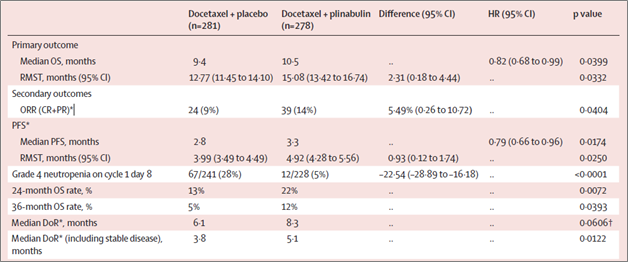
Key findings of Dublin-3 study are summarized below:
- Favorable benefit/risk ratio: Significant improvement in OS (Hazard ratio or HR=0.82; same HR in the Western vs. Asian patients), PFS (HR=0.79) and ORR (nearly doubled). Durable anti-cancer benefits in doubling 24-months and 36-months OS rates. And
82% relative reduction in Grade 4 neutropenia in Cycle 1 Day 8 (p<0.0001). - Consistent OS benefit in 24-month follow up after the database lock: OS HR=0.81 in the ITT population, with better OS benefit in the non-squamous subset (OS HR=0.72, p=0.0078). For the non-squamous subset patients, median OS (mOS) in plinabulin/docetaxel arm was 11.4 months vs. 8.8 months in the docetaxel arm, with a mOS benefit of 2.6 months.
- Improved OS benefit with more cycles of treatment (≥ 4, 6, 8, 10, or 12 cycles): for patients who used at least 4 cycles of treatment, OS HR=0.64, p=0.0027, with a mOS benefit of 4.8 months (plinabulin/docetaxel arm n=133; docetaxel arm n=127).
- Plinabulin/docetaxel combination is well-tolerated: Treatment-emergent adverse-events occurred in 273/274 (99·
6% ) of patients in the plinabulin group and 276/278 (99·3% ) in the control group. Higher incidences of Grade 3/4 gastrointestinal disorders (46 patients [16·8% ] vs. 8 [2·9% ]) and transient Grade 3 hypertension (50 patients [18·2% ] vs. 8 [2·9% ]) occurred in the plinabulin vs. control group.
“There is a poor prognosis for NSCLC patients without targetable alterations whose disease has progressed on platinum-based therapies. Unfortunately, multiple high-profile phase 3 studies failed to show overall survival benefit in this hard-to-treat population compared to standard of care docetaxel, a drug approved over 20 years ago. The data from DUBLIN-3 study demonstrates that the addition and proper sequencing of plinabulin to docetaxel has a favorable benefit/risk ratio compared with docetaxel alone and may have broad utility. This combination could be considered as a new treatment option for this population with high unmet medical needs,” said Dr. Feinstein, a lead principal investigator of the DUBLIN-3 study at Piedmont Cancer Center, Atlanta.
Citation:
Han B., et al. Plinabulin plus docetaxel versus docetaxel in patients with non-small-cell lung cancer after disease progression on platinum-based regimen (DUBLIN-3): a phase 3, international, multicentre, single-blind, parallel group, randomised controlled trial. Lancet Respir Med. 2024 Sep 09: S2213-2600(24)00178-4.
About Plinabulin
Plinabulin is a novel first-in-class dendritic cell maturation agent with durable anti-cancer benefit observed across multiple clinical studies. As a reversible binder at a distinct tubulin pocket, plinabulin does not change tubulin dynamics or antagonize tubulin stabilizing agents, such as docetaxel, which contributes to its differentiated activity and tolerability compared to other tubulin binders. In addition, plinabulin significantly reduces chemotherapy induced neutropenia and could thereby increase docetaxel tolerability. Over 700 patients have been treated with plinabulin with good tolerability.
About Dublin-3 Study
DUBLIN-3 is a multicenter, single-blinded (patient) and randomized, phase 3 trial in 58 medical centers (US, China, and Australia). Only patients with EGFR wild-type NSCLC who had progressed after first-line platinum-based therapy were enrolled. Patients were randomized (1:1) to receive docetaxel (75 mg/m2) on Day 1 and either plinabulin (30 mg/m2) or placebo on Days 1 and 8 in 21-day cycles until progression, unacceptable toxicity, withdrawal, or death. Treated patients were included in the safety analysis and ITT population in the primary efficacy analyses (NCT02504489). The primary endpoint for the study was OS, and secondary endpoints were PFS, ORR, Duration of Response (DoR), Grade 4 neutropenia and Quality of Life.
About BeyondSpring
BeyondSpring is a global clinical-stage biopharmaceutical company focused on developing innovative therapies to improve clinical outcomes for patients with high unmet medical needs. The Company is advancing its first-in-class lead asset, Plinabulin, a potent inducer of dendritic cell maturation, in late-stage clinical development as a direct anti-cancer agent in NSCLC and a variety of cancer indications. BeyondSpring’s pipeline also includes three preclinical immuno-oncology assets. Additionally, BeyondSpring is an equity owner of SEED Therapeutics, Inc which is a pioneer in Target Protein Degradation technology and its application in innovative drug development. Learn more by visiting https://beyondspringpharma.com.
Investor Contact:
IR@beyondspringpharma.com
Media Contact:
PR@beyondspringpharma.com
A photo accompanying this announcement is available at:
https://www.globenewswire.com/NewsRoom/AttachmentNg/66242c15-b61a-48be-a69d-8cf334951a84

FAQ
AI-generated questions and answers. How Rhea-AI works. Not financial advice.