
CBAK Energy Reports Progress in Customer Testing of Full-Tab 26650 LFP Cells for AI Data Center Backup Power
Rhea-AI Summary
CBAK Energy (NASDAQ: CBAT) reported progress in customer testing and commercialization planning for its new full-tab cylindrical LFP cells, the 26650 HP V2.0 and 26650 PFS2 V2.0, developed over a 15‑month R&D program for AI data center BBU and UPS backup power.
According to CBAK Energy, dedicated cathode, anode, and electrolyte formulations and a full-tab architecture target voltage sag, heat buildup, and degradation during high‑rate discharge. Internal tests showed maximum discharge power of 260 W (HP V2.0) and 310 W (PFS2 V2.0) and internal resistance of about 2–3 mΩ versus roughly 6–7 mΩ for conventional multi‑tab cells. The company estimates these traits could cut thermal‑management costs by 5%–10% and extend system service life by 10%–15%, depending on system design. Samples are under evaluation by leading customers, with several moving to joint module‑level validation, while UL/CE qualification, long‑term materials supply agreements, and overseas supply‑chain options are being advanced within a broader dual‑track cylindrical battery strategy.
Positive
- High discharge performance 260 W (HP V2.0) and 310 W (PFS2 V2.0) in internal tests
- Lower internal resistance about 2–3 mΩ vs. 6–7 mΩ for conventional multi‑tab cells
- Estimated cost benefits 5%–10% lower thermal‑management costs and 10%–15% longer service life, per company assessments
- Customer engagement samples under evaluation and multiple customers moving to joint module‑level validation
- Supply readiness long‑term agreements with key materials partners and exploration of overseas supply‑chain options
- Platform strategy dual‑track cylindrical roadmap covering high‑rate and high‑capacity application segments
Negative
- None.
Details
News Market Reaction – CBAT
In the Jul 14 session, CBAT gained 0.46%, reflecting a mild positive market reaction. Argus tracked a trough of -6.6% from its starting point during tracking. Our momentum scanner triggered 2 alerts that day, indicating moderate trading interest and price volatility.
Data tracked by StockTitan Argus on the day of publication.
Key Figures
- Max discharge power (HP V2.0)
- 260 W
- Internal test result for 26650 HP V2.0 cell
- Max discharge power (PFS2 V2.0)
- 310 W
- Internal test result for 26650 PFS2 V2.0 cell
- Full-tab internal resistance
- 2–3 mΩ
- Measured internal resistance of full-tab 26650 cells
- Conventional internal resistance
- 6–7 mΩ
- Measured internal resistance of conventional multi-tab cells
- Thermal-management cost reduction
- 5% to 10%
- Estimated reduction in equipment-room thermal-management costs
- System service-life extension
- 10% to 15%
- Estimated extension of system service life vs multi-tab alternatives
- Capacity per 26650 cell
- more than 20% higher
- Capacity advantage vs smaller 18-/21-series cylindrical cells
- Cell count reduction
- approximately 20%
- Fewer cells needed for equivalent pack capacity
Previous AI Reports
-
Preview of next‑generation high‑rate LFP cells for AI data center backup
24h Move is the share-price change in the day after each event; other market factors may also have contributed.
Key Terms
lfp technical
ce regulatory
AI-generated analysis. How Rhea-AI works. Not financial advice.




Samples of the 26650 HP V2.0 and 26650 PFS2 V2.0 are under evaluation by leading customers; early feedback indicates strong performance across key metrics, and multiple customers are advancing to joint module-level validation
DALIAN, China, July 14, 2026 (GLOBE NEWSWIRE) --
CBAK Energy Technology Limited (NASDAQ: CBAT) (“CBAK Energy” or the “Company”), a leading lithium-ion battery manufacturer and electric energy solution provider in China, today reported progress in customer testing and outlined the technical roadmap and commercialization strategy for its new 26650 HP V2.0 and 26650 PFS2 V2.0 full-tab cylindrical LFP cells designed for AI data center battery backup unit (“BBU”) and uninterruptible power supply (“UPS”) applications. The update was provided in a recent interview with Huabin Dai, who serves as Deputy General Manager of Dalian CBAK Power Battery Co., Ltd. (“Dalian CBAK”), a wholly owned subsidiary of the Company, and as R&D Lead for the 26650 HP/PFS2 V2.0 program.

Huabin Dai, Deputy General Manager of Dalian CBAK, led the 15-month R&D program for the new full-tab 26650 cells designed for AI data center backup power.
As rack-level power density rises in AI data centers, backup power requirements are expanding beyond stored capacity alone to include faster response, higher discharge capability, effective thermal control, and long-term standby reliability. “We recognized early that these requirements would reshape cell design for AI data center backup power,” Dai said. “For rack-level BBU and UPS applications, high-rate discharge, long service life, and thermal safety must be achieved together. Over 15 months, our team completed dozens of material-formulation iterations and validated more than 20 process routes.”
Dai outlined the Company’s approach across three areas: the technical foundation of the cells, the rationale for selecting the 26650 format, and CBAK Energy’s commercialization and cylindrical battery platform strategy.
Purpose-Built for AI Data Center Backup Power
At the material level, Dai said Dalian CBAK developed dedicated cathode, anode, and electrolyte formulations to support high-rate backup operation. According to Dai, these formulations, together with the broader cell design, are intended to address three operational challenges in AI data center backup power: voltage sag during rack-level load transients, heat buildup during high-rate discharge in enclosed cabinets, and accelerated degradation under frequent pulse cycling.
The core differentiator, Dai said, is CBAK Energy’s full-tab architecture, supported by seven years of R&D in full-tab technology. By expanding the current-carrying area and reducing ohmic resistance, the design supports high-rate discharge within the standard 26650 format. Under specified internal test conditions, the 26650 HP V2.0 and 26650 PFS2 V2.0 achieved maximum discharge power of 260 W and 310 W, respectively. According to Dai, internal testing measured the internal resistance of the full-tab 26650 cells at approximately 2–3 mΩ, compared with approximately 6–7 mΩ for conventional multi-tab cells. In CBAK Energy’s assessments of BBU and UPS projects, this lower-resistance architecture is designed to support more stable voltage output during instantaneous high-current discharge, reduce pack-level heat generation, and help slow pack-level degradation. Depending on system design and operating conditions, CBAK Energy estimates that these characteristics could reduce thermal-management costs in equipment rooms by
At the process level, Dai said Dalian CBAK optimized key manufacturing steps, including laser welding and electrolyte injection, to improve consistency in full-tab production. These process upgrades are designed to reduce contact resistance, improve electrolyte wetting, and support low impedance and long-term reliability in high-rate backup applications.
Why the 26650 Format Fits BBU and UPS Systems
According to Dai, CBAK Energy selected the 26650 format not simply as a cell size, but as a platform for BBU and UPS backup applications—one that balances high-rate output, pack-level integration efficiency, thermal-layout flexibility, and deployment readiness. With more than two decades of manufacturing history, the format benefits from established tooling, components, and pack-design ecosystems, helping customers shorten product upgrade cycles and reduce integration complexity. Compared with smaller 18-series and 21-series cylindrical cells, Dai said 26650 cells provide more than
Advancing from Customer Testing Toward Commercialization
Dai said CBAK Energy is advancing the program toward commercialization in BBU and UPS applications through customer testing and validation, international qualification and compliance, supply-chain preparation, and channel collaboration. According to Dai, samples of the new cells are being evaluated by leading customers; early feedback indicates strong performance across key metrics, and multiple customers are advancing to joint module-level validation. International certification and compliance work relating to applicable UL and CE requirements is underway to support international market access. The Company has secured long-term supply agreements with key materials partners and is evaluating overseas supply-chain options to help reduce trade and logistics exposure. CBAK Energy is also working with system integrators and UPS OEMs to jointly develop application-specific cell solutions across multiple deployment scenarios.
Beyond the new 26-series products, Dai said CBAK Energy will continue to pursue a dual-track cylindrical battery strategy: smaller cylindrical cells for high-rate applications such as AI data center BBU, UPS, and industrial power tools, and larger cylindrical cells for high-capacity energy applications. This approach is intended to help the Company address both high-rate and high-capacity segments while strengthening its technology and product portfolio across different market cycles.
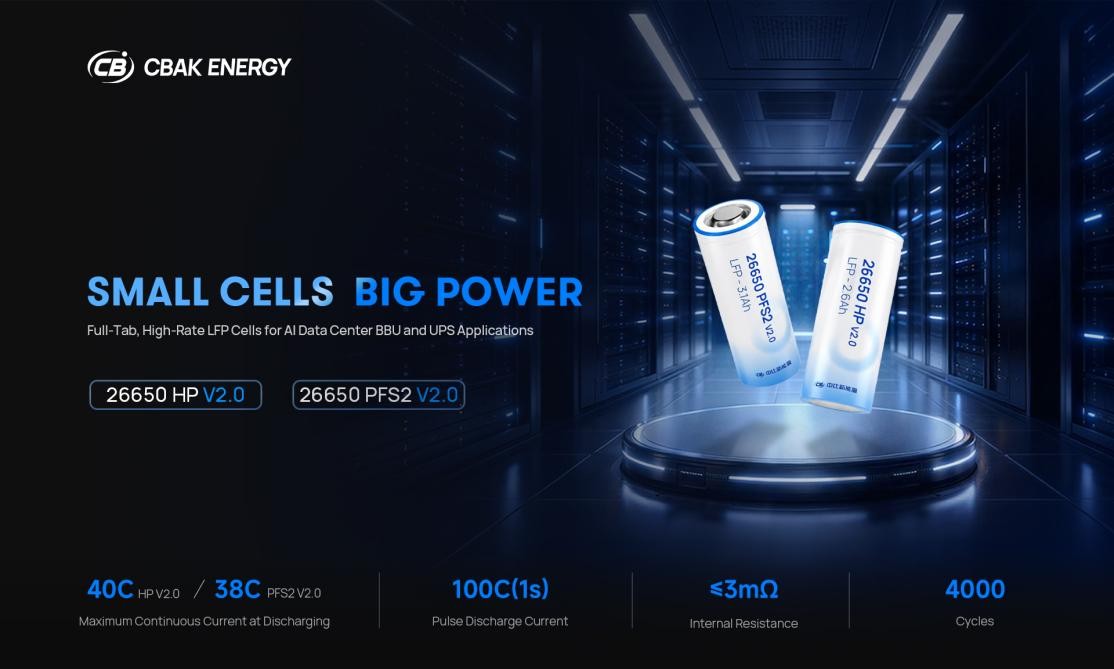
CBAK Energy’s 26650 HP V2.0 and 26650 PFS2 V2.0 cells are designed for AI data center BBU and UPS applications.
The new 26-series cells extend CBAK Energy’s full-tab cylindrical platform into high-rate backup power for AI data centers. More than a specification upgrade, the products reflect the Company’s broader strategy to develop application-specific cylindrical battery platforms for power-intensive infrastructure and underscore its technical direction and market focus in high-rate backup power.
All performance data presented in this release are based on internal laboratory testing conducted by CBAK Energy under specified conditions. Cost and service-life estimates are based on CBAK Energy’s project assessments. Actual performance, cost savings, service life, and other system-level results may vary depending on system design, operating conditions, and other factors.
About CBAK Energy
CBAK Energy Technology Limited (NASDAQ: CBAT) is a leading high-tech enterprise in China engaged in the development, manufacture, and sale of high-power lithium-ion and sodium-ion batteries, as well as the production of raw materials used to manufacture high-power lithium batteries. The Company’s products and solutions are used in electric vehicles, light electric vehicles, energy storage systems, and other high-power applications. In January 2006, CBAK Energy became the first lithium battery manufacturer in China to list on the Nasdaq Stock Market. CBAK Energy has multiple operating subsidiaries in Dalian, Nanjing, Shaoxing, and Shangqiu, as well as a large-scale R&D and production base in Dalian.
Forward-Looking Statements
This press release contains forward-looking statements within the meaning of the safe harbor provisions of the U.S. Private Securities Litigation Reform Act of 1995. Statements that are not historical facts, including statements regarding customer testing, validation, and qualification; anticipated product performance and specifications; expected cost savings and service-life benefits; product certification and regulatory compliance; product development and commercialization; market opportunities and potential customer demand; supply-chain development; future collaborations; emerging applications; and the Company’s product and platform strategy, are forward-looking statements. These forward-looking statements are based on the Company’s current expectations and assumptions and are subject to risks and uncertainties that could cause actual results to differ materially from those expressed or implied. Actual results may differ as a result of various factors, including the outcomes of customer testing, validation, and qualification and whether they result in commercial orders; market adoption and customer demand; the Company’s ability to achieve anticipated technical performance and product specifications under commercial operating conditions; the extent to which anticipated cost savings and service-life benefits are realized; the Company’s ability to scale production while maintaining product consistency; product certification and regulatory requirements; manufacturing and supply-chain conditions; product development and commercialization timelines; macroeconomic conditions; and other risks described in the Company’s filings with the U.S. Securities and Exchange Commission. The Company undertakes no obligation to update any forward-looking statements, except as required by applicable law.
For more information, please visit: https://en.cbak.com.cn/
Email: marketing@cbak.com.cn
LinkedIn: https://www.linkedin.com/company/cbakenergy
X: https://x.com/CBAKEnergy
Stocktwits: https://stocktwits.com/CBAK_Official
Investor Relations
Email: ir@cbak.com.cn
Website: https://ir.cbak.com.cn/
Photos accompanying this announcement are available at
https://www.globenewswire.com/NewsRoom/AttachmentNg/5dacc46b-1994-4b87-a868-5144bf202536
https://www.globenewswire.com/NewsRoom/AttachmentNg/e7803681-d65a-4501-8f9a-b6a052a5a42b

FAQ
AI-generated questions and answers. How Rhea-AI works. Not financial advice.