
Collective Mining Discovers a New Tungsten Enriched High-Grade Subzone 300 Meters Below Surface at Apollo by Drilling 27.35 m at 37.55 g/t AuEq (1.68% WO3, 11.62 g/t Au, 54 g/t Ag, 0.43% Cu)
Collective Mining (CNL) reported new drill results from the Apollo system at Guayabales and the San Antonio project in Colombia.
Sentiment and the balance of points
Rhea-AI Sentiment reads the wording of the document, how positive or negative its language is on a 1 to 5 scale. The balance of points shown with the takes weighs what the document actually discloses, so the two can disagree, for example when a trial that missed its main goal is described in upbeat language.
Rhea-AI Summary
Collective Mining (CNL) reported new drill results from the Apollo system at Guayabales and the San Antonio project in Colombia.
A new high-grade, tungsten-enriched subzone was discovered 300 m below surface at Apollo, plus a 77 m northwest extension of the breccia body and additional halo and infill mineralization. The company holds US$113.3 million in cash and is fully funded for up to 100,000 m of drilling in 2026 with 13 rigs operating.
Positive
- New tungsten-enriched subzone: 27.35 m @ 37.55 g/t AuEq from 300 m (APC-162)
- Previous tungsten-rich intercept: 28.45 m @ 0.80% WO3 and 1.63 g/t Au (APC107-D5)
- Apollo breccia extended 77 m northwest at 900 m depth (APC160-D1)
- Infill at Apollo: 116.25 m @ 1.41 g/t AuEq from 433.10 m (APC160-D1)
- Additional Apollo interval: 51.05 m @ 1.00 g/t AuEq from 618.05 m (APC160-D1)
- Halo mineralization outside breccia: 58.00 m @ 1.03 g/t AuEq (APC-167D)
- San Antonio Dollar target hit: 0.90 m @ 962 g/t Ag and 0.98 g/t Au (SAC-36)
- San Antonio interval: 29.20 m @ 1.28 g/t Au and 11 g/t Ag (SAC-39)
- Completed 184,000 m of drilling, including 120,000 m at Apollo
- Cash balance of US$113.3 million as of March 31, 2026
- Fully funded 2026 plan for up to 100,000 m of drilling
- Thirteen diamond drill rigs active across the Guayabales project
Negative
- Several Apollo exploratory holes (APC160-D2, APC169-D1, APC169-D2, APC-173) returned no significant values
- San Antonio drill hole SAC-37 reported no significant values
- True widths at Apollo estimated at 60%–100%, requiring further drilling for confirmation
- San Antonio mineralized zone geometry remains unconstrained and needs more drilling
- Zinc recovery assumptions in AuEq calculation described as speculative due to limited metallurgical work
Details
News Market Reaction – CNL
On Jun 29, the day this news came out, CNL closed 3.54% below the previous close.
Data tracked by StockTitan Argus for the Jun 29 session.
Key Figures
- High-grade intercept
- 27.35 m @ 37.55 g/t AuEq
- Apollo breccia, APC-162, 300 m below surface
- Tungsten grade
- 1.68% WO3
- Within 27.35 m intercept, APC-162
- Gold grade
- 11.62 g/t Au
- Within 27.35 m intercept, APC-162
- Breccia extension
- 77 m
- Apollo breccia extended northwest by APC160-D1 at 900 m depth
- Cash balance
- US$113.3 million
- As of March 31, 2026
- Total drilling completed
- 184,000 meters
- Guayabales and San Antonio projects to date
- Apollo drilling completed
- 120,000 meters
- Flagship Apollo system to date
- Planned 2026 drilling
- 100,000 meters
- Envisioned 2026 program
Key Terms
gold equivalent technical
core lengths technical
cutoff grade technical
AI-generated analysis. How Rhea-AI works. Not financial advice.




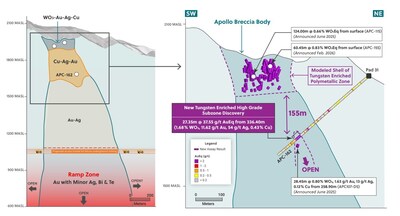
- High-grade tungsten, gold, silver and copper mineralization has been discovered along the eastern contact of the Apollo breccia body as follows:
- 27.35m @ 37.55 g/t gold equivalent (
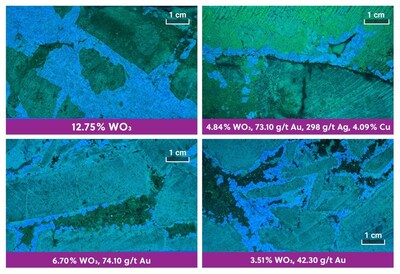
1.68% WO3, 11.62 g/t Au, 54 g/t Ag,0.43% Cu) from 300m below surface (APC-162)
- 27.35m @ 37.55 g/t gold equivalent (
- APC-162 was designed to target 30 meters up-dip of previously released hole APC107-D5, which cut a tungsten rich intercept of 28.45m @
0.80% WO3, 1.63 g/t Au, 13 g/t Ag,0.12% Cu. - The new tungsten rich subzone, as defined by holes APC107-D5 and APC-162, begins at approximately 300 meters below surface and is distinct and separate from the upper tungsten rich zone in the Apollo breccia body, which covers the top 100 meters of the Apollo system from surface.
- The new tungsten enriched subzone remains fully open down dip with follow-up drilling expected to commence in the near future.
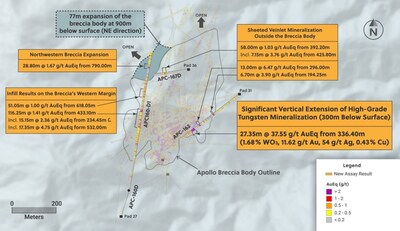
- Drill hole APC160-D1 has locally extended the Apollo breccia by 77 meters to the northwest beyond the current outline at 900 meters below surface by intersecting:
- 28.80m @ 1.67 g/t gold equivalent
Ari Sussman, Executive Chairman commented: "These results reinforce the exceptional scale and depth potential of the Apollo system. The discovery of a new high-grade, tungsten-enriched subzone beginning 300 meters below surface, distinct from and well below the near-surface tungsten zone, demonstrates that Apollo continues to grow in both size and metal endowment with virtually every hole we drill. With 13 rigs turning and a fully funded 2026 program, we are well positioned to continue expanding the Apollo system in multiple directions."
To date, Collective has completed 184,000 meters of diamond drilling across the Guayabales and
With
Details (See Table 1 and Figure 1-2)
Drill hole APC-162, collared from Pad31 and directed to the southwest, was designed as the initial follow-up hole to test for a potential up-dip extension to the Tungsten rich subzone initially intersected in hole APC107-D5, which returned 28.45m at
- 27.35m @ 37.55 g/t gold equivalent (
1.68% WO3, 11.62 g/t Au, 54 g/t Ag,0.43% Cu) from 300 meters below surface
This newly identified tungsten enriched subzone remains open down-dip along the Apollo breccia body eastern contact margin, with follow up drilling expected to commence shortly.
Drill hole APC160-D1 is the initial directional drill hole collared from mother hole APC-160D from Pad27 and was directed to the north on the breccia's western margin. The hole meaningfully expanded the breccia body by 77 meters to the northwest at 900 meters below surface with assay results as follows:
- 28.80m @ 1.67 g/t gold equivalent
APC160-D1 also intersected infill mineralization along the western margin of the breccia body with results as follow:
- 116.25 m @ 1.41 g/t gold equivalent from 647m below surface including 15.15m @ 2.36 g/t gold equivalent and 17.35 m @ 4.75 g/t gold equivalent and
- 51.05 m @ 1.00 g/t gold equivalent from 800m below surface
Two holes, APC-167D and APC-162, were drilled into diorite host rock to the north and outside the main breccia body to improve confidence in the lower grade halo mineralization surrounding the main Apollo breccia body. Both holes intersected sheeted veinlet mineralization with better grades than the existing internal block model, with assay results as follows:
- 58.00 m @ 1.03 g/t gold equivalent from 418m below surface including 7.15 m @ 3.76 g/t gold equivalent (APC-167D)
- 6.70 m @ 3.90 g/t gold equivalent from 223m below surface and 13.00 m @ 6.47 g/t gold equivalent from 264m below surface (APC-162)
Holes APC160-D2, APC169-D1, APC169-D2 and APC-173 were exploratory in nature and failed to intersect any significant mineralization other than thin modest grading individual veinlets.
Table 1: Assays Results for Apollo Drill Holes APC160-D1, APC160-D2, APC-162, APC-167D, APC169-D1, APC169-D2 and APC-173
Hole # | From | To | Length | Au | Ag | Cu | Zn | WO3 | AuEq |
APC160-D1 | 433.10 | 549.35 | 116.25 | 1.23 | 11 | 0.02 | 0.11 | 1.41 | |
Incl. | 433.10 | 448.25 | 15.15 | 2.09 | 15 | 0.02 | 0.34 | 2.36 | |
& Incl. | 532.00 | 549.35 | 17.35 | 4.46 | 23 | 0.04 | 0.22 | 4.75 | |
and | 618.05 | 669.10 | 51.05 | 0.86 | 9 | 0.03 | - | 1.00 | |
and | 790.00 | 818.80 | 28.80 | 1.55 | 8 | 0.03 | 0.10 | 1.67 | |
APC-162 | 194.25 | 200.95 | 6.70 | 3.37 | 34 | 0.03 | 0.44 | 3.90 | |
and | 250.70 | 251.80 | 1.10 | 21.70 | 25 | 0.03 | 0.34 | 21.51 | |
and | 267.90 | 269.30 | 1.40 | 30.90 | 56 | 0.05 | 0.73 | 31.01 | |
and | 296.00 | 309.00 | 13.00 | 5.09 | 12 | 0.04 | - | 0.09 | 6.47 |
and | 336.40 | 363.75 | 27.35 | 11.62 | 54 | 0.43 | - | 1.68 | 37.55 |
APC-167D | 392.20 | 450.20 | 58.00 | 0.85 | 10 | 0.01 | 0.18 | 1.03 | |
Incl. | 425.80 | 432.95 | 7.15 | 3.16 | 38 | 0.01 | 0.59 | 3.76 | |
APC160-D2 | Greenfield Exploratory Drill Holes with no Significant Values | ||||||||
APC169-D1 | |||||||||
APC169-D2 | |||||||||
APC-173 | |||||||||
*AuEq (g/t) is calculated as follows: (Au (g/t) x 0.97) + (Ag (g/t) x 0.017 x 0.85) + (Cu (%) x 1.14 x 0.95) + (Zn (%) x 0.31 x 0.85) + (WO3 (%) x 20.74 x 0.72) utilizing metal prices of Au – |
San Antonio Drill Holes (See Table 2)
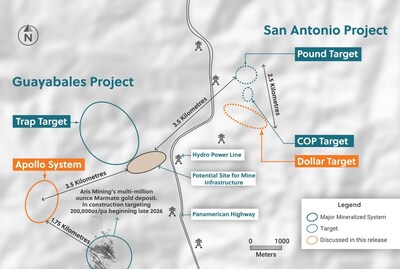
Four exploratory drill holes (SAC-36, SAC-37, SAC-38 and SAC-39) were collared from Pad15 and Pad16 at the Dollar target, which locates in the southern portion of the San Antonio Project approximately 700 meters to the south of the deep porphyry discovery made at the Pound target. Modest porphyry-related vein mineralization was encountered in two of the holes with assay results as follows:
- 0.90m @ 962 g/t Ag, 0.98 g/t Au,
0.15% Cu and0.58% Zn from 101.40 meters down hole and;
2.00m @ 14.15 g/t Au from 471.35 meters down hole (SAC-36) - 29.20m @ 1.28 g/t Au, 11 g/t Ag and
0.30% Zn from 246.30 meters down hole including;
5.95 m @ 3.51 g/t Au,1.03% Zn from 269.55 meters down hole (SAC-39)
The Company is evaluating the San Antonio Project to assess its exploration potential and define priority targets ahead of future field work.
Table 2: Assays Results for San Antonio Drill Holes SAC-36, SAC-37, SAC-38 and SAC-39
Hole # | From | To | Length | Au | Ag | Cu | Zn |
SAC-36 | 101.40 | 102.30 | 0.90 | 0.98 | 962 | 0.15 | 0.58 |
and | 471.35 | 473.35 | 2.00 | 14.15 | 9 | - | - |
SAC-37 | No significant values | ||||||
SAC-38 | |||||||
SAC-39 | 246.30 | 275.50 | 29.20 | 1.28 | 11 | 0.04 | 0.30 |
Incl. | 269.55 | 275.50 | 5.95 | 3.51 | 12 | 0.02 | 1.03 |
Composite widths are presented as core lengths. Additional drilling will be required to confirm the geometry of the mineralized zones, with not enough drilling to estimate the true width of the zone. No grade capping has been applied and internal and continuous dilution of up to |
About Collective Mining Ltd.
To see our latest corporate presentation and related information, please visit www.collectivemining.com.
Founded by the team that developed and sold Continental Gold Inc. to Zijin Mining for approximately
The Company's flagship project, Guayabales, is anchored by the Apollo system, which hosts the large-scale, bulk-tonnage and high-grade gold-silver-copper-tungsten Apollo system. The Company's objectives at the Guayabales Project are to expand the newly discovered high-grade Ramp Zone along strike and to depth, drill test the new outcropping Northern Apollo Oxidized area, drill the recently granted license covering the northwestern extension of the Trap target, and drill a series of greenfield generated targets across the property.
Management, insiders, a strategic investor and close family and friends own
Qualified Person (QP) and NI43-101 Disclosure
David J Reading, Independent Consultant, is the designated Qualified Person for this news release within the meaning of National Instrument 43-101 ("NI 43-101") and has reviewed and verified that the technical information contained herein is accurate and has approved of the written disclosure of same. Mr. Reading has an MSc in Economic Geology and is a Fellow of the Institute of Materials, Minerals and Mining and of the Society of Economic Geology (SEG).
Technical Information
Samples were cut by Company personnel at Collective Mining's core facility in Caldas, Colombia. Diamond drill core was sawed and then sampled in maximum 2-meter intervals, stopping at geological boundaries. Drill hole core diameter is a mix of PQ, HQ and NQ depending on the depth of the drill hole. Core samples have been prepared and analyzed at ALS laboratory facilities in Medellin, Colombia and Lima, Peru for copper, gold and silver assays, and multi-element ICP. ALS is an accredited laboratory which is independent of the Company. Gold assays are obtained by fire assay fusion with AAS finish on a 50g sample (Au-AA24). Any samples returning > 10 g/t were then reanalyzed by fire assay with gravimetric finish on a 50g sample (Au-GRA22). Copper and silver were assayed by inductively Coupled Plasma - Atomic Emission Spectroscopy (ICP-AES) and Mass Spectrometry (ICP-MS) following a 4-acid digestion. Samples were also analyzed for a suite of 48 elements with ME-MS61 plus mercury and a sequential copper leach analysis was completed on each sample with copper greater than 10,000 parts per million. Blanks, duplicates, and certified reference standards are inserted into the sample stream to monitor laboratory performance. Crush rejects and pulps are kept and stored in a secured storage facility for future assay verification. No capping has been applied to sample composites. The Company utilizes a rigorous, industry-standard QA/QC program.
Information Contact:
Follow Executive Chairman Ari Sussman (@Ariski73) on X
Follow Collective Mining (@CollectiveCNL) on X, (Collective Mining) on LinkedIn, and (@collectivemining) on Instagram
FORWARD-LOOKING STATEMENTS
This news release contains "forward-looking statements" and "forward-looking information" within the meaning of applicable securities legislation (collectively, "forward-looking statements"). All statements, other than statements of historical fact, are forward-looking statements and are based on expectations, estimates and projections as at the date of this news release. Any statement that involves discussion with respect to predictions, expectations, beliefs, plans, projections, objectives, assumptions, future events or performance (often, but not always using phrases such as "plans", "expects", "is expected", "budget", "scheduled", "estimates", "forecasts", "intends", "anticipates", or "believes" or variations (including negative variations) of such words and phrases, or state that certain actions, events or results "may", "could", "would", "might" or "will" be taken, occur or be achieved) are not statements of historical fact and may be forward-looking statements. In this news release, forward-looking statements relate, among other things, to the anticipated advancement of mineral properties or programs; future operations; future recovery metal recovery rates; future growth potential of Collective; and future development plans.
These forward-looking statements, and any assumptions upon which they are based, are made in good faith and reflect our current judgment regarding future events including the direction of our business. Management believes that these assumptions are reasonable. Forward-looking statements involve known and unknown risks, uncertainties and other factors which may cause the actual results, performance or achievements of the Company to be materially different from any future results, performance or achievements expressed or implied by the forward-looking statements. Such factors include, among others: risks related to the speculative nature of the Company's business; the Company's formative stage of development; the Company's financial position; possible variations in mineralization, grade or recovery rates; actual results of current exploration activities; conclusions of future economic evaluations; fluctuations in general macroeconomic conditions; fluctuations in securities markets; fluctuations in spot and forward prices of gold, precious and base metals or certain other commodities; fluctuations in currency markets; change in national and local government, legislation, taxation, controls regulations and political or economic developments; risks and hazards associated with the business of mineral exploration, development and mining (including environmental hazards, industrial accidents, unusual or unexpected formation pressures, cave-ins and flooding); inability to obtain adequate insurance to cover risks and hazards; the presence of laws and regulations that may impose restrictions on mining; employee relations; relationships with and claims by local communities and indigenous populations; availability of increasing costs associated with mining inputs and labor; the speculative nature of mineral exploration and development (including the risks of obtaining necessary licenses, permits and approvals from government authorities); and title to properties, as well as those risk factors discussed or referred to in the annual information form of the Company dated March 30, 2026. Forward-looking statements contained herein are made as of the date of this news release and the Company disclaims any obligation to update any forward-looking statements, whether as a result of new information, future events or results, except as may be required by applicable securities laws. There can be no assurance that forward-looking statements will prove to be accurate, as actual results and future events could differ materially from those anticipated in such statements and there may be other factors that cause results not to be anticipated, estimated or intended. Accordingly, readers should not place undue reliance on forward-looking statements.

 View original content to download multimedia:https://www.prnewswire.com/news-releases/collective-mining-discovers-a-new-tungsten-enriched-high-grade-subzone-300-meters-below-surface-at-apollo-by-drilling-27-35-m-at-37-55-gt-aueq-1-68-wo3--11-62-gt-au-54-gt-ag-0-43-cu-302812605.html
SOURCE Collective Mining Ltd.
FAQ
AI-generated questions and answers. How Rhea-AI works. Not financial advice.