
Equifax Second Quarter 2026 Market Pulse Index Report Sees First Pause in K-Shaped Economic Widening in Three Years
Late debt payments fell from 2.1% to 1.9% in the quarter, even as consumer sentiment declined.
Rhea-AI Summary
Equifax (EFX) released its second-quarter 2026 Market Pulse Index, showing a pause in the widening U.S. consumer financial gap. The index edged up from 60.9 in the prior quarter to 61.3, but remained just below its year-earlier level. It was the first quarter in three years without an observed widening gap between financially stronger and weaker consumers.
The share of consumers classified as Thrivers grew 3.2%, while the Middle expanded 0.9% and Strivers contracted 4.2%. The Middle represents nearly 70% of the U.S. population. Assets remained a dividing line: nearly 78% of Thrivers held more than $1 million in assets, while over 97% of Strivers held less than $100,000.
Index values rose across all age groups for the first time since the third quarter of 2025. Millennials recorded a 1.0% quarterly gain to 58.7. Consumer sentiment fell to 49.5 in the second quarter, its lowest reading since tracking began.
Key Figures
- Market Pulse Index
- 61.3 (previous quarter: 60.9)
- Q2 2026
- Thriver segment change
- 3.2% growth
- Q2 2026
- Middle segment change
- 0.9% growth
- Q2 2026
- Striver segment change
- 4.2% contraction
- Q2 2026; sharpest drop since Q4 2023
- Late debt payments
- 2.1% to 1.9%
- Quarterly change
- Consumer sentiment
- 49.5
- Q2 2026 University of Michigan Survey of Consumers; lowest reading since tracking began
AI-generated analysis. How Rhea-AI works. Not financial advice.




Measure of
- The Q2 2026 Equifax Market Pulse Index rose marginally to 61.3, marking the first pause in the widening K-shaped economic gap in three years.
- Financial stability improved across every generation despite record-low consumer sentiment, driven primarily by wealth and asset cushions rather than credit scores or annual income alone.
For the first time in three years, there was no observation of a widening gap in the K-shaped economy. The Index continues to track three consumer segments — Thrivers (those with an Index above 80), the Middle (those with an Index between 50 and 79), and Strivers (those with an Index of 49 and below) — each experiencing different financial realities.
"We have closely observed the K-shaped economy since the COVID-19 pandemic. For the last three years, we have watched the gap between the top and the bottom of the 'K' widen, while the middle class shrank. In the second quarter of 2026, that pattern paused," said Emmaline Aliff, Advisory Leader at Equifax. "The Middle grew slightly, while the Striver population shrank and the Thriver population grew. One quarter does not make a trend, but this is the first quarter in some time where we have observed some improvement."
The Economic Divide Paused
Movement across the three Market Pulse Index consumer segments ran in the opposite direction from recent quarters. The top-tier Thrivers grew by
Assets Remain the Clearest Dividing Line
Assets, not income or credit, defined as savings or other sources of wealth that can be used for pending needs or debt obligations if needed, remain the clearest dividing line between the segments. Nearly
The Middle segment is where wealth is most mixed. About
Every Generation Improves Across The Board
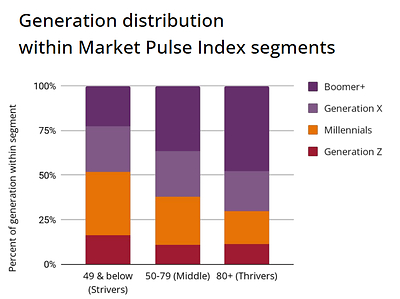
For the first time since the third quarter of 2025, Market Pulse Index values rose across all age segments, with the share of Strivers falling in all four groups:
- Millennials led the entire population with a
1.0% quarterly gain to an average Index of 58.7, and posted the largest drop in their Striver share at 1.4 points. Millennials still represent the largest generational group among Strivers at35.7% of that segment. - Generation Z rose
0.6% to an average Index of 59.3, continuing a pattern of steady career integration and financial growth. Gen Z posted the largest gain in Thrivers of any generation, up 0.7 points. - Generation X increased
0.8% to an average Index of 60.8 as they continue to balance peak career debt against the cost of essential needs. - Boomers+ remain the most financially stable segment with an average Index of 64.5. Their asset cushions anchor both the middle and upper tiers: Boomers+ make up
36.6% of the Middle and47.8% of Thrivers, the largest generational group in each.
Sentiment vs. Reality: Feelings Didn't Match Financial Changes
Consumer sentiment, as measured by the University of Michigan Survey of Consumers, fell to 49.5 in the second quarter, marking its lowest reading since tracking began. However, this feeling did not match consumers' actual financial status change for the quarter as sentiment continued to fall even though the Market Pulse Index incrementally rose, and late debt payments improved from
Credit Behavior Is Not the Same as Financial Capacity
Additionally, the latest Market Pulse Index data reiterates that consumers' financial position is not the same as a credit score alone. Prime borrowers (scores of 661–780) make up almost exactly the same share of every segment:
At the same time,
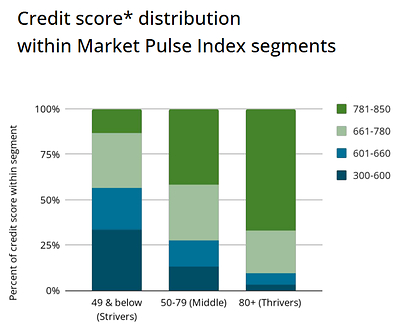
What separates Strivers are tight budgets and a lack of assets rather than difficulty meeting credit obligations:
The Equifax Market Pulse Index provides a comprehensive view of
The Equifax Market Pulse Index was built using AI and machine learning methods leveraging proprietary Equifax wealth and asset data along with data from the Equifax credit file and VantageScore 4.0 credit scores to provide a comprehensive view of consumer financial health. It distills the credit, debt, income, capacity, and assets of
ABOUT EQUIFAX INC.
At Equifax (NYSE: EFX), we believe knowledge drives progress. As a global data, analytics, and technology company, we play an essential role in the global economy by helping financial institutions, companies, employers, and government agencies make critical decisions with greater confidence. Our unique blend of differentiated data, analytics, and cloud technology drives insights to power decisions to move people forward. Headquartered in Atlanta and supported by nearly 15,000 employees worldwide, Equifax operates or has investments in 24 countries in North America, Central and South America, Europe, and the Asia Pacific region. For more information, visit Equifax.com.
FOR MORE INFORMATION:
Tiffany Smith for Equifax
mediainquiries@equifax.com
 View original content to download multimedia:https://www.prnewswire.com/news-releases/equifax-second-quarter-2026-market-pulse-index-report-sees-first-pause-in-k-shaped-economic-widening-in-three-years-302890538.html
SOURCE Equifax Inc.
FAQ
AI-generated questions and answers. How Rhea-AI works. Not financial advice.
What did Equifax's second-quarter 2026 Market Pulse Index show?
The index rose from 60.9 in the prior quarter to 61.3, while remaining just below its year-earlier level. It was the first quarter in three years without an observed widening gap between financially stronger and weaker consumers.
How does Equifax classify consumers in its Market Pulse Index?
Equifax classifies consumers as Thrivers when their index is above 80, the Middle when it is between 50 and 79, and Strivers when it is 49 or below. The index uses a scale of 1 to 100, with 100 representing the greatest financial strength.
What data goes into Equifax's Market Pulse Index?
The index combines anonymized credit, debt, income and asset data with VantageScore credit score insights. Equifax built it using AI and machine learning methods, including its wealth and asset data, credit-file data and VantageScore 4.0 scores.
Why does Equifax's Market Pulse Index measure more than credit scores?
Consumers with similar credit scores can fall into different index segments. Prime borrowers account for 30.0% of Strivers and 30.7% of the Middle, while 43.5% of Strivers have prime or super-prime credit scores. The index also measures debt, income and assets.