
SEALSQ and Kaynes Semicon Mark a Major Milestone in the Development of India’s First Post-Quantum Cryptography Personalization Center with the Inauguration of Kaynes’ New OSAT Facility in Sanand, Gujarat
SEALSQ (NASDAQ: LAES) and Kaynes Semicon inaugurated Kaynes’ new OSAT facility in Sanand, Gujarat on April 1, 2026, and announced the first-phase localization of an India-first Post-Quantum Cryptography (PQC) Personalization Center embedded in that facility.
Sentiment and the balance of points
Rhea-AI Sentiment reads the wording of the document, how positive or negative its language is on a 1 to 5 scale. The balance of points shown with the takes weighs what the document actually discloses, so the two can disagree, for example when a trial that missed its main goal is described in upbeat language.
Rhea-AI Summary
SEALSQ (NASDAQ: LAES) and Kaynes Semicon inaugurated Kaynes’ new OSAT facility in Sanand, Gujarat on April 1, 2026, and announced the first-phase localization of an India-first Post-Quantum Cryptography (PQC) Personalization Center embedded in that facility. The Center will personalize SEALSQ’s QS7001 quantum-safe microcontrollers, host India-sovereign PKI operations, and operate under a joint venture, SEALKAYNESQ, following an LOI signed in January 2026.
The initiative is aligned with MeitY, aims for FIPS 140-3 L3 HSMs, and targets national IoT, identity, and critical infrastructure deployments with devices rooted in an India-controlled CA.
Positive
- LOI signed in January 2026 to form SEALKAYNESQ joint venture
- India-first PQC personalization center localized inside Kaynes’ Sanand OSAT
- India-sovereign PKI with planned intermediate CA and onshore certificate issuance
- Alignment with MeitY positions the JV for national digital identity and IoT programs
Negative
- Joint venture is in process after an LOI, not yet finalized
- Key capabilities (FIPS L3 HSM root CA and personalization throughput) are planned, not operational
Details
News Market Reaction – LAES
On Apr 1, the day this news came out, LAES closed 4.20% below the previous close.
Data tracked by StockTitan Argus for the Apr 1 session.
Key Figures
- Post-quantum standards
- FIPS 203, 204, 205
- NIST 2024 PQC standardization
- Symmetric cipher
- AES-256
- Classical crypto supported by QS7001
- Key length
- RSA-4096
- Classical public-key option on QS7001
- Elliptic curve
- ECC P-384
- Classical ECC support on QS7001
- Security certification
- FIPS 140-3 Level 3
- Planned HSM base for Center
- Standards year
- 2024
- Year NIST finalized initial PQC standards
- Deployment year
- 2026
- Devices referenced for long operational lifespans
- Algorithm names
- ML-KEM, ML-DSA, SLH-DSA
- NIST-standardized PQC algorithms in QS7001
Historical Context
-
Joined ECHONET Consortium to provide PKI services for Japanese smart-home IoT.
-
Highlighted readiness to support Wi-SUN Alliance with post-quantum chips and PKI.
-
Expanded dedicated Quantum Fund to $200M and outlined deployment plans.
-
Signed LOI to acquire Miraex to enhance quantum interconnect capabilities.
-
Announced deployment of PQC to secure blockchain and digital transaction systems.
24h Move is the share-price change in the day after each event; other market factors may also have contributed.
Key Terms
post-quantum cryptography technical
outsourced semiconductor assembly and test technical
osat technical
hardware security module technical
true random number generator technical
side-channel attacks technical
x.509 technical
certificate authority financial
AI-generated analysis. How Rhea-AI works. Not financial advice.




Geneva, Switzerland / Sanand, Gujarat, India, April 01, 2026 (GLOBE NEWSWIRE) --
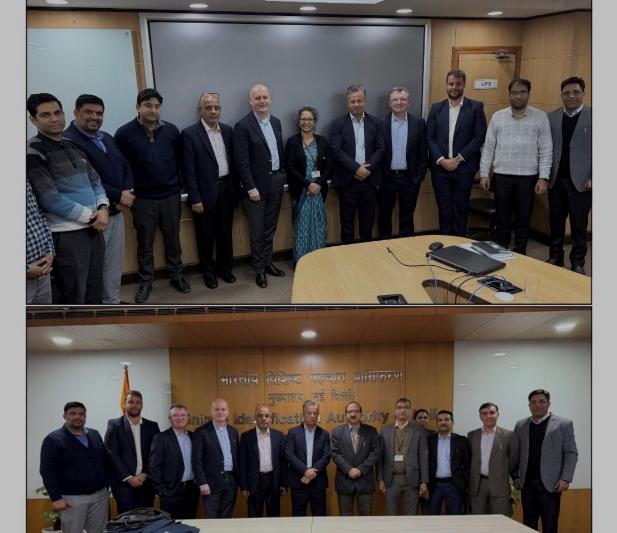
SEALSQ Corp (NASDAQ: LAES) (“SEALSQ” or “Company”), a leader in semiconductor, PKI, and post-quantum technology solutions today announced its participation at the inauguration of Kaynes Semicon’s state-of-the-art Outsourced Semiconductor Assembly and Test (OSAT) facility in Sanand, Gujarat, and within it, the first phase localization of the planned SEALSQ–Kaynes Post-Quantum Cryptography (PQC) Personalization Center (‘the Center”), which will be India’s first facility dedicated to the sovereign, large-scale personalization of quantum-safe semiconductor devices. The inauguration was attended by Prime Minister Narendra Modi and broadcast live across the country via Doordarshan, marking a defining moment in India’s semiconductor journey.
A New Chapter in India’s Semiconductor Sovereignty
The inauguration of the Sanand OSAT facility is far more than a milestone in manufacturing, it is a statement of strategic intent. India is no longer simply a consumer of semiconductor technology; it is building the sovereign infrastructure to produce, secure, and deploy that technology at scale. The Center, which will be physically embedded within the OSAT facility, aims to transform this ambition into operational reality.
The Center plans to enable end-to-end, sovereign semiconductor production: chips will be assembled, tested, and cryptographically personalized within a single, India-controlled environment. This aims to eliminate the need to ship uninitialized devices abroad for security provisioning, a supply chain vulnerability that has long exposed critical national infrastructure to risk. From this Center, QS7001-secured devices are planned to flow directly into India’s IoT ecosystems, digital identity programs, industrial networks, and government systems, as well as into markets across South and Southeast Asia.
Why Post-Quantum Security Cannot Wait
The threat posed by quantum computing to classical cryptography is no longer theoretical. Public-key systems, including RSA, ECC, and Diffie-Hellman, which underpin virtually all secure digital communications, are vulnerable to Shor’s algorithm, which a sufficiently powerful quantum computer could execute to break these ciphers in polynomial time. Governments, intelligence agencies, and standards bodies worldwide have concluded that the transition to post-quantum cryptography must begin now.
The urgency is compounded by the “Harvest Now, Decrypt Later” threat: adversaries are already collecting encrypted data today, with the intention of decrypting it once quantum computing becomes viable. For devices with long operational lifespans, industrial sensors, medical equipment, national identity infrastructure, this means that hardware deployed in 2026 must already be quantum-safe to remain secure through its working life. In 2024, the U.S. National Institute of Standards and Technology (NIST) finalized its first post-quantum cryptographic standards (FIPS 203, 204, and 205) establishing ML-KEM, ML-DSA, and SLH-DSA as the new global baseline. SEALSQ’s QS7001 platform implements these standards at the silicon level.
The QS7001: Quantum-Safe Security at the Hardware Root of Trust
The QS7001 is SEALSQ’s flagship post-quantum secure microcontroller, purpose-built for IoT, industrial, and critical infrastructure applications. It is a hardware security module (HSM) in silicon form, a tamper-resistant, cryptographically capable chip that serves as the root of trust for any device in which it is embedded. Its architecture combines NIST-standardized post-quantum algorithms (ML-KEM for key encapsulation, ML-DSA for digital signatures, SLH-DSA for long-term hash-based signing) with classical cryptographic capabilities (AES-256, RSA-4096, ECC P-384) to support both pure post-quantum and hybrid migration deployments.
At the hardware level, the QS7001 incorporates a True Random Number Generator (TRNG) for on-chip key generation, secure non-volatile storage from which private keys are never exposed in plaintext, a dedicated cryptographic co-processor with hardware acceleration for lattice-based algorithms, and a suite of physical security countermeasures including anti-tamper detection, automatic key zeroization, and resistance to side-channel attacks such as differential power analysis (DPA) and fault injection. Secure boot ensures that only authenticated firmware executes, while native X.509 certificate support enables seamless integration with PKI-based device identity infrastructure.
The QS7001 is designed for deployment across a broad spectrum of applications: smart factory sensors and SCADA systems, national digital identity and e-passport programs, 5G network equipment and subscriber authentication, payment terminals and financial HSMs, medical devices, smart grid infrastructure, and defense communications. In each of these contexts, the chip provides the cryptographic foundation upon which system-level security is built.
The PQC Personalization Center: Secure Identity at Industrial Scale
Chip personalization is the process by which an anonymous silicon die becomes a device with a verifiable, unforgeable identity. During personalization, each QS7001 will receive a globally unique device identifier, will have an asymmetric key pair generated on-chip using its hardware TRNG (with the private key remaining sealed inside the device), will be issued an X.509 device certificate signed by a trusted Certificate Authority, will have its post-quantum algorithm parameters loaded and locked to device-specific values, and will have its security policies, secure boot keys, and lifecycle state transitions programmed and write-protected. The result will be a chip that can authenticate itself, sign data, and establish encrypted communications with quantum-safe guarantees from the moment it leaves the facility.
The Center is planned to be built on FIPS 140-3 Level 3 certified Hardware Security Modules that aim to serve as the root of trust for all key generation and certificate signing operations. Root CA key generation is planned to be conducted through air-gapped key ceremonies with multi-party authorization controls. Every personalization event will be logged with full chain-of-custody records, compatible with MeitY compliance requirements and international standards including ISO/IEC 15408 and Common Criteria. The center is to be designed for high-volume, industrial-scale throughput to support the demands of national IoT and digital identity programs.
A defining feature of the center is intended to be the deployment of an India-sovereign intermediate Certificate Authority, jointly operated by SEALSQ and Kaynes under SEALKAYNESQ governance. Device certificates issued in Sanand are planned to be rooted in this Indian-controlled PKI node, meaning that the cryptographic trust anchor for India-deployed devices resides within India, not on foreign infrastructure. The architecture will support certificate revocation and lifecycle management, interoperability with SEALSQ’s global PKI trust chain, and alignment with India’s Personal Data Protection framework and national cybersecurity standards.
SEALKAYNESQ Ltd: A Joint Venture Built for India’s Scale
The Center will operate under the governance of SEALKAYNESQ Ltd, the joint venture in the process of being established by SEALSQ and Kaynes Semicon following the signing of an LOI in January 2026.
SEALKAYNESQ aims to bring together two complementary bodies of expertise: SEALSQ’s deep IP in post-quantum cryptography, PKI architecture, and secure semiconductor design, and Kaynes Semicon’s proven OSAT manufacturing capabilities, MeitY-aligned regulatory standing, and established relationships across India’s electronics and government ecosystem. Together, they plan to form a vertically integrated platform, from wafer-level assembly and electrical test, through to secure cryptographic personalization and sovereign certificate issuance, that is entirely India-based and India-controlled.
The initiative is being developed in active coordination with the Ministry of Electronics and Information Technology (MeitY), the central authority overseeing India’s electronics, IT, cybersecurity, and emerging technology strategy. This alignment with MeitY positions SEALKAYNESQ as a natural partner for national programs requiring trusted, certified, quantum-safe hardware, from Digital India and BharatNet IoT deployments to defense and public safety infrastructure.
Carlos Moreira, Founder & CEO, SEALSQ Corp, noted, “Our partnership with Kaynes and the launch of this PQC Personalization Center represent a critical step in enabling India to secure its digital future. By embedding post-quantum security directly into semiconductor infrastructure, and doing so on Indian soil, under Indian governance, we are helping build a resilient, sovereign, and future-proof technology ecosystem that can serve as a model for the region.”
Raghu Panicker, CEO, Kaynes Semicon, added, “The inauguration of our Sanand OSAT facility is a defining step in India’s semiconductor journey and reflects the speed at which the nation is translating vision into capability. At Kaynes Semicon, we are proud to be leading from the front by building world-class semiconductor infrastructure, strengthening trusted supply chains, and enabling advanced, secure manufacturing from India for the world. The integration of the SEALSQ PQC Personalization Center within our facility further reinforces our commitment to shaping a future-ready, resilient, and globally relevant semiconductor ecosystem.”
About Kaynes Semicon
Kaynes Semicon, a
About SEALKAYNESQ Ltd
SEALKAYNESQ Ltd is the joint venture in the process of being established by SEALSQ and Kaynes Semicon to develop, personalize, and deploy a sovereign Indian post-quantum semiconductor platform. The venture intends to operate the PQC Personalization Center within the Kaynes OSAT facility in Sanand and aims to focus on the commercialization of QS7001-based security solutions across India and the South and Southeast Asian region, in coordination with MeitY.
About SEALSQ:
SEALSQ is a leading innovator in Post-Quantum Technology hardware and software solutions. Our technology seamlessly integrates Semiconductors, PKI (Public Key Infrastructure), and Provisioning Services, with a strategic emphasis on developing state-of-the-art Quantum Resistant Cryptography and Semiconductors designed to address the urgent security challenges posed by quantum computing. As quantum computers advance, traditional cryptographic methods like RSA and Elliptic Curve Cryptography (ECC) are increasingly vulnerable.
SEALSQ is pioneering the development of Post-Quantum Semiconductors that provide robust, future-proof protection for sensitive data across a wide range of applications, including Multi-Factor Authentication tokens, Smart Energy, Medical and Healthcare Systems, Defense, IT Network Infrastructure, Automotive, and Industrial Automation and Control Systems. By embedding Post-Quantum Cryptography into our semiconductor solutions, SEALSQ ensures that organizations stay protected against quantum threats. Our products are engineered to safeguard critical systems, enhancing resilience and security across diverse industries.
For more information on our Post-Quantum Semiconductors and security solutions, please visit www.sealsq.com.
Forward-Looking Statements
This communication expressly or implicitly contains certain forward-looking statements concerning SEALSQ Corp and its businesses. Forward-looking statements include statements regarding our business strategy, financial performance, results of operations, market data, events or developments that we expect or anticipate will occur in the future, as well as any other statements which are not historical facts. Although we believe that the expectations reflected in such forward-looking statements are reasonable, no assurance can be given that such expectations will prove to have been correct. These statements involve known and unknown risks and are based upon a number of assumptions and estimates which are inherently subject to significant uncertainties and contingencies, many of which are beyond our control. Actual results may differ materially from those expressed or implied by such forward-looking statements. Important factors that, in our view, could cause actual results to differ materially from those discussed in the forward-looking statements include SEALSQ's ability to continue beneficial transactions with material parties, including a limited number of significant customers; market demand and semiconductor industry conditions; and the risks discussed in SEALSQ's filings with the SEC. Risks and uncertainties are further described in reports filed by SEALSQ with the SEC.
SEALSQ Corp is providing this communication as of this date and does not undertake to update any forward-looking statements contained herein as a result of new information, future events or otherwise.
| SEALSQ Corp. Carlos Moreira Chairman & CEO Tel: +41 22 594 3000 info@sealsq.com | SEALSQ Investor Relations (US) The Equity Group Inc. Lena Cati Tel: +1 212 836-9611 lcati@theequitygroup.com |

FAQ
AI-generated questions and answers. How Rhea-AI works. Not financial advice.