
SEALSQ and Parrot Expand Their Strategic Partnership: Parrot to Integrate SEALSQ Post-Quantum Cryptography into Its Next Generation of Secure Drones
SEALSQ (Nasdaq: LAES) and Parrot announced on March 13, 2026 an expanded strategic collaboration to integrate post-quantum cryptography (PQC) into Parrot’s next-generation professional drones.
Sentiment and the balance of points
Rhea-AI Sentiment reads the wording of the document, how positive or negative its language is on a 1 to 5 scale. The balance of points shown with the takes weighs what the document actually discloses, so the two can disagree, for example when a trial that missed its main goal is described in upbeat language.
Rhea-AI Summary
SEALSQ (Nasdaq: LAES) and Parrot announced on March 13, 2026 an expanded strategic collaboration to integrate post-quantum cryptography (PQC) into Parrot’s next-generation professional drones.
The partnership builds on existing deployments—ANAFI UKR and CHUCK 3.0—and will develop a Proof of Concept to add NIST-standard PQC (CRYSTALS-Kyber, CRYSTALS-Dilithium), leveraging SEALSQ Secure Elements that are FIPS-compliant and Common Criteria EAL5+ certified to meet emerging CNSA 2.0 migration timelines.
Positive
- Roadmap to integrate NIST-standard PQC (Kyber, Dilithium)
- Secure Elements are FIPS-compliant and Common Criteria EAL5+
- SEALSQ security already embedded in ANAFI UKR and CHUCK 3.0
- Proof of Concept collaboration to add quantum-resistant authentication
- Supports compliance with CNSA 2.0 binding PQC timelines
Negative
- None.
Details
News Market Reaction – LAES
On Mar 13, the day this news came out, LAES closed 1.53% below the previous close.
Data tracked by StockTitan Argus for the Mar 13 session.
Key Figures
- Commercial drone market (current)
- $4 billion
- Approximate current worldwide commercial drone market size mentioned in article
- Commercial drone market (projected)
- $40 billion
- Projected worldwide commercial drone market size mentioned in article
- Encryption key length
- 512-bit
- SD card AES-XTS encryption key length on Parrot platforms
Previous Partnership Reports
-
Final agreement for Indian sovereign post-quantum semiconductor joint venture.
-
Partnership with Airmod on quantum-ready middleware to speed secure IoT development.
-
Quantum security collaboration with BWT Alpine F1 team around QS7001 launch.
-
Team Partner agreement with BWT Alpine F1 ahead of Las Vegas Grand Prix.
-
JV with Kaynes SemiCon to build India’s first secure, quantum-ready semiconductor center.
24h Move is the share-price change in the day after each event; other market factors may also have contributed.
Key Terms
post-quantum cryptography technical
secure element technical
aes-xts technical
crystals-kyber technical
nist regulatory
AI-generated analysis. How Rhea-AI works. Not financial advice.




Paris, France / Geneva, Switzerland , March 13, 2026 (GLOBE NEWSWIRE) --
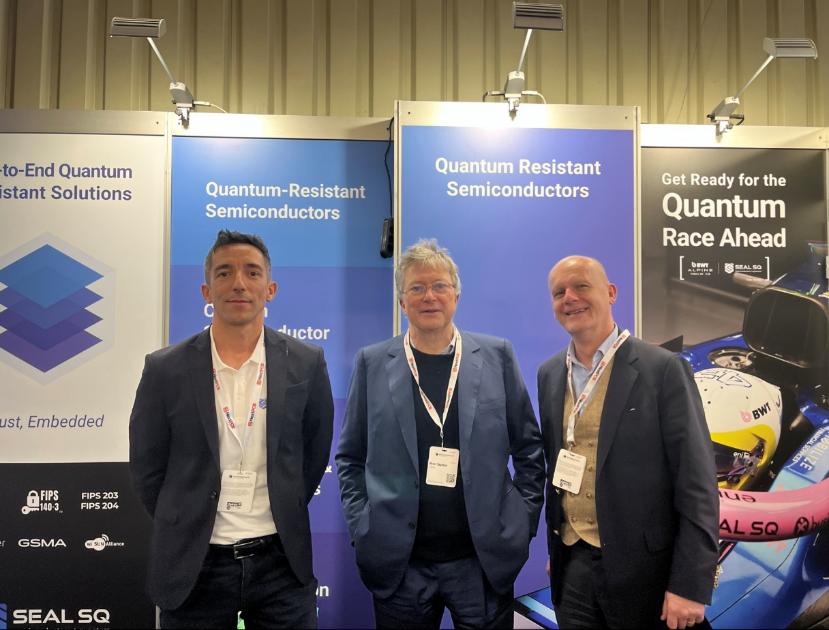
Parrot CEO & founder Henri Seydoux together with SEALSQ General Manager Bernard Vian and EMEA Sales Director Fabien Treillaud at Embedded World, Nuremberg, on March 11, 2026.
SEALSQ Corp (Nasdaq: LAES) (“SEALSQ” or the “Company”), a global leader in post-quantum semiconductor security, and Parrot SA, Europe’s leading commercial micro-UAV group, today announced the expansion of their long-standing strategic collaboration to integrate Post-Quantum Cryptography (PQC) technologies from SEALSQ into Parrot’s next generation of professional drones.
A Partnership Built on Proven Security Excellence
Parrot and SEALSQ have been working in close collaboration for several years to deliver industry-leading cybersecurity across Parrot’s professional drone lineup. SEALSQ’s secure semiconductor technology is embedded in Parrot’s current flagship platforms for defense, public safety, and government applications: the ANAFI UKR, Parrot’s latest ISR (Intelligence Surveillance Recognition) tactical micro-drone designed for demanding operational environments, and the CHUCK 3.0, Parrot’s autopilot powering all types of UAV platforms. Building on earlier deployments in the ANAFI Ai and ANAFI USA, SEALSQ’s role as Parrot’s trusted security partner has deepened with each new platform generation. Across all these systems, SEALSQ co-develops and provisions NIST “FIPS” compliant and Common Criteria EAL5+ certified Secure Elements, delivering cryptographic device identity, tamper-resistant key storage, and secure boot integrity.
On the ANAFI UKR and CHUCK 3.0, SEALSQ’s Secure Element technology enables a comprehensive security architecture built for the most demanding government and defense missions:
- NIST “FIPS” compliant cryptographic operations providing hardware-rooted device identity and tamper-resistant key storage.
- Zero data shared without user consent.
- Full data privacy between drone and operator device, with optional sharing exclusively on secured sovereign servers.
- SD card AES-XTS encryption with a 512-bit key.
- Digitally signed firmware ensuring only authenticated software runs on the platform.
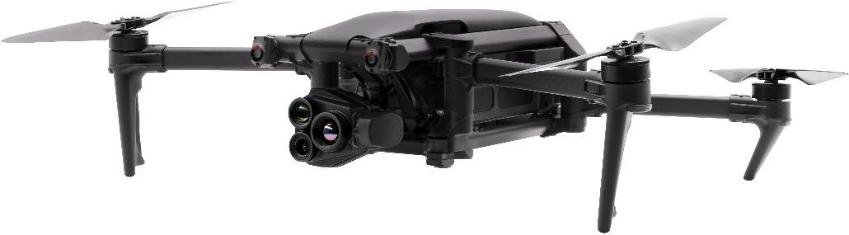
This security architecture reflects the same principles pioneered on earlier Parrot platforms, the ANAFI Ai and ANAFI USA, where SEALSQ first established its role as Parrot’s embedded security partner, and which set the standard for cybersecurity-by-design in the professional drone industry.
Expanding into the Post-Quantum Era
With this new phase of collaboration, the partnership now advances to post-quantum security. The partners have agreed to work together on a roadmap, starting with the development of a Proof of Concept, to incorporate SEALSQ’s quantum-resistant cryptographic technologies, enabling secure authentication, encrypted communications, and trusted device identity engineered to withstand both classical and quantum-era cyberattacks.
A Critical Market at an Inflection Point
The worldwide commercial drone market continues to expand rapidly, with projections indicating growth from approximately
The integration of post-quantum cryptography into drone platforms represents a critical step in ensuring that fleets deployed today remain secure for decades ahead, protecting sensitive operational data against emerging cryptographic threats, including “harvest now, decrypt later” attacks, in which adversaries capture encrypted data today with the intent to decrypt it once sufficiently powerful quantum computers are available. Critically, this transition is no longer purely forward-looking: PQC is rapidly becoming a binding regulatory requirement. The U.S. National Security Agency’s Commercial National Security Algorithm Suite 2.0 (CNSA 2.0) mandates the migration to quantum-resistant algorithms for all systems handling national security information, with targeted compliance timelines already in effect for software and firmware, and imminent deadlines for networking equipment and platforms. CNSA 2.0 explicitly requires the adoption of NIST-standardized PQC algorithms, including CRYSTALS-Kyber for key encapsulation and CRYSTALS-Dilithium for digital signatures, for government and defense-grade applications. Drone platforms operating in public safety, defense, and critical infrastructure missions fall squarely within this scope. Beyond the United States, equivalent frameworks are emerging across NATO allies and the European Union, signaling that PQC compliance will become a baseline procurement requirement for government drone programs worldwide. For Parrot and its professional customers, early adoption of post-quantum security is not only a competitive differentiator, it is a prerequisite for continued access to the most sensitive and high-value government missions.
Carlos Moreira, Chairman & CEO of SEALSQ, said: “Drones are becoming essential tools for governments, defense, public safety, and industrial operations worldwide. Having contributed to build the security foundation of Parrot’s ANAFI USA and ANAFI Ai platforms, we are proud to take our partnership to the next level by integrating post-quantum cryptography directly into Parrot’s next drone generation. With frameworks like CNSA 2.0 now setting binding PQC migration timelines for national security systems, being quantum-ready is no longer optional for platforms serving government and defense customers, it is a requirement. Our collaboration with Parrot demonstrates the importance of embedding quantum-resistant security at the semiconductor level to protect critical autonomous systems and ensure their long-term regulatory compliance.”
Henri Seydoux, CEO of Parrot, added: “Security and data integrity are fundamental requirements for our range of ISR micro-drone. SEALSQ is and has been our trusted security partner on our most demanding platforms, including the ANAFI UKR, and previously ANAFI USA and ANAFI Ai. Post-quantum cryptography is becoming a mandatory standard for platforms engaged in sensitive government and public safety missions, frameworks like CNSA 2.0 are already setting clear compliance deadlines, and equivalent requirements are taking shape across Europe and within NATO. Expanding our collaboration with SEALSQ into the post-quantum domain allows us to get ahead of these requirements, integrate the most advanced semiconductor security into our next-generation platforms, and continue delivering the level of trust and reliability that our most demanding customers expect.”
About Parrot:
Parrot is Europe’s leading group in the field of professional micro-UAVs and 3D mapping and modeling solutions. The Group designs, develops and markets a complementary range of high-performance micro-UAVs and photogrammetry software, serving both operational and analytical needs of security forces, industrial and commercial operators as well as public authorities worldwide.
Parrot integrates artificial intelligence at the core of its microdrone systems, enabling advanced capabilities in autonomous flight, detection, tracking, and analysis in complex environments. Its ANAFI range, renowned for its compact design, robustness and ease of deployment, is built to meet the demanding requirements of critical missions in Intelligence, Surveillance and Reconnaissance (ISR), public safety, and technical inspection.
Parrot is also behind Pix4D, a leading suite of software solutions for photogrammetry and geospatial data processing. Designed for professionals in surveying, construction, infrastructure, agriculture, public safety and environmental monitoring, Pix4D enables advanced 2D and 3D modeling, mapping and digital twin generation.
Founded in 1994 by Henri Seydoux, Chairman, CEO and main shareholder, Parrot is headquartered in Paris and develops its products in Europe. The Group employs over 400 people and generates most of its revenue,
About SEALSQ:
SEALSQ is a leading innovator in Post-Quantum Technology hardware and software solutions. Our technology seamlessly integrates Semiconductors, PKI (Public Key Infrastructure), and Provisioning Services, with a strategic emphasis on developing state-of-the-art Quantum Resistant Cryptography and Semiconductors designed to address the urgent security challenges posed by quantum computing. As quantum computers advance, traditional cryptographic methods like RSA and Elliptic Curve Cryptography (ECC) are increasingly vulnerable.
SEALSQ is pioneering the development of Post-Quantum Semiconductors that provide robust, future-proof protection for sensitive data across a wide range of applications, including Multi-Factor Authentication tokens, Smart Energy, Medical and Healthcare Systems, Defense, IT Network Infrastructure, Automotive, and Industrial Automation and Control Systems. By embedding Post-Quantum Cryptography into our semiconductor solutions, SEALSQ ensures that organizations stay protected against quantum threats. Our products are engineered to safeguard critical systems, enhancing resilience and security across diverse industries.
For more information on our Post-Quantum Semiconductors and security solutions, please visit www.sealsq.com.
Forward-Looking Statements
This communication expressly or implicitly contains certain forward-looking statements concerning SEALSQ Corp and its businesses. Forward-looking statements include statements regarding our business strategy, financial performance, results of operations, market data, events or developments that we expect or anticipate will occur in the future, as well as any other statements which are not historical facts. Although we believe that the expectations reflected in such forward-looking statements are reasonable, no assurance can be given that such expectations will prove to have been correct. These statements involve known and unknown risks and are based upon a number of assumptions and estimates which are inherently subject to significant uncertainties and contingencies, many of which are beyond our control. Actual results may differ materially from those expressed or implied by such forward-looking statements. Important factors that, in our view, could cause actual results to differ materially from those discussed in the forward-looking statements include SEALSQ's ability to continue beneficial transactions with material parties, including a limited number of significant customers; market demand and semiconductor industry conditions; and the risks discussed in SEALSQ's filings with the SEC. Risks and uncertainties are further described in reports filed by SEALSQ with the SEC.
SEALSQ Corp is providing this communication as of this date and does not undertake to update any forward-looking statements contained herein as a result of new information, future events or otherwise.
| Parrot Press Contact Marie Calleux Head of Communications and IR marie.calleux@parrot.com | SEALSQ Press Contact SparkPR Amy Packard Berry amy.packardberry@sparkpr.com |
| SEALSQ Corp. Carlos Moreira Chairman & CEO Tel: +41 22 594 3000 info@sealsq.com | SEALSQ Investor Relations (US) The Equity Group Inc. Lena Cati Tel: +1 212 836-9611 lcati@theequitygroup.com |

FAQ
AI-generated questions and answers. How Rhea-AI works. Not financial advice.