
SEALSQ Signs MoU with the Government of Gujarat to Establish a 300-Million-Unit-Per-Year Post-Quantum Semiconductor Center in India
SEALSQ (NASDAQ: LAES) signed a non-binding MoU with the Government of Gujarat and Kaynes SemiCon on Jan 21, 2026 to pursue India’s first secure semiconductor design, test, and personalization center focused on post-quantum cryptography.
Sentiment and the balance of points
Rhea-AI Sentiment reads the wording of the document, how positive or negative its language is on a 1 to 5 scale. The balance of points shown with the takes weighs what the document actually discloses, so the two can disagree, for example when a trial that missed its main goal is described in upbeat language.
Rhea-AI Summary
SEALSQ (NASDAQ: LAES) signed a non-binding MoU with the Government of Gujarat and Kaynes SemiCon on Jan 21, 2026 to pursue India’s first secure semiconductor design, test, and personalization center focused on post-quantum cryptography.
The planned Outsourced Semiconductor Test and Personalization (OSTP) facility at Kaynes SemiCon’s Sanand campus aims for up to 300 million units per year, joint-venture formation (tentatively SEALKAYNESQ Ltd), and capabilities including secure personalization, cryptographic key injection, PKI provisioning, and Common Criteria-compliant testing, supported by government incentives and private investment.
Positive
- 300M units/year planned production capacity
- Joint venture proposed to localize secure semiconductor personalization
- OSTP to include cryptographic key injection and PKI provisioning
- Strong state support via Government of Gujarat presence and incentives
Negative
- MoU is non-binding, not a firm investment or timeline
- No committed financing or commercial schedule disclosed
Details
News Market Reaction – LAES
On Jan 21, the day this news came out, LAES closed 3.34% above the previous close.
Data tracked by StockTitan Argus for the Jan 21 session.
Key Figures
- Planned annual capacity
- 300 million units/year
- Proposed post-quantum semiconductor OSTP center in Sanand, Gujarat
Historical Context
-
Confirmed active U.S. deployments of post-quantum semiconductor trust anchors.
-
Non-binding MoU for staged strategic investment in quantum firm Quobly.
-
Preliminary FY2025 metrics with strong revenue growth and large cash position.
-
Announcement of Needham Growth Conference presentation and investor meetings.
-
Final binding agreement to form SEALKAYNESQ sovereign post-quantum JV in India.
24h Move is the share-price change in the day after each event; other market factors may also have contributed.
Key Terms
post-quantum cryptography technical
PKI technical
post-quantum secure semiconductors technical
quantum-resistant technologies technical
outsourced semiconductor test and personalization technical
Common Criteria-compliant technical
cryptographic key injection technical
post-quantum cryptographic enablement technical
AI-generated analysis. How Rhea-AI works. Not financial advice.




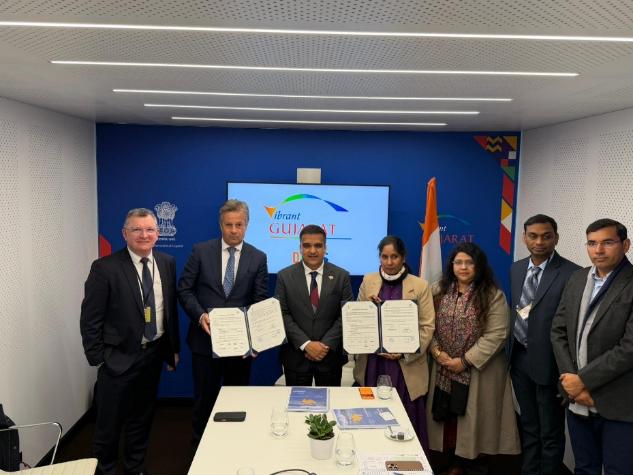
SEALSQ Corp (NASDAQ: LAES) ("SEALSQ" or "Company"), a company that focuses on developing and selling Semiconductors, PKI, and Post-Quantum technology hardware and software products, and a subsidiary of WISeKey International Holding AG, WISeKey International Holding Ltd (“WISeKey”) (SIX: WIHN, NASDAQ: WKEY), a leading global cybersecurity, blockchain, and IoT company, today announced the signing of a Non-binding Memorandum of Understanding (MoU) with the Government of Gujarat and Kaynes SemiCon Private Limited (“Kaynes SemiCon”), a subsidiary of Kaynes Technology India Limited, to collaborate on the establishment of India’s first Secure Semiconductor Design, Test, and Personalization Center dedicated to post-quantum cryptography technologies.
The MoU was signed in the presence of Shri Harsh Rameshbhai Sanghavi, Honorable Deputy Chief Minister of Gujarat, underscoring the Government of Gujarat’s strong commitment to positioning the state as a global hub for advanced semiconductor manufacturing and next-generation secure technologies.
The proposed OSTP center will be located at Kaynes SemiCon’s manufacturing campus in Sanand, Gujarat, and is planned to achieve an annual production capacity of up to 300 million post-quantum secure semiconductors. The facility aims to support India’s growing demand for quantum-resistant technologies across security-sensitive and regulated sectors, including government, defense, critical infrastructure, telecommunications, automotive, IoT, and digital identity.
The parties of the MoU, the Government of Gujarat, acting through its competent authority, SEALSQ and Kaynes SemiCon, plan to collaborate on building a trusted, onshore semiconductor ecosystem aligned with India’s national security, regulatory, and digital sovereignty requirements.
The purpose of the MoU is to formalize the mutual understanding of the parties to cooperate on the establishment of a secure semiconductor platform in India, with a strategic focus on onshore semiconductor personalization, post-quantum cryptography and quantum-resistant semiconductor technologies, and the strengthening of India’s strategic autonomy and resilience within the global semiconductor supply chain.
Under the MoU, the parties intend to establish a joint venture company in India, tentatively named SEALKAYNESQ Ltd, with the aim to secure semiconductor design, testing, and personalization. The proposed initiative includes the planned creation of an Outsourced Semiconductor Test and Personalization (OSTP) facility within Kaynes SemiCon’s campus, that aims to enable advanced capabilities such as Common Criteria-compliant wafer testing, final testing, secure personalization, cryptographic key injection, PKI provisioning, and post-quantum cryptographic enablement.
The proposed OSTP center is expected to receive financial support through a combination of government incentives, private sector investment, and direct investment from SEALSQ, reflecting a public-private partnership model designed to accelerate execution, ensure long-term sustainability, and with the goal of establishing a globally competitive secure semiconductor platform in India.
The collaboration aims to enable localized deployment of quantum-resistant secure processors and cryptographic semiconductor platforms to serve India’s regulated and security-sensitive sectors, while reducing reliance on offshore personalization and supply chains. The proposed project aligns with national and state initiatives including the India Semiconductor Mission, Make in India, and Atmanirbhar Bharat.
By combining SEALSQ’s post-quantum semiconductor and secure hardware expertise with Kaynes SemiCon’s manufacturing infrastructure and the strong institutional support of the Government of Gujarat, the initiative seeks to position Gujarat as a strategic hub for next-generation secure semiconductor technologies and to prepare India’s digital infrastructure for the post-quantum era.
About SEALSQ:
SEALSQ is a leading innovator in Post-Quantum Technology hardware and software solutions. Our technology seamlessly integrates Semiconductors, PKI (Public Key Infrastructure), and Provisioning Services, with a strategic emphasis on developing state-of-the-art Quantum Resistant Cryptography and Semiconductors designed to address the urgent security challenges posed by quantum computing. As quantum computers advance, traditional cryptographic methods like RSA and Elliptic Curve Cryptography (ECC) are increasingly vulnerable.
SEALSQ is pioneering the development of Post-Quantum Semiconductors that provide robust, future-proof protection for sensitive data across a wide range of applications, including Multi-Factor Authentication tokens, Smart Energy, Medical and Healthcare Systems, Defense, IT Network Infrastructure, Automotive, and Industrial Automation and Control Systems. By embedding Post-Quantum Cryptography into our semiconductor solutions, SEALSQ ensures that organizations stay protected against quantum threats. Our products are engineered to safeguard critical systems, enhancing resilience and security across diverse industries.
For more information on our Post-Quantum Semiconductors and security solutions, please visit www.sealsq.com.
Forward-Looking Statements
This communication expressly or implicitly contains certain forward-looking statements concerning SEALSQ Corp and its businesses. Forward-looking statements include statements regarding our business strategy, financial performance, results of operations, market data, events or developments that we expect or anticipate will occur in the future, as well as any other statements which are not historical facts. Although we believe that the expectations reflected in such forward-looking statements are reasonable, no assurance can be given that such expectations will prove to have been correct. These statements involve known and unknown risks and are based upon a number of assumptions and estimates which are inherently subject to significant uncertainties and contingencies, many of which are beyond our control. Actual results may differ materially from those expressed or implied by such forward-looking statements. Important factors that, in our view, could cause actual results to differ materially from those discussed in the forward-looking statements include SEALSQ's ability to continue beneficial transactions with material parties, including a limited number of significant customers; market demand and semiconductor industry conditions; and the risks discussed in SEALSQ's filings with the SEC. Risks and uncertainties are further described in reports filed by SEALSQ with the SEC.
SEALSQ Corp is providing this communication as of this date and does not undertake to update any forward-looking statements contained herein as a result of new information, future events or otherwise.
| SEALSQ Corp. Carlos Moreira Chairman & CEO Tel: +41 22 594 3000 info@sealsq.com | SEALSQ Investor Relations (US) The Equity Group Inc. Lena Cati Tel: +1 212 836-9611 lcati@theequitygroup.com |

FAQ
AI-generated questions and answers. How Rhea-AI works. Not financial advice.