
LG Display becomes world's first to mass-produce 1-120Hz laptop panel
LG Display (LPL) has begun the world's first mass production of a laptop LCD panel using Oxide 1Hz technology that dynamically switches between 1Hz and 120Hz.
Sentiment and the balance of points
Rhea-AI Sentiment reads the wording of the document, how positive or negative its language is on a 1 to 5 scale. The balance of points shown with the takes weighs what the document actually discloses, so the two can disagree, for example when a trial that missed its main goal is described in upbeat language.
Rhea-AI Summary
LG Display (LPL) has begun the world's first mass production of a laptop LCD panel using Oxide 1Hz technology that dynamically switches between 1Hz and 120Hz.
The panel claims 48% longer use on a single charge versus existing solutions, will supply Dell's XPS premium lineup, and LG plans 1Hz OLED mass production from 2027. The company links the tech to a Carbon Emission Reduction Project aiming up to 10% lower usage-phase emissions.
Positive
- World-first mass production of a 1-120Hz laptop LCD panel
- Battery efficiency improvement of 48% on a single charge versus existing solutions
- Commercial supply agreement with Dell for XPS flagship laptops
- Planned mass production of a 1Hz OLED panel beginning in 2027
- Inclusion in a Carbon Emission Reduction effort aiming up to 10% lower usage-phase emissions
Negative
- None.
Details
News Market Reaction – LPL
On Mar 23, the first trading day after this news, LPL closed 6.72% above the previous close.
Data tracked by StockTitan Argus for the Mar 23 session.
Key Figures
- Variable refresh range
- 1–120Hz
- Oxide 1Hz laptop LCD panel capability
- Low refresh mode
- 1Hz
- When viewing static content like emails or e‑books
- High refresh mode
- 120Hz
- When streaming video or gaming with frequent screen changes
- Battery efficiency gain
- 48% more use
- Single‑charge battery life vs existing laptop display solutions
- Carbon reduction target
- Up to 10%
- Carbon Emission Reduction Project product‑usage phase goal
- OLED 1Hz timeline
- From 2027
- Planned mass production start for 1Hz OLED panels
Historical Context
-
Industry’s first 100% dimming consistency verification for large OLED panels.
-
Strategic OLED lineup and gaming/auto displays planned for CES 2026.
-
World‑first gaming OLED monitors with ultra‑high refresh rates for CES 2026.
-
World’s first 27-inch 4K RGB‑stripe OLED panel with 240Hz refresh.
-
CES Innovation Awards for Dual View OLED and UDC‑IR OLED auto displays.
24h Move is the share-price change in the day after each event; other market factors may also have contributed.
Key Terms
lcd technical
refresh rate technical
thin-film transistor (tft) technical
oled technical
variable refresh rate technical
AI-generated analysis. How Rhea-AI works. Not financial advice.




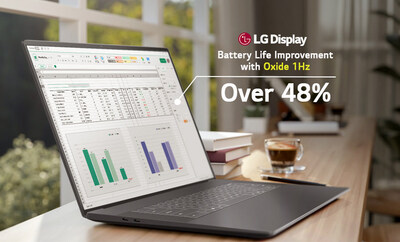
The panel's core feature is its ability to intelligently detect the usage environment. It automatically switches the refresh rate down to 1Hz when the screen is static and up to 120Hz when needed. For example, when performing tasks involving primarily still images — such as checking emails or reading e-books and research papers — the panel operates at the lowest refresh rate of 1Hz. Conversely, it runs in high-refresh-rate mode at up to 120Hz when streaming content such as movies or sports as well as playing games with frequent screen changes.
Refresh rate refers to the number of times a screen is redrawn per second. A higher refresh rate reduces flickering, delivering smoother and clearer visuals. However, maintaining a high refresh rate on a static screen results in unnecessary power consumption due to continuous circuit operation.
By ushering in the unprecedented mass production of a laptop panel that flexibly adjusts the refresh rate based on on-screen activity, LG Display is able to offer a product that boasts greater power efficiency.
In order to achieve this world first, the company developed its own circuit algorithms and panel design technology, discovering new materials and applying the oxide with the lowest power leakage during low-refresh-rate mode to the display's thin-film transistor (TFT).
The result is dramatically improved battery efficiency, including
Considering mobility is a key purchasing factor for laptops, extending usage time with a high-efficiency battery is expected to significantly enhance consumer freedom and convenience. Furthermore, with the recent increase in AI computational tasks driving up power consumption, laptops incorporating Oxide 1Hz are anticipated to rise to even greater prominence.
LG Display will be supplying the Oxide 1Hz laptop panel to global PC manufacturer Dell for its flagship premium XPS lineup. Dell unveiled new XPS models featuring the panel at CES 2026 in January.
In addition, LG Display is preparing to begin mass production of a 1Hz OLED panel incorporating the same technology from 2027.
The company will continue to develop and apply energy-saving technologies such as Oxide 1Hz to advance its "Carbon Emission Reduction Project," which aims to reduce carbon emissions during the product usage phase by up to
"We will deliver differentiated customer value through a 1-120Hz variable refresh rate that integrates world class technology," said Jae-won Jang, Head of LG Display's Medium Display Product Planning Division. "This unique value includes maximizing laptop battery efficiency for consumer convenience in the AI era."
About LG Display
LG Display Co., Ltd. [NYSE: LPL, KRX: 034220] is the world's leading innovator of display technologies, including thin-film transistor liquid crystal and OLED displays. The company manufactures display panels in a broad range of sizes and specifications primarily for use in TVs, notebook computers, desktop monitors, automobiles, and various other applications, including tablets and mobile devices. LG Display currently operates manufacturing facilities in
Media Contact:
Joo Yeon Jennifer Ha, Team Leader, Communication Team
Email: hjy05@lgdisplay.com
 View original content to download multimedia:https://www.prnewswire.com/news-releases/lg-display-becomes-worlds-first-to-mass-produce-1-120hz-laptop-panel-302719732.html
SOURCE LG Display
FAQ
AI-generated questions and answers. How Rhea-AI works. Not financial advice.