
Global Hiring Outlook Strengthens for Q4 as Workforce Transformation Drives Demand for New Skills
ManpowerGroup’s Q4 2026 Employment Outlook Survey shows stronger global hiring plans, driven largely by shifting roles and skills rather than simple expansion.
Sentiment and the balance of points
Rhea-AI Sentiment reads the wording of the document, how positive or negative its language is on a 1 to 5 scale. The balance of points shown with the takes weighs what the document actually discloses, so the two can disagree, for example when a trial that missed its main goal is described in upbeat language.
Rhea-AI Summary
ManpowerGroup (MAN) reports that global hiring momentum is expected to strengthen slightly in Q4 2026, with a Net Employment Outlook (NEO) of 29%, up two points quarter-over-quarter and six points year-over-year, based on a survey of 39,878 employers in 42 countries.
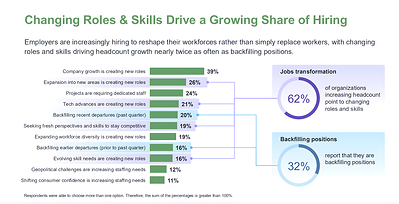
Among employers planning to add staff, 62% say changing roles and skills are the main reason, while 39% cite company expansion and 32% are backfilling positions. Overall, 43% of employers plan to increase headcount between October and December, 14% expect reductions and 41% foresee no change, with cuts driven more by a soft economy than by AI or automation. Entry-level demand remains resilient, with 45% of employers increasing early-career hiring versus 20% reducing it. Construction & Real Estate and Finance & Insurance show the strongest sector outlooks at 36%, while the Americas lead regions with a 36% NEO and India tops all countries at 54%.
Details
News Market Reaction – MAN
On Sep 8, the day this news came out, MAN closed 7.70% below the previous close. Argus tracked a trough of -4.2% from its starting point during tracking. Our momentum scanner recorded 41 alerts for this stock that day. Relative volume reached 2.6x the daily average during tracking.
Data tracked by StockTitan Argus for the Sep 8 session.
Key Figures
- Q4 2026 Net Employment Outlook
- 29%
- Up 2 points from Q3 2026 and 6 points year-over-year
- Survey scope
- 39,878 employers across 42 countries
- Q4 2026 Employment Outlook Survey
- Employers increasing staffing
- 43%
- October–December 2026
- Employers reducing staffing
- 14%
- October–December 2026
- Changing roles and skills
- 62%
- Primary hiring driver among employers planning to add staff
- Entry-level hiring increases
- 45%
- Employers adding early-career talent compared with 2025
- Entry-level hiring reductions
- 20%
- Employers pulling back early-career hiring compared with 2025
- Time-to-hire unchanged
- 41%
- Compared with 2025
Historical Context
-
Revenue increased and ManpowerGroup returned to profitability during the second quarter.
-
Research found limited leadership readiness for AI-enabled work and substantial employee resistance.
24h Move is the share-price change in the day after each event; other market factors may also have contributed.
Key Terms
net employment outlook (neo) technical
time-to-hire technical
AI-generated analysis. How Rhea-AI works. Not financial advice.




Employer hiring intentions rise six points year-over-year, with nearly two-thirds of those expanding headcount hiring for new capabilities and just one third replacing like-for-like skills
Beneath the headline, the data points to a workforce in transition. Among employers planning to add staff,
"This data demonstrates employers continue to place high value on human skills, even as the nature of work shifts with technological advancements," said Jonas Prising, ManpowerGroup Chair & CEO. "Nearly two-thirds of employers tell us they are hiring because the roles and skills their organizations need are changing – many are reconsidering the tasks within jobs rather than displacing full positions. Over the next five years, the defining challenge will be redesigning work at scale. The most forward-thinking employers are building the skills they need from both within and outside their companies – shaping agile workforces that can adapt as organizations seek to realize the true value of AI."
Forty-three percent of employers globally plan to increase staffing between October and December, compared with
Entry-Level Hiring Holds Firm as AI Reshapes Early-Career Work
The survey also points to a more surprising finding on early-career hiring. Across every industry surveyed, more employers report increasing entry-level hiring than cutting it, with
Changing Roles and Skills Drive a Growing Share of Hiring
While company expansion (
At the same time,
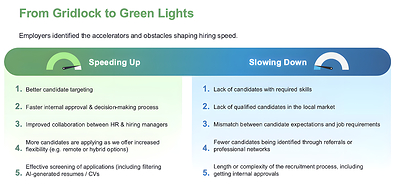
AI Has Yet to Make Hiring Consistently Faster
Despite increasing use of AI across recruitment, employers are not yet seeing a universal improvement in time-to-hire. Twenty-eight percent say their average time-to-hire has become faster compared with 2025, while
Sector and Regional Highlights
Sector Insights
- Construction & Real Estate and Finance & Insurance report the strongest hiring intentions for Q4 2026 at
36% , followed by Information at35% . - Construction & Real Estate posted the largest year-over-year improvement among sectors, rising 13 points.
Regional Hiring Plans
- The
Americas posts the strongest regional hiring outlook at36% , up two points quarter-over-quarter and 11 points year-over-year.Brazil (53% ),Panama (49% ),Mexico (41% ) andthe United States (36% ) report some of the strongest hiring intentions in the region, with employers inPanama posting the largest year-over-year improvement worldwide, up 26 points.
Asia Pacific reports a34% NEO, up six points quarter-over-quarter and three points year-over-year.India leads all 42 countries surveyed at54% , followed byVietnam at36% andChina at34% .
Europe and theMiddle East reports a22% NEO, up five points quarter-over-quarter and five points year-over-year.- Employers in The
United Arab Emirates (41% ),Sweden (39% ) andIsrael (34% ) report the region's most optimistic hiring plans. - Among the region's largest economies, the
United Kingdom (23% ) leads, followed byGermany (15% ), andFrance (13% ).
- Employers in The
To explore global hiring trends in detail, explore the complete Q4 2026 ManpowerGroup Employment Outlook Survey.
The next survey will be released in December 2026, reporting hiring expectations for Q1 2027. The 2027 cycle marks the 65th anniversary of the ManpowerGroup Employment Outlook Survey.
ABOUT THE SURVEY
The ManpowerGroup Employment Outlook Survey, now in its 64th year, is the most comprehensive, forward-looking employment survey of its kind, used globally as a key labor market indicator. The Net Employment Outlook (NEO) is derived by taking the percentage of employers anticipating an increase in hiring activity and subtracting from this the percentage of employers expecting a decrease in hiring activity.
SURVEY METHODOLOGY
The data for the fourth quarter was collected between July 1–31, 2026. The findings are based on interviews with 39,878 public and private employers across 42 countries to measure anticipated employment changes and trends. The results reflect employer sentiment at the time of data collection and may not capture the potential impact of subsequent events. Size of organization and sector are standardized across all countries and territories to allow international comparisons.
ABOUT MANPOWERGROUP
ManpowerGroup® (NYSE: MAN), the leading global workforce solutions company, helps organizations transform in a fast-changing world of work by sourcing, assessing, developing, and managing the talent that enables them to win. We develop innovative solutions for hundreds of thousands of organizations every year, providing them with skilled talent while finding meaningful, sustainable employment for millions of people across a wide range of industries and skills. Our expert family of brands – Manpower, Experis, and Talent Solutions – creates substantially more value for candidates and clients across more than 70 countries and territories and has done so for more than 75 years. We are recognized consistently as a best place to work for Women, Inclusion, Equality, and Disability, and in 2026 ManpowerGroup was named one of the World's Most Ethical Companies for the 17th time; all confirming our position as the brand of choice for in-demand talent.
For more information, visit www.manpowergroup.com, or follow us on LinkedIn, Facebook, and Bluesky.
FORWARD-LOOKING STATEMENTS
This report contains forward-looking statements, including statements regarding labor demand in certain regions, countries and industries, and economic uncertainty. Actual events or results may differ materially from those contained in the forward-looking statements, due to risks, uncertainties and assumptions. These factors include those found in the Company's reports filed with the U.S. Securities and Exchange Commission (SEC), including the information under the heading "Risk Factors" in its Annual Report on Form 10-K for the year ended December 31, 2025, whose information is incorporated herein by reference. ManpowerGroup disclaims any obligation to update any forward-looking or other statements in this release, except as required by law.
 View original content to download multimedia:https://www.prnewswire.com/news-releases/global-hiring-outlook-strengthens-for-q4-as-workforce-transformation-drives-demand-for-new-skills-302871645.html
SOURCE ManpowerGroup
FAQ
AI-generated questions and answers. How Rhea-AI works. Not financial advice.
What is the Net Employment Outlook (NEO) and how is it calculated?
The Net Employment Outlook (NEO) is calculated by taking the percentage of employers expecting to increase hiring and subtracting the percentage expecting to decrease hiring. It is used as a forward-looking indicator of labor market conditions.
How is AI currently affecting hiring speed according to the survey?
Despite greater use of AI in recruitment, 28% of employers say time-to-hire is faster than in 2025, 41% say it is about the same and 30% report it has become slower, indicating that AI has not yet produced a consistent reduction in hiring times.
What does the survey reveal about entry-level hiring trends?
Across all industries surveyed, 45% of employers are increasing early-career hiring compared with 2025, while 20% are pulling back. Where entry-level hiring is reduced, cost pressures and lack of experience are cited more often than AI, suggesting automation is changing early-career roles rather than eliminating them.
Which sectors show the strongest hiring intentions for Q4 2026?
Construction & Real Estate and Finance & Insurance report the strongest Q4 2026 hiring intentions with NEOs of 36%, followed by the Information sector at 35%. Construction & Real Estate also records the largest year-over-year sector improvement, rising 13 points.
Which regions and countries have the most optimistic hiring outlooks?
The Americas post the strongest regional outlook with a 36% NEO, up two points quarter-over-quarter and 11 points year-over-year. Asia Pacific records a 34% NEO, and Europe and the Middle East report 22%. Among countries, India leads at 54%, followed by Brazil at 53%, Panama at 49%, Vietnam at 36% and the United Arab Emirates at 41%, with Panama showing the largest year-over-year improvement, up 26 points.
When was the Q4 2026 Employment Outlook Survey conducted and what is its scope?
Data for the Q4 2026 survey were collected between July 1 and July 31, 2026. The findings are based on interviews with 39,878 public and private employers across 42 countries, with organization size and sector standardized to support international comparisons. Results reflect employer sentiment at the time of data collection and may not include the impact of later events.
When will the next ManpowerGroup Employment Outlook Survey be released?
The next Employment Outlook Survey is scheduled for release in December 2026 and will cover hiring expectations for Q1 2027. The 2027 cycle will mark the 65th anniversary of the survey.