
AI Adoption Is Outpacing Leadership Readiness as New Research Finds Only 3% of Organizations Say Their Leaders Are Fully Prepared to Lead AI-Enabled Teams
ManpowerGroup (NYSE:MAN), through ManpowerGroup Talent Solutions, released Part II of its New Talent Equation research series, developed with Everest Group, on how organizations convert AI investment into business impact.
Rhea-AI Summary
ManpowerGroup (NYSE:MAN), through ManpowerGroup Talent Solutions, released Part II of its New Talent Equation research series, developed with Everest Group, on how organizations convert AI investment into business impact. The study surveyed 80 senior leaders in the US and UK across healthcare, life sciences, manufacturing, and technology.
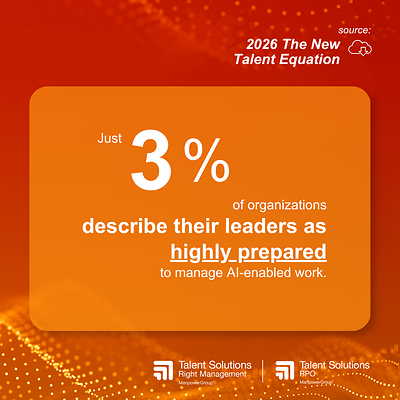
According to the report, only 3% of organizations say their leaders are highly prepared to manage AI-enabled work, and just 17% report advanced workforce readiness. About 78% see employee fear of job displacement and 63% report resistance to AI tools. Most organizations emphasize reskilling and AI-focused upskilling, and report the strongest productivity gains when humans and AI collaborate in redesigned workflows.
Positive
- None.
Negative
- None.
Details
News Market Reaction – MAN
On Jul 22, the day this news came out, MAN closed 0.04% below the previous close. Our momentum scanner recorded 3 alerts in the available session data.
Data tracked by StockTitan Argus for the Jul 22 session.
Key Figures
- Highly prepared leaders
- 3% of organizations
- Managing AI-enabled ways of working
- Employee AI concern
- 78% of organizations
- Reported employee concern about AI's effect on jobs
- Advanced workforce readiness
- 17% of organizations
- Advanced or transformational workforce readiness
- Employee job-displacement fear
- Nearly 78% of organizations
- Reported employee fear of job displacement
- AI tool resistance
- 63% of organizations
- Reported workforce resistance after AI-tool deployment
- Reskilling and redeployment
- Nearly 63% of organizations
- Identified these as the most common outcome for significantly impacted employees
- AI upskilling priority
- 86% of organizations
- Ranked AI-focused upskilling and reskilling among top priorities
- AI-augmented productivity gains
- 34% of organizations
- Reported greatest productivity improvements in AI-augmented roles
Previous AI Reports
-
Experis launched an AI-powered workflow offering built with IBM watsonx Orchestrate.
-
Research found widespread AI hiring adoption but fewer than 5% transformational outcomes.
-
Outlook identified strong demand for AI skills despite moderating global technology hiring.
-
ManpowerGroup presented AI tools and workforce research at VivaTech 2026.
-
Experis reported mounting pressure on CIOs to deliver AI return on investment.
24h Move is the share-price change in the day after each event; other market factors may also have contributed.
Key Terms
chro technical
ai-augmented roles technical
AI-generated analysis. How Rhea-AI works. Not financial advice.




Part II of The New Talent Equation research series finds workforce confidence, leadership capability, and employee trust are determining which organizations realize value from AI and which fall behind.
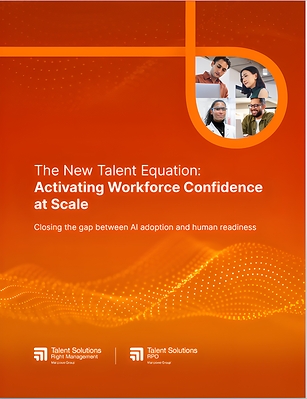
The New Talent Equation: Activating Workforce Confidence at Scale, a new report commissioned by Talent Solutions and developed with Everest Group, is the second report in a two-part research series examining how organizations can turn AI investment into business impact. Building on the first report's focus on fragmented talent systems, this edition explores the human side of transformation, finding that leadership capability, employee trust, and workforce adaptability increasingly determine which organizations realize AI's full value.
"The conversation around AI has fundamentally changed," said Caroline Pfeiffer Marinho, Global Business Leader, Talent Solutions RPO & Right Management. "Most organizations have made significant progress deploying AI. What we're seeing now is that technology is no longer the primary challenge. Leaders are asking how to build workforce confidence, prepare managers, and help people adapt as work changes. The organizations creating lasting advantage are investing in both system transformation and workforce transformation."
"The first phase of Al transformation has been defined by adoption. The next phase is likely to be defined by adaptation," Sailesh Hota, Vice President, Everest Group, said. "As Al becomes embedded across talent processes and workforce systems, the ability to redesign how work is organized may become a more important determinant of success than technology deployment alone."
The research draws on a survey of 80 C-suite, CHRO, and senior talent acquisition leaders across
Key Findings
- Workforce Readiness Is Falling Behind AI Adoption
Organizations are deploying AI faster than they are preparing people to use it. Only17% of organizations report advanced or transformational workforce readiness, where AI capability is deeply embedded into workflows and linked to measurable business outcomes. - Leadership Readiness Has Become AI's Biggest Bottleneck
Just3% of organizations describe their leaders as highly prepared to manage AI-enabled ways of working, while nearly half say their leaders are only moderately prepared. The findings suggest leadership capability may now be a greater barrier to transformation than technology itself. - Trust Is Becoming a Business Performance Issue
Nearly78% of organizations report employee fear of job displacement, while63% report workforce resistance to adopting AI tools after deployment. Workforce confidence now influences adoption, engagement, and how quickly organizations realize value from AI. Without employee trust, organizations will struggle to scale AI, regardless of the technology they deploy. - AI Is Reshaping Jobs, Not Eliminating Them
Despite widespread concern about job displacement, organizations are responding to AI by redesigning work rather than reducing headcount. Nearly63% identify reskilling and redeployment as the most common outcome for employees whose roles are significantly impacted by AI, while86% rank AI-focused upskilling and reskilling among their top workforce priorities over the next 12 to 18 months. - The Best Results Come from Human and AI Collaboration
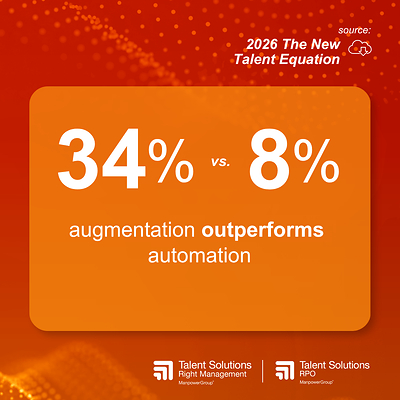
Organizations achieve their greatest productivity gains when AI augments human work rather than fully automating it. Thirty-four percent of organizations report their greatest productivity improvements in AI-augmented roles, where people and AI collaborate through redesigned workflows, compared with just8% reporting their strongest gains from fully automated roles.
Together, the two reports point to two equally important priorities for organizations navigating AI transformation. Organizations must build integrated talent systems that enable AI while also building the workforce confidence, leadership capability, and trust needed to sustain change. The next phase of AI transformation will be defined less by how quickly organizations deploy AI and more by how effectively they prepare people to work, adapt, and succeed alongside it.
The New Talent Equation: Activating Workforce Confidence at Scale is available now at mpgtalentsolutions.com/the-new-talent-equation, along with the first report in the series, The New Talent Equation: Building Better Talent Decisions.
ABOUT MANPOWERGROUP TALENT SOLUTIONS
Talent Solutions combines RPO, TAPFIN-MSP, and Right Management to deliver end-to-end, data-driven capabilities across the talent lifecycle. Drawing on deep industry expertise and a genuine understanding of what talent wants, we help organizations address complex workforce needs, from attraction and acquisition to upskilling, development, and retention. Through seamless delivery, best-in-class technology, and extensive workforce insights, we serve clients across multiple countries and at scale. Talent Solutions is part of the ManpowerGroup® (NYSE: MAN) family of brands, which also includes Manpower and Experis.
For more information, visit www.mpgtalentsolutions.com, or follow us on LinkedIn.

 View original content to download multimedia:https://www.prnewswire.com/news-releases/ai-adoption-is-outpacing-leadership-readiness-as-new-research-finds-only-3-of-organizations-say-their-leaders-are-fully-prepared-to-lead-ai-enabled-teams-302831661.html
SOURCE ManpowerGroup
FAQ
AI-generated questions and answers. How Rhea-AI works. Not financial advice.