STOCK TITAN

CIOs Face Mounting Pressure to Deliver AI ROI as the Business-IT Divide Reaches a New High

(Moderate)
(Neutral)
Tags
AI

ManpowerGroup (NYSE:MAN) brand Experis released its CIO 2026 Outlook, based on 1,930 tech leaders across 12 countries. CIO priorities have shifted, with business-IT alignment overtaking cybersecurity, while AI ROI, digital sovereignty, skills shortages, and misunderstood CIO roles create mounting execution pressure.

Loading...
Loading translation...

Positive

  • None.

Negative

  • None.

News Market Reaction – MAN

+2.81%
+2.81% Session close to close

In the Jun 11 session, MAN gained 2.81%, reflecting a moderate positive market reaction.

Data tracked by StockTitan Argus on the day of publication.

Market Context

This announcement underscores how AI is reshaping technology leadership, with 48% of IT leaders rank...
Analysis

This announcement underscores how AI is reshaping technology leadership, with 48% of IT leaders ranking business-IT alignment as the top CIO priority and 54% already seeing positive AI ROI. Yet 61% say C-suite peers do not fully understand the CIO role, and 81% cite digital sovereignty as a high priority despite growing offshore plans. In the context of ManpowerGroup’s prior AI initiatives, investors may watch how these leadership pressures influence future AI offerings, talent strategies, and demand for technology services.

Key Figures

CIO 2026 Outlook respondents: 1,930 technology leaders Countries covered 2026: 12 countries Business-IT alignment priority: 48% +5 more
8 metrics
CIO 2026 Outlook respondents 1,930 technology leaders Survey sample across 12 countries in CIO 2026 Outlook report
Countries covered 2026 12 countries Geographic scope of CIO 2026 Outlook survey
Business-IT alignment priority 48% IT leaders citing alignment of IT strategy with business objectives as top CIO task
Cybersecurity priority 2025 34% IT leaders previously prioritizing alignment in 2025 survey
C-suite misunderstanding CIO role 61% Tech leaders saying senior peers do not fully understand the CIO role
AI investments positive ROI 54% Tech leaders reporting AI investments already producing positive ROI
Perceived AI overinvestment 31% Leaders who believe their organizations are overinvesting in AI
Digital sovereignty priority 81% IT leaders rating digital sovereignty as a high priority

Previous AI Reports

5 past events · Latest: Mar 24 (Positive)
Same Type Pattern 5 events
Date Event Sentiment 24h Move Catalyst
Mar 24 AI startup challenge Positive +0.1% Launch of VivaTech AI startup challenge focused on workforce solutions.
Mar 3 AI interviewing rollout Positive +3.8% Global partnership to scale AI-powered, structured interviewing for hiring.
Feb 26 AI skills shortage Positive +8.0% Report highlighting global talent shortages and rising demand for AI skills.
Jan 20 Talent barometer Neutral -2.6% Global Talent Barometer showing higher AI use but falling confidence and burnout.
Jan 16 WEF AI initiatives Positive -2.9% WEF Davos engagement and large-scale AI and upskilling initiatives launch.

24h Move is the share-price change in the day after each event; other market factors may also have contributed.

Pattern Detected

AI-themed announcements have often been followed by modestly positive moves, though there are notable negative reactions to broader workforce and confidence surveys.

Recent Company History

Over recent months, ManpowerGroup has issued multiple AI-tagged updates, from Davos initiatives and workforce readiness programs to global talent barometers and AI interviewing partnerships. Several of these, such as news on AI-driven interviewing and AI-skills shortages, were followed by positive reactions of up to 8.01%, while broader sentiment and confidence reports saw declines of around 2–3%. Today’s CIO-focused AI ROI report extends this narrative, emphasizing leadership pressure, skills gaps, and the operational realities of scaling AI across global enterprises.

Key Terms

digital sovereignty, cybersecurity, cloud computing, machine learning, +4 more
8 terms
digital sovereignty regulatory
"Digital sovereignty concerns grow despite offshore expansion: 81% of IT leaders..."
Digital sovereignty is the idea that a country, organization, or individual controls its own data, digital systems, and the rules that govern them, rather than relying on foreign providers or distant rules. For investors it matters because laws, contracts, and technology choices driven by digital sovereignty can reshape markets, create compliance costs, alter where companies store and process data, and influence which vendors and suppliers win or lose—similar to how owning the keys and locks to a building determines who can access it.
cybersecurity technical
"One year ago, cybersecurity kept CIOs up at night. Today, business-IT alignment..."
Cybersecurity involves protecting computers, networks, and digital information from theft, damage, or unauthorized access. It is essential for safeguarding sensitive data and maintaining trust in digital systems, which matters to investors because strong cybersecurity reduces the risk of costly breaches and disruptions that can impact a company’s performance and reputation. Think of it as locking and safeguarding valuable information much like securing a safe to prevent theft.
cloud computing technical
"while 41% still see cloud computing and scalable digital infrastructure as the top ROI..."
Cloud computing is the use of remote computers and data centers accessed over the internet to store data, run software, and handle computing tasks instead of keeping those resources on local machines. For investors it matters because companies that use or provide cloud services can scale faster, cut upfront costs, and convert one‑time purchases into steady subscription revenue, much like renting a flexible workshop instead of buying and maintaining your own tools.
machine learning technical
"Cybersecurity skills remain most in demand: 46%... followed by AI and machine learning..."
Machine learning is a set of computer programs that learn patterns from large amounts of data and improve their predictions or decisions over time, like a recipe that gets better each time it’s adjusted based on taste tests. For investors it matters because these systems can speed up analysis, spot trends or risks humans might miss, automate routine work, and potentially create competitive advantages or cost savings that affect a company’s performance.
View in glossary
automation technical
"One-third (34%) report that automation and AI-powered solutions are delivering the best ROI..."
Automation is the use of technology to perform tasks with minimal human intervention, often replacing manual work with machines or software. It matters to investors because it can increase efficiency, reduce costs, and enable faster decision-making, potentially leading to higher profits and competitive advantages for businesses.
AI-powered technical
"One-third (34%) report that automation and AI-powered solutions are delivering the best ROI..."
"AI-powered" describes technology that uses artificial intelligence to perform tasks, make decisions, or analyze information automatically. It’s similar to having a highly skilled assistant that can learn from data, recognize patterns, and improve over time, helping to make processes faster and more accurate. For investors, this means better insights and more efficient operations, potentially leading to smarter investment choices.
offshore technical
"yet 67% plan to increase their dependence on offshore or nearshore IT delivery in 2026."
Offshore describes business activities, assets, or entities located outside an investor's home country—such as a company, bank account, or production site registered or operating under a foreign jurisdiction. It matters because being offshore changes tax treatment, legal protections, regulatory oversight, transparency and currency exposure, which can alter returns, costs and risk; think of it like storing valuables in a foreign storage unit where different rules, access and fees apply.
nearshore technical
"yet 67% plan to increase their dependence on offshore or nearshore IT delivery in 2026."
Nearshore describes the practice of locating business functions—such as manufacturing, software development, or customer support—in a nearby country rather than domestically or in a distant one. For investors this matters because nearshoring can lower costs while keeping communication, travel time and political or supply-chain risks closer to home—think hiring a neighbor instead of someone across the globe—potentially improving reliability and margins without the complexity of far-flung operations.

AI-generated analysis. How Rhea-AI works. Not financial advice.

See more from StockTitan in Google Search and AI answers. Adds StockTitan as a preferred source · opens Google
Add on Google

New Experis research reveals CIOs' top priorities have shifted dramatically in just one year, as AI transforms what leadership requires.
MILWAUKEE, June 11, 2026 /PRNewswire/ -- One year ago, cybersecurity kept CIOs up at night. Today, business-IT alignment has overtaken cybersecurity as the top CIO priority for the first time, as technology leaders face rising pressure to prove the business value of AI investments. According to the CIO 2026 Outlook report released today by Experis, a global leader in technology services and part of the ManpowerGroup® (NYSE: MAN) family of brands, CIOs are under greater pressure than ever to translate technology potential into measurable business results, even as their peers struggle to grasp what that requires.

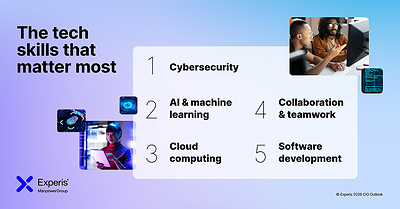
CIOs share the tech skills that matter most

The report draws on responses from 1,930 technology leaders across 12 countries, expanding significantly from the 1,400 respondents across nine countries surveyed in 2025. The broader sample reflects growing global urgency around the CIO function as AI moves from proof of concept to proof of value.

"CIOs are being asked to lead AI transformation, drive growth, improve productivity, and manage risk all while facing significant talent shortages," said Kye Mitchell, President of Experis U.S. "When 61% of technology leaders say their C-suite peers don't fully understand the CIO role, it creates a barrier to execution. The organizations that will win with AI are the ones that treat technology leadership as a business leadership function and invest accordingly."

Key Findings:

  • Business-IT alignment surges to the top CIO priority: Nearly half (48%) of IT leaders say aligning IT strategy with business objectives is the most important thing a CIO can do, up sharply from 34% in 2025 — overtaking cybersecurity for the first time.
  • Keeping pace with change is now the #1 business barrier: 44% of tech leaders cite the pace of technological innovation as their top challenge, up from 34% in 2025. The pressure is most acute in Israel (63%), Sweden (57%), and Switzerland (56%).
  • AI is generating returns, but scrutiny is rising: 54% of tech leaders say AI investments are already producing positive ROI. Still, 31% believe their organizations are overinvesting in AI, and just 17% classify delivering AI solutions as a top CIO responsibility.
  • CIOs remain misunderstood: 61% of tech leaders say their senior leader peers do not fully understand the CIO role and its responsibilities, up from 49% in 2025.
  • Training and risk strategies are slipping: Just 72% of IT leaders say their risk strategy aligns with their cybersecurity readiness, down from 77% in 2025. Only 72% conduct regular cybersecurity training, a slight decline from 74% last year.
  • Digital sovereignty concerns grow despite offshore expansion: 81% of IT leaders name digital sovereignty a high priority, yet 67% plan to increase their dependence on offshore or nearshore IT delivery in 2026.
  • Cybersecurity skills remain most in demand: 46% of tech leaders identify cybersecurity as the most important skill their IT teams need, followed by AI and machine learning (37%) and cloud computing (31%).
  • Talent acquisition and retention persist as a top challenge: CIOs continue to struggle to find workers with rapidly evolving tech skills, with traditional hiring approaches falling short of the pace of change.

"One of the most striking findings in this year's data is the gap between stated priorities and actual behavior on sovereignty," James Hallahan, Experis Europe Brand Leader, said. "Eighty-one percent of tech leaders say digital sovereignty is a high priority, yet two-thirds are planning to increase their dependence on offshore delivery. In Europe, where regulatory exposure and geopolitical risk make data residency a board-level conversation, that disconnect has real stakes. Organizations need to decide what sovereignty actually means to them operationally, not just rhetorically, before the gap between their stated priorities and their actual investments becomes a liability."

Six in ten tech leaders are actively implementing AI-based technologies into current systems. One-third (34%) report that automation and AI-powered solutions are delivering the best ROI in production, while 41% still see cloud computing and scalable digital infrastructure as the top ROI drivers. Cybersecurity and digital sovereignty top the list of priorities earmarked for budget increases in 2026 even as the share of IT leaders whose risk strategy aligns with their cybersecurity readiness has declined, from 77% in 2025 to 72% today.

For the full report and insights, visit www.experis.com/cio-outlook.

ABOUT EXPERIS
Experis®, a global leader in technology services, provides the experience and expertise to shorten the distance between innovation and business impact in a digital world. Experis is guided by the principle that only human ingenuity can unlock the true potential of advanced technologies like AI. For clients, Experis offers the right mix of talent and technology to accelerate progress and deliver real-world results. For individuals, Experis has the insight, size, and scale to help tech professionals expand their skills, increase their value, and find the right opportunities. By matching talent to technology in transformative ways, Experis creates brighter futures for everyone. Experis is part of the ManpowerGroup® (NYSE: MAN) family of brands, which also includes Manpower and Talent Solutions

For more information, visit www.experis.com, or follow us on LinkedIn

Experis, part of the ManpowerGroup family of brands

Cision View original content to download multimedia:https://www.prnewswire.com/news-releases/cios-face-mounting-pressure-to-deliver-ai-roi-as-the-business-it-divide-reaches-a-new-high-302797593.html

SOURCE ManpowerGroup

FAQ

What are the main findings of the Experis CIO 2026 Outlook report for ManpowerGroup (NYSE:MAN)?

The report finds CIO priorities have shifted toward business-IT alignment and AI ROI, with rising pressure on technology leaders. According to Experis, 48% now rank alignment as top priority, while 54% already see positive AI returns and 61% feel misunderstood by peers.

How are CIO priorities changing in the Experis CIO 2026 Outlook for 2026 (MAN)?

CIOs now rank aligning IT strategy with business objectives above cybersecurity for the first time. According to Experis, 48% cite alignment as the most important CIO task, up from 34% in 2025, reflecting growing focus on measurable business value from technology.

How big is the Experis CIO 2026 Outlook survey sample and which regions are covered?

The report is based on 1,930 technology leaders across 12 countries, expanding prior coverage. According to Experis, this broader sample versus 1,400 leaders in nine countries in 2025 reflects rising global urgency around the CIO role as AI moves toward proof of value.

What does the Experis CIO 2026 Outlook reveal about digital sovereignty and offshore IT delivery?

Digital sovereignty is rated highly important, yet offshore reliance is set to rise, creating tension. According to Experis, 81% call sovereignty a high priority, while 67% still plan to increase offshore or nearshore IT delivery in 2026, especially relevant in Europe’s regulatory context.

Which technology skills are most in demand in the Experis CIO 2026 Outlook (NYSE:MAN)?

Cybersecurity remains the most sought-after capability for IT teams, followed by AI and cloud skills. According to Experis, 46% of tech leaders prioritize cybersecurity skills, 37% focus on AI and machine learning, and 31% highlight cloud computing as critical for their organizations.