
90% of Companies Use AI in Hiring. Fewer Than 5% Are Seeing It Work
ManpowerGroup (NYSE:MAN) released research showing AI adoption in hiring is widespread but impact is limited.
Rhea-AI Summary
ManpowerGroup (NYSE:MAN) released research showing AI adoption in hiring is widespread but impact is limited. Over 90% of organizations use AI in talent acquisition, yet fewer than 5% report transformational outcomes.
The study cites fragmented workflows, governance gaps, data issues, and AI-assisted candidate behavior as key barriers, and proposes a four-stage roadmap focused on workflow redesign rather than simply adding more AI tools.
Positive
- None.
Negative
- None.
Details
News Market Reaction – MAN
On Jun 23, the day this news came out, MAN closed 2.97% above the previous close.
Data tracked by StockTitan Argus for the Jun 23 session.
Key Figures
- AI adoption in hiring
- More than 90%
- Organizations reporting active AI use in talent acquisition
- Transformational outcomes
- Fewer than 5%
- Organizations reporting AI-driven transformational outcomes in hiring metrics
- Survey participants
- 80 leaders
- C-suite, CHRO, and senior talent acquisition leaders surveyed in US and UK
- Operational efficiency gains
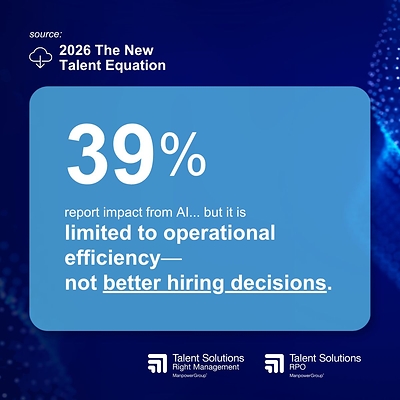
- 39%
- Organizations citing significant AI impact on hiring operational efficiency
- Change management barrier
- 58%
- Organizations citing change management and adoption as AI scaling challenge
- Governance barrier
- 55%
- Organizations citing governance and compliance as AI scaling challenge
- Data readiness barrier
- 55%
- Organizations citing data readiness limitations as AI scaling challenge
- AI-assisted signal problem
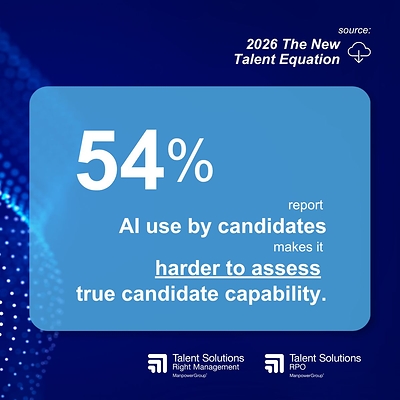
- Nearly 54%
- Organizations saying AI-assisted candidate behavior makes capability assessment harder
Previous AI Reports
-
Experis Tech Talent Outlook highlighting Q3 2026 hiring trends and AI skill demand.
-
VivaTech 2026 presence showcasing AI-powered tools and workforce strategy initiatives.
-
Experis CIO 2026 Outlook on AI ROI, business-IT alignment, and execution pressures.
-
Launch of VivaTech startup challenge for AI-powered workforce solutions and skills platforms.
-
Global partnership to scale AI-based structured interviewing under a human-first hiring model.
24h Move is the share-price change in the day after each event; other market factors may also have contributed.
AI-generated analysis. How Rhea-AI works. Not financial advice.




New research commissioned by ManpowerGroup Talent Solutions finds that fragmented workflows, governance gaps, and AI-assisted candidate behavior are blocking transformation even as adoption reaches near-universal levels.
The report, the first in a two-part series, draws on a survey of 80 C-suite, CHRO, and senior talent acquisition leaders across
"AI is not transforming talent evenly, it is exposing it," said Caroline Pfeiffer Marinho, Global Senior Vice President, Talent Solutions RPO and Right Management. "While adoption is widespread, the ability to translate that into meaningful outcomes is far less consistent. What the research makes clear is that the constraint is no longer access to AI tools. It is how talent operations are designed around them. The organizations that move from deploying AI to redesigning how work gets done will be the ones that pull ahead."
"The conversation around AI transformation has largely focused on technology adoption. The research suggests the more significant challenge lies elsewhere," Sailesh Hota, Vice President, Everest Group, said. "As AI becomes embedded into workflows and decisions, organizations are discovering that adapting workforce models, leadership practices, and operating structures is proving equally important."
AI Adoption Has Scaled. Impact Has Not.
The research documents a significant and growing gap between AI's widespread deployment and its realized business value. More than
Thirty-nine percent of organizations report significant impact on operational efficiency — the clearest area of measurable gain. Improvements in decision quality, workforce agility, and strategic capacity remain limited, with moderate outcomes dominating across nearly every dimension the research examined.
The research identifies a core structural reason: most organizations are layering AI onto workflows built for a pre-AI environment. Isolated tools, siloed data, and outdated hiring processes are preventing AI from generating cumulative value across the full hiring lifecycle.
Key Findings
- Adoption is outpacing transformation. More than
90% of organizations have deployed AI in talent acquisition, but the vast majority remain in early maturity stages; automating tasks without rethinking how hiring decisions actually work. - Fragmented systems are the primary constraint. Organizations cite change management and adoption challenges (
58% ), governance and compliance concerns (55% ), and data readiness limitations (55% ) as the top barriers to scaling AI. Most deployments continue to operate within isolated use cases rather than integrated, end-to-end talent workflows. - AI is creating a new signal problem in hiring. Nearly
54% of organizations report that AI-assisted candidate behavior, AI-generated resumes, applications, and interview preparation, is making it harder to accurately assess true candidate capability. Hiring managers are finding it increasingly difficult to distinguish between a genuinely skilled candidate and one who simply used AI to polish their application. - Quick wins are crowding out transformation. Nearly
72% of organizations report achieving expected AI outcomes within two years, with26% realizing value in under a year. But the research finds this speed comes at a cost: organizations are prioritizing near-term, measurable gains over the deeper workflow redesign and governance investment required for lasting impact. The result is faster hiring processes, but not smarter hiring decisions. - The path forward is redesign, not more deployment. The research outlines a four-stage roadmap — from rationalization through adoption, enablement, and transformation — and identifies the foundational investments in data integration, governance, and operating model alignment required to move organizations across it.
The New Talent Equation: Building Better Talent Decisions is available now at mpgtalentsolutions.com/the-new-talent-equation. Part II of the series examines the human side of AI transformation, including workforce readiness, leadership capability, and how organizations can move beyond isolated deployments to redesign how work gets done, and will be released soon.
ABOUT MANPOWERGROUP TALENT SOLUTIONS
Talent Solutions combines RPO, TAPFIN-MSP, and Right Management to deliver end-to-end, data-driven capabilities across the talent lifecycle. Drawing on deep industry expertise and a genuine understanding of what talent wants, we help organizations address complex workforce needs, from attraction and acquisition to upskilling, development, and retention. Through seamless delivery, best-in-class technology, and extensive workforce insights, we serve clients across multiple countries and at scale. Talent Solutions is part of the ManpowerGroup® (NYSE: MAN) family of brands, which also includes Manpower and Experis.
For more information, visit www.mpgtalentsolutions.com, or follow us on LinkedIn.

 View original content to download multimedia:https://www.prnewswire.com/news-releases/90-of-companies-use-ai-in-hiring-fewer-than-5-are-seeing-it-work-302808083.html
SOURCE ManpowerGroup
FAQ
AI-generated questions and answers. How Rhea-AI works. Not financial advice.