
MATSON CHRISTENS NEXT ALOHA CLASS VESSEL 'MAKUA'
The replacement ships will arrive LNG-ready, with dual-fuel engines designed for conventional marine fuels or liquefied natural gas.
Sentiment and the balance of points
Rhea-AI Sentiment reads the wording of the document, how positive or negative its language is on a 1 to 5 scale. The balance of points shown with the takes weighs what the document actually discloses, so the two can disagree, for example when a trial that missed its main goal is described in upbeat language.
Rhea-AI Summary
Matson (NYSE: MATX) christened Makua on October 10, the first of three new containerships being built by Hanwha Philly Shipyard.
The vessels represent an investment of approximately $1 billion and will replace three ships in Matson's Hawaii and China-Long Beach Express services. Makua is scheduled for delivery in the first quarter of 2027, followed by the second ship in the third quarter of 2027; the third is expected in the second quarter of 2028. Matson expects the additions to improve operating efficiency and reliability and increase capacity in both services. The new Jones Act-compliant vessels will match the size and speed of its two existing Aloha Class ships.
How this balance works
Rhea-AI gives every point it takes from this document a weight. Minor counts 1, Moderate 3 and Major 9, so one Major point outweighs several Minor ones. The bar adds up the weights on each side, and when neither side holds more than 65% of the total the balance reads Mixed.
It reads the document as published, with the same rules for every company, and it does not look at what the market expected or at how the stock traded, so a point can be objectively good on a day the stock falls.
Rhea-AI Sentiment measures something else, the tone of the wording.
Hollow bars mark forward-looking points. How the balance works
Positive
- Moderate point. Forward-looking: it has not happened yet and may not happen.Matson expects three replacement vessels to improve operating efficiency and reliability and increase Hawaii and China-Long Beach Express capacity.
- Minor point. Forward-looking: it has not happened yet and may not happen.Makua delivery is scheduled for the first quarter of 2027.
- Minor point. Forward-looking: it has not happened yet and may not happen.Second vessel delivery is scheduled for the third quarter of 2027.
- Minor point. Forward-looking: it has not happened yet and may not happen.Third vessel delivery is expected in the second quarter of 2028.
Negative
- Major pointApproximately $1 billion investment funds construction of the three new containerships. 15% of market cap
Key Figures
- Program investment
- Approximately $1 billion
- Three new Jones Act-compliant vessels
- Vessels in program
- 3 vessels
- New Aloha Class containerships replacing vessels in Hawaii and CLX services
- Containership capacity
- 3,600 TEU
- Aloha Class design; new vessels are being built to match the existing ships
- Makua scheduled delivery
- First quarter 2027
- First vessel
- Second vessel scheduled delivery
- Third quarter 2027
- Second vessel
- Third vessel expected delivery
- Second quarter 2028
- Third vessel
Historical Context
-
Hull assembly began on the second ship and steel cutting on the third in the same three-vessel program.
24h Move is the share-price change in the day after each event; other market factors may also have contributed.
Key Terms
jones act-compliant regulatory
dual fuel engines technical
lng technical
teu technical
AI-generated analysis. How Rhea-AI works. Not financial advice.




First of Three New Containerships Will Enter Service in 2027
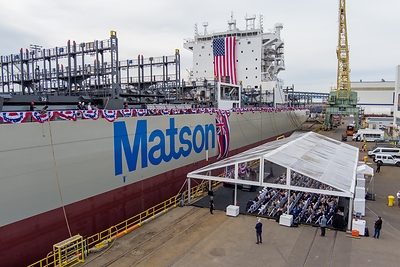
At the ceremony, Matson board member Jenai Wall officially christened the vessel 'Makua' by breaking a ceremonial bottle of champagne against the ship's hull before a gathering of approximately 300 attendees including
Representing an investment of approximately
Weighing in at over 51,400 metric tons, Matson's 850-foot long and 3,600-TEU*-capacity Aloha Class containerships are also Matson's fastest vessels, with a top speed of nearly 24 knots, helping ensure on-time deliveries in
Like their sisterships, the new vessels will be equipped with dual fuel engines designed to operate on either conventional marine fuels or liquefied natural gas (LNG), as well as other "green ship technology" features, such as a fuel-efficient hull design, environmentally safe double hull fuel tanks, and freshwater ballast systems. While the earlier ships required some modification to operate with LNG, the new ships will be delivered LNG-ready.
The three new ships will replace three vessels currently deployed in Matson's
"We look forward to putting Makua to work serving our customers early next year," said Matt Cox, chairman and chief executive officer. "We're excited that adding three new Aloha Class ships to Matson's fleet over the next 18 months will improve operating efficiencies and reliability, and increase capacity in our core
HPSI is a leading
"Today's christening of Makua is especially meaningful because Matson has been part of the story of this shipyard from its earliest days," said David Kim, CEO of HPSI. "Our partnership spans generations of vessels and reflects a shared commitment to American shipbuilding and the
Matson plans to name the other two new containerships Malama and Makena. Founded in 1882 as a
Matson's original ships named Makua, Malama, and Makena were all freighters commissioned by the United States Shipping Board (USSB), an emergency agency established by the 1916 Shipping Act to increase the number of
Makua ("mah-KOO-ah") is a Hawaiian word for parent, elder, ancestor, or family.
Malama ("MAH-lah-mah") is a Hawaiian word meaning to care for or protect.
Makena ("Mah-KEN-ah") is a Hawaiian word for abundance.
More information on Makua and Matson's fleet modernization program is available at www.Matson.com.
* TEU = Twenty-foot Equivalent Units, the standard unit of measurement for container capacity
About Matson
Founded in 1882, Matson (NYSE: MATX) is a leading provider of ocean transportation and logistics services. Matson provides a vital lifeline of ocean freight transportation services to the domestic non-contiguous economies of
About Hanwha Philly Shipyard, Inc.
Hanwha Philly Shipyard, Inc. (HPSI) is a leading U.S. shipbuilder with a state-of-the-art shipbuilding facility that has earned a reputation as a preferred provider of ocean-going merchant vessels with a track record of delivering quality ships, having delivered around
The Shipyard is part of Hanwha Group, a multinational company with a robust network of affiliates in the energy, ocean, aerospace, finance, and retail & services industries.
For more information, visit www.hanwhaphillyshipyard.com.
|
Matson Investor Relations inquiries: |
Matson News Media inquiries: |
Hanwha Philly Shipyard Media inquiries: |
|
Justin Schoenberg |
Keoni Wagner |
Kelly |
|
Matson, Inc. |
Matson, Inc. |
Philly Shipyard, Inc. |
|
510.628.4234 |
510.628.4534 |
215-875-2640 |

 View original content to download multimedia:https://www.prnewswire.com/news-releases/matson-christens-next-aloha-class-vessel-makua-302906159.html
SOURCE Matson, Inc.
FAQ
AI-generated questions and answers. How Rhea-AI works. Not financial advice.
When will Matson's new containership Makua be delivered?
Makua is scheduled for delivery in the first quarter of 2027. The second new ship is scheduled for delivery in the third quarter of 2027, and the third is expected in the second quarter of 2028.
Will Matson's new Aloha Class ships be ready to use LNG?
The three new ships will be delivered LNG-ready, with dual-fuel engines designed to operate on conventional marine fuels or liquefied natural gas. Matson's earlier Aloha Class ships required some modification to operate with LNG.