
US Consumers Struggle with Longevity Preparedness According to Inaugural "Longevity Preparedness Index" from John Hancock and MIT AgeLab
John Hancock (MFC) and MIT AgeLab released the inaugural Longevity Preparedness Index (LPI) on Oct. 15, 2025, finding US adults average 60/100 overall and are broadly underprepared for longer lives.
Rhea-AI Summary
John Hancock (MFC) and MIT AgeLab released the inaugural Longevity Preparedness Index (LPI) on Oct. 15, 2025, finding US adults average 60/100 overall and are broadly underprepared for longer lives.
The LPI measures eight domains: social connection, daily activities, care, home, community, life transitions, health, and finance. Lowest domain scores: Care 42, Home 56, Health 56; highest: Community 70, Social connection 69. Women scored 2–3 points higher than men in most domains; men scored higher in finance (65 vs 63). Caregivers scored higher in care (46 vs 39) and home (58 vs 54).
The LPI is based on a NORC AmeriSpeak survey of 1,307 US adults (May 14–June 5, 2025) and will be updated annually for four years. John Hancock will extend Vitality benefits including access to Galleri and discounted Prenuvo scans.
Positive
- Overall LPI score of 60/100 establishes a baseline metric
- Highest domain: Community 70
- Women outperform men by 2–3 points in several domains
- Caregivers score higher in care (46) and home (58) preparedness
- John Hancock expanding Vitality access to Galleri and Prenuvo offers
Negative
- Lowest domain: Care 42 indicates widespread planning gaps
- Health preparedness is low at 56
- Home preparedness below average at 56, signaling housing risks for aging
- Survey finds many adults haven’t discussed future care or affordability
Details
News Market Reaction – MFC
In the Oct 15 session, MFC declined 0.62%, reflecting a mild negative market reaction.
Data tracked by StockTitan Argus on the day of publication.
AI-generated analysis. How Rhea-AI works. Not financial advice.




TSX/NYSE/PSE: MFC SEHK: 945
New Index Introduces Groundbreaking Benchmarks for Thriving Throughout the Aging Journey Across Eight Critical Domains; Finds Women Are Outpacing Men in Readiness and Planning for Care is a Gap
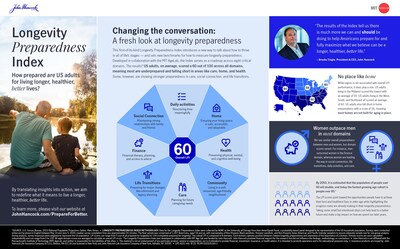
The LPI measures US adults' preparedness to thrive as they age and serves as a road map across eight critical domains: social connection, daily activities, care, home, community, life transitions, health and finance. These domains were developed based on decades of longevity research conducted at the MIT AgeLab and other global universities and organizations. The domains are each evaluated on a scale of 0 to 100, along with an overall score that represents the average of the domain scores. In a survey of over 1,300 adults, US consumers on average scored a 60 out of 100 overall, revealing most adults are underprepared for longer lives, falling short in critical areas like care, housing, finance, and health. However, the LPI reveals some US adults – particularly women and caregivers – are showing stronger preparedness across several domains.
"Our inaugural Longevity Preparedness Index introduces a new way of thinking about longevity – it's frankly no longer just about how much you've saved for retirement or even about how healthy you are; it's also about where you'll live, how you'll get where you need to go, how you'll fill your days, and who you will share your time with," said Brooks Tingle, President and Chief Executive Officer, John Hancock. "And the results of the Index tell us that while some people are preparing for longer lives, there is much more our industry can and should be doing to help customers. MIT AgeLab identified eight critical levers of longevity preparedness we need to pay closer attention to as an industry to better help Americans prepare for and fully maximize what we believe can be a longer, healthier, better life."
"The LPI is more than a measurement; it is a research-based framework that seeks to redefine how we think about preparing for later life," said Dr. Joe Coughlin, Founder and Director of the MIT AgeLab. "While health and wealth security are key, between those two vital bookends are the routines and assumptions that make up daily life. The LPI seeks to spark public awareness and action to prepare people for living what is likely to be a full one-third of their adult lives."
The US population aged 65+ is projected to surge from 58 to 82 million by 2050.1 And one-fifth of an individual's life, on average, is now expected to be lived in a state of illness,2 while almost four in 10 people will face financial instability as they age.3 More than ever, people need more than just financial resilience to feel secure and fulfilled as they age.
Longevity Preparedness Index Key Findings
The results of the index highlight opportunities to improve preparedness for longevity from a holistic perspective. The LPI kicks off a national conversation about what it truly means to be prepared for today's unprecedented longevity. Key findings from the inaugural index include:
- Overall Longevity Preparedness is Generally Low: US adults scored an average of 60 on the LPI across all eight domains, showing the greatest room for improvement in the care (score of 42), home (score of 56), and health (score of 56) domains. However, US adults on average demonstrated strength in the community (score of 70) and social connection (score of 69) domains, which measure things like having friends and family you can rely on and living in an area with access to recreation spaces, health services, transportation, and more.
- Women Are Outpacing Men in Most Domains : Women outperformed men by two to three points in areas such as care (score of 43 vs 41), social connection (score of 71 vs 68), daily activities (score of 61 vs 59), and managing life transitions (score of 62 vs 60), while men scored higher than women in the finance domain (score of 65 vs 63). While financial preparedness is often the primary focus of planning for later life, women demonstrate higher preparedness in domain areas that are just as crucial for longer, healthier, better lives.
- The Biggest Longevity Blind Spot? Care: Few US adults know who will care for them as they age or how they will afford that care, and many haven't discussed their wishes with family or loved ones (respondents scored just a 42 in Care preparedness, the lowest score of all eight domains). Although, those who identified as caregivers scored higher than those without caregiving experience in the care (score of 46 vs. 39) and home (score of 58 vs. 54) categories, both groups have significant opportunities to make progress in planning for their own future care needs.
"Our goal with the LPI is simple: expand the conversation around what it means to prepare well for longer lives by taking a holistic perspective. LPI scores point toward the opportunities people have to achieve their best and healthiest lives while highlighting the progress many are already making in their longevity preparedness," said Dr. Coughlin. "Results from the LPI underscore that taking some small but intentional steps – such as planning for a new hobby, starting a fitness routine, or having a conversation about care – can lead to a better future and make a big impact on how we spend our later years. We're proud to work with John Hancock on this research and look forward to seeing what actions organizations, governments, and individuals take as a result of this groundbreaking way of approaching longevity preparedness in the US."
Expanding Access to Prevention, Early Detection and Nutrition Tools
As a life insurer, asset manager, and retirement plan provider, John Hancock is uniquely positioned to leverage learnings from the LPI as a tool to unlock opportunities to help people live longer, healthier, better lives across the eight domains.
Since 2015, John Hancock has offered life insurance customers education, resources, incentives, and rewards for the everyday things they do to support a longer lifespan and improved healthspan through its John Hancock Vitality Program. John Hancock will soon be providing Manulife John Hancock Retirement plan participants access to some of the leading health and wellness resources currently offered to Vitality members through their life insurance policies, including:
- Access to GRAIL's multi-cancer early detection test, Galleri®, a simple blood test that screens for a "fingerprint" of many of the deadliest cancers before they become symptomatic, including cancers with no recommended screening tests today. In 2022, John Hancock became the first life insurer to offer customers access to Galleri.4
- Discounted access to Garmin products, which offer detailed health and wellness insights to support fitness goals. John Hancock Vitality customers have had access to discounted Garmin technology since the start of the program.
- Free access to the Tufts Health & Nutrition Letter, a subscription-based publication providing honest, reliable, scientifically authoritative health and nutrition information published each month by the Gerald J. and Dorothy R. Friedman School of Nutrition Science and Policy at Tufts University, which has been available to John Hancock life insurance customers since 2016.
Additionally, John Hancock is continuing to enhance and expand its existing offerings for life insurance customers in support of their holistic longevity preparedness. John Hancock Vitality members will have expanded discounted access to Prenuvo's newest suite of offerings, including:5
- An enhanced scan that includes Prenuvo's standard whole-body MRI scan with the addition of blood draws assessing various functional biomarkers, an advanced brain health assessment, and a body composition analysis.
- A torso only scan that can help detect solid tumors as small as 1cm in the organs of the chest, abdomen, and pelvis.*
"Through John Hancock Vitality, we've seen firsthand that it's possible to drive better health outcomes when we support customers in taking small steps toward a longer, healthier, better life," said Tingle. "And the LPI findings show the tremendous potential that still exists to help all generations better prepare. We're eager to implement the LPI findings into our solutions and services across insurance, retirement, and wealth management, to help people take action against all the dimensions that can help them prepare for longevity. Together – across public and private sectors – we can turn insight into impact."
The LPI, which will be updated annually over the next four years, is part of a five-year research collaboration between John Hancock and MIT AgeLab announced in 2024. Drawing on the social and behavioral sciences, engineering, data science, and design, the AgeLab works with leading companies, policymakers, and NGOs worldwide to reimagine the future of longevity and aging.
Read more about the LPI and see the full results of the study at www.johnhancock.com/prepareforbetter.
|
1 U.S. Census Bureau, 2023 National Population Projections Tables: Main Series. |
|
2 National Library of Medicine, Longevity leap: mind the healthspan gap |
|
3 World Economic Forum: These 6 'longevity economy' principles can help an ageing population live well |
|
4 The Galleri test is currently only available to registered John Hancock Vitality PLUS members who are 40 years of age or older and have completed the initial Vitality Health Review. For eligible polices with Face Amounts of |
|
5 The Prenuvo scan is only available to registered John Hancock Vitality PLUS and GO members who have completed the Vitality Health Review (VHR) for the current program year. The offer of discounted access to the Prenuvo scan is subject to change. Access to the Prenuvo scan through the John Hancock Vitality Program is not currently available in all states. The Prenuvo scan is developed and administered by Prenuvo and its affiliated professional entities. John |
|
|
|
*As with any medical test, there are limitations, which make it impossible to detect all malignancies and disease conditions. Please note that if a solid lesion has similar imaging characteristics to surrounding tissue, MRI may not be able to detect it regardless of its size. Additionally, Prenuvo may be unable to detect tumors which originate in the gastrointestinal tract (e.g. stomach, large intestine, small intestine, colon, etc.) or in the lungs, or breasts. |
Longevity Preparedness Index Methodology
Data for the Longevity Preparedness Index were collected by NORC at the University of
LPI scores can range from 0 (not at all prepared for longevity) to 100 (completely prepared for longevity). The overall LPI is composed of 8 domains. Each domain captures positive behaviors toward longevity preparedness and awareness of the importance of a domain. Domain scores are each calculated independently and can range from 0 to 100. All eight domain scores are averaged to calculate an overall LPI score.
The Longevity Preparedness Index was developed in collaboration with MIT Age Lab and funded by John Hancock. John
John
About John Hancock and Manulife
John
One of the largest life insurers in
Vitality is the provider of the John Hancock Vitality Program in connection with life insurance policies issued by John Hancock. John Hancock Vitality Program rewards and discounts are available only to the person insured under the eligible life insurance policy, may vary based on the type of insurance policy purchased and the state where the policy was issued, are subject to change and are not guaranteed to remain the same for the life of the policy. To be eligible to earn rewards and discounts by participating in the Vitality program, the insured must register for Vitality and in most instances also complete the Vitality Health Review (VHR).
John
MLINY100225129-1
Media Contact:
news@jhancock.com
 View original content to download multimedia:https://www.prnewswire.com/news-releases/us-consumers-struggle-with-longevity-preparedness-according-to-inaugural-longevity-preparedness-index-from-john-hancock-and-mit-agelab-302584847.html
SOURCE John Hancock
FAQ
AI-generated questions and answers. How Rhea-AI works. Not financial advice.