
ServiceNow advances its operational harness for enterprise AI with AI Passport and expanded governance capabilities
ServiceNow (NYSE: NOW) announced AI Passport and expanded governance capabilities to control AI agents and track their costs and outcomes.
Sentiment and the balance of points
Rhea-AI Sentiment reads the wording of the document, how positive or negative its language is on a 1 to 5 scale. The balance of points shown with the takes weighs what the document actually discloses, so the two can disagree, for example when a trial that missed its main goal is described in upbeat language.




New AI Passport solution verifies first- and third-party AI agents’ scopes in real time
Super Intelligence Control Tower expands discovery, visibility, control, and cost-to-value measurement capabilities on a single data model
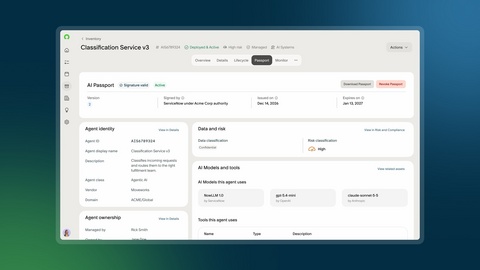
AI agents need more than a reasoning model to execute enterprise workflows securely. They need structure: which data or tools they can access, clear rules for what actions they’re allowed to do, and an auditable record of who authorized it. ServiceNow provides the operational foundation that helps enterprises make AI agents safe for production. AI Passport is a cryptographically signed credential that AI agents refer to at runtime, including environments such as NVIDIA OpenShell, to verify their authorized scope, grounded in enterprise business context for governed decisions. When an AI agent stays within its passport scope, it can operate freely. When it drifts, graduated responses can be enforced — redirecting, restricting, or reconnecting the AI agent with proper context — including kill switch capabilities at machine speed if termination is needed. ServiceNow’s Super Intelligence Control Tower keeps the full audit record behind actions, transforming AI agent execution into governed, auditable, and accountable work.
"As AI agents proliferate across the enterprise, visibility alone isn’t enough. Enterprises need confidence that every AI agent is operating within its authorized scope,” said Jon Sigler, executive vice president and general manager, AI Platform at ServiceNow. “ServiceNow closes that gap with an operational harness across AI Passport and new capabilities that unify agent authority, governance, and operational oversight so enterprises can scale agentic AI with control."
AI Passport: attested authority, enforceable at the edge
AI Passport is built on open specifications so that any governance product, identity provider, or enforcement point can issue and verify credentials for their own and third-party AI agents. Credentials are verifiable at every step in multi-agent workflows.
This represents a fundamental shift from reaction to prevention. Unlike audit trails, which show what happened after the fact, AI Passport helps prevent AI agents from acting outside their scope by authorizing what they can do at runtime. It brings ServiceNow’s ‘Shift Zero’ approach to life: secure by design, at inception. Each AI agent receives its own AI Passport, issued by the Super Intelligence Control Tower and grounded in the enterprise's live business context through ServiceNow Configuration Management Database (CMDB), Governance, Risk, and Compliance (GRC) policies, and workflow approvals. For third-party AI agents especially, this creates a verifiable permissions record rather than relying on the AI agent’s own ‘claims’ about its permissions.
The approach to AI Passport enables precision revocation and scoped delegation that narrows at each step for third-party agent governance, along with audit trails that include full compliance signatures. ServiceNow is also announcing NVIDIA as a design and launch partner, building a production-ready enforcement implementation using the NVIDIA Open Agent Safety Platform, which features NVIDIA OpenShell open-source secure runtime software and the NVIDIA Sentry security framework.
"As enterprises shift from experimenting with agents to running them in production, securing those agents demands enforcement at the infrastructure layer," said Itay Ozery, director of Product Marketing for Networking and Cybersecurity at NVIDIA. "By implementing AI Passport with the NVIDIA Open Agent Safety Platform, ServiceNow customers can continuously verify and enforce what every agent is authorized to do — at machine speed and at runtime."
Unified discovery, visibility, and measurement
In addition to AI Passport, ServiceNow delivers end-to-end AI governance on one unified platform across discovery, visibility, control, measurement, and compliance. The new capabilities announced today build on ServiceNow’s autonomous remediation and kill switch capabilities that empower enterprises to act with speed.
The ServiceNow AI Platform runs on a single unified data model, which enables governance decisions to happen automatically across asset intelligence, identity security, and AI observability, eliminating manual handoffs between teams:
- Shadow AI detection that finds unapproved AI agents running in the network
- 400+ out-of-box connectors that will enable AI discovery across platforms and vendors
- Access mapping that grounds authorization decisions in actual entitlements
- Continuous enterprise AI observability that keeps track of AI agent traces and behavior
Beyond discovering what AI is running, enterprises need visibility into whether that AI is delivering value and operating within budget. ServiceNow is announcing:
- Cost governance that tracks user, department, and runtime spending
- Value intelligence that connects consumption, cost, quality, and realized user value so teams can optimize AI use, maintain budget commitments, and help prove business value
- AI Cost Management as part of IT Asset Management (ITAM), which will integrate with the Super Intelligence Control Tower to bring frontier model, embedded SaaS AI, hyperscaler, and data center GPU costs into a single view, alert teams to potential budget overruns, and ground spend in business context
- Policy enforcement that will manage alert-to-throttle-to-block graduated responses
AI control in highly regulated industries
For financial institutions, ungoverned assets and shadow AI multiply risk across compliance clocks. Regulators are shrinking incident notification windows far faster than manual, spreadsheet-driven programs can respond. ServiceNow's 2026 Banking AI Maturity Index reveals that gap: while 100 percent of banks report using AI, only 24 percent have the governance to match it. Unmanaged service accounts, shadow AI agents, and unregistered devices remain exposed.
ServiceNow's new Operational Resilience solution brings AI governance, risk, and security together in one place, with centralized data that helps financial institutions respond quickly. It gives CROs and CISOs the same real-time visibility and control. The Super Intelligence Control Tower senses ungoverned assets, identities, and AI agents across IT, OT, cloud, and third-party systems on one data model and unified platform. It is designed to treat a rogue AI agent like any other exposed asset: it finds it, flags it, and shuts it down, if needed. When an incident hits, banks can triage, contain, and revoke access inside the regulatory window, with auditable proof already in hand.
What customers are saying
LTM Limited
"As we accelerate LTM’s growth as an AI-led enterprise, we have deployed 1,500 AI agents across the organization, each assigned an employee ID and manager to ensure accountability, oversight, and continuous improvement,” said Chandan Pani, Chief Information Security Officer, LTM. “ServiceNow’s control tower provides a single system of record for these AI agents, giving us centralized visibility into inventory, risk, and compliance. By streamlining AI asset management and strengthening governance, we expect to improve operational efficiency significantly. These capabilities will be foundational to scaling AI responsibly across LTM, enabling stronger governance, enhanced risk oversight, and greater business value from our AI investments."
Availability
AI Passport, shadow AI detection, and AI Cost Management are expected to be available in Q4 2026. ServiceNow’s Operational Resilience solution for financial services is available today.
Attendees of NVIDIA GTC Berlin can also learn more about AI Passport, powered by the ServiceNow AI Platform and NVIDIA Open Agent Safety Platform, by joining session SB61172.
About ServiceNow
ServiceNow (NYSE: NOW) is the Super Intelligence Control Tower for business reinvention. The ServiceNow platform integrates with any model, any cloud, and any data source to orchestrate, govern, and secure work across the agentic enterprise. ServiceNow gives customers the enterprise context and control to build and scale confidently. With more than 100 billion workflows running on the platform each year, ServiceNow helps organizations turn fragmented operations into coordinated, autonomous work for IT, CRM, Security, Employee Experience, and more. Learn how ServiceNow puts AI to work for people at www.servicenow.com.
Forward-looking statements
This press release contains “forward-looking statements” about the expectations, beliefs, plans, and intentions relating to ServiceNow’s AI Passport, Super Intelligence Control Tower, AI Cost Management, and Operational Resilience offerings and capabilities. Such statements include statements regarding future product capabilities and offerings and expected benefits to ServiceNow. Forward-looking statements are subject to known and unknown risks and uncertainties and are based on potentially inaccurate assumptions that could cause actual results to differ materially from those expected or implied by the forward-looking statements. If any such risks or uncertainties materialize or if any of the assumptions prove incorrect, ServiceNow’s results could differ materially from the results expressed or implied by the forward-looking statements made. ServiceNow undertakes no obligation, and does not intend, to update the forward-looking statements. Factors that may cause actual results to differ materially from those in any forward-looking statements include: (i) delays and unexpected difficulties and expenses in executing the product capabilities and offerings, (ii) changes in the regulatory landscape related to AI and (iii) uncertainty as to whether sales will justify the investments in the product capabilities and offerings. Further information on factors that could affect ServiceNow’s financial and other results is included in the filings ServiceNow makes with the Securities and Exchange Commission from time to time.
© 2026 ServiceNow, Inc. All rights reserved. ServiceNow, the ServiceNow logo, Now, and other ServiceNow marks are trademarks and/or registered trademarks of ServiceNow, Inc. in the United States and/or other countries. Other company names, product names, and logos may be trademarks of the respective companies with which they are associated.
View source version on businesswire.com: https://www.businesswire.com/news/home/20261015785673/en/
Media contact
Katlyn Hirokawa
408.489.7381
press@servicenow.com
Source: ServiceNow