
NordX Metals Intersects 2.35m at 0.62% U3O8 from 9.4m Downhole in First Diamond Drillhole at the Riutta Uranium Project, Finland
The ongoing program uses revised drilling directions to test uranium-bearing structures at three Riutta target areas.
Sentiment and the balance of points
Rhea-AI Sentiment reads the wording of the document, how positive or negative its language is on a 1 to 5 scale. The balance of points shown with the takes weighs what the document actually discloses, so the two can disagree, for example when a trial that missed its main goal is described in upbeat language.
Rhea-AI Summary
NordX Metals (NRDMF) reported shallow uranium mineralization in the first diamond drillhole at its wholly owned Riutta project in Finland. Hole SWM26001 returned 2.35m at 0.62% U3O8, uranium oxide, from 9.4m downhole, including 1.1m at 1.10%. It was collared approximately 40m north of historical hole AREVA DH1. NordX says the intercept supports its revised interpretation of the mineralized structure.
The company has drilled 19 holes totalling approximately 995m and expects to finish within two days, with 20 holes totalling approximately 1,070m across three target areas. Only the first hole has assay results. Historical results remain independently unverified. Uranium assays are non-accredited determinations; additional dilution may increase measurement uncertainty. Testing also identified minor sample-preparation contamination and duplicate variation above the generally applied acceptance threshold.
Positive
- Minor pointFirst-hole intercept returned 2.35m at 0.62% U3O8 from 9.4m downhole, including 1.1m at 1.10%.
- Minor pointCompleted drilling totals 19 holes and approximately 995m at Riutta.
- Minor point. Forward-looking: it has not happened yet and may not happen.NordX expects completion within two days, with 20 holes totalling approximately 1,070m.
- Minor point. Forward-looking: it has not happened yet and may not happen.Ristimonttu plan assigns 13 holes to test down-dip and strike extensions of historically documented mineralization.
- Minor point. Forward-looking: it has not happened yet and may not happen.Unimonttu plan assigns five holes to test continuity of a historical uranium intercept.
- Minor point. Forward-looking: it has not happened yet and may not happen.Kolmosviuhka plan assigns two holes to target previously undrilled locations beneath historical trenches.
Negative
- Minor pointHistorical drilling results are not independently verified and should not be relied upon.
- Minor pointUranium assays are non-accredited determinations within the laboratory's analytical method.
- Minor point. Forward-looking: it has not happened yet and may not happen.Additional dilution of over-limit samples may increase measurement uncertainty; results remain quantitative with that qualification.
- Minor pointBlank testing indicated minor cross-contamination; NordX does not consider it material to the reported assays.
- Minor pointCore duplicate variation of 24.7% exceeded the generally applied 20% acceptance threshold.
AI-generated analysis. How Rhea-AI works. Not financial advice.




Vancouver, British Columbia--(Newsfile Corp. - September 30, 2026) - NordX Metals Corp. (CSE: NRDX) (OTCQB: NRDMF) (FSE: 0UL0) ("NordX" or the "Company") is pleased to announce that assay results from the first diamond drillhole in an ongoing diamond drilling program have been received at its
Highlights:
Significant, shallow mineralization intercepted in first drillhole: Assay results from drillhole SWM26001 revealed 2.35 metres ("m") grading
0.62% uranium oxide ("U3O8") from 9.4m downhole including the first 1.1m of this interval grading1.10% U3O8.Drillhole collared 40m along interpreted strike from historical drillhole where significant results were obtained: Drillhole SWM26001 was designed to test the geometry and continuity of uranium-bearing structures associated with historical drillhole AREVA DH1 which intersected an 11.3m wide interval grading
0.68% U3O8 from 21.2m downhole including 3.7m grading1.52% U3O8 from 28.30m downhole (this "historical result" has not been independently verified by a Qualified Person and should be viewed with caution; see "Riutta Uranium Project History" below and NordX's news release dated August 5, 2026).Revised Drilling Orientation: NordX has reinterpreted historical drill data, geophysical and geochemical data, and concluded that the majority of historical drilling was either positioned away from the principal uranium-bearing structures or oriented sub-parallel to them. The current NordX drilling program is using revised azimuths based upon this reinterpretation to test a potential north-northwest striking and steeply west-southwest dipping mineralized structure.
District-Scale Setting: Riutta is strategically located approximately 12 kilometres south of the historical, past-producing Paukanvaara uranium mine.
Jon Franklin, President and Director of NordX, commented: "We are very pleased with the results from SWM26001, which was collared approximately 40m north of historical drillhole AREVA DH1. This drill program aims to systematically test zones of uranium mineralization identified by AREVA (now Orano) through trenching and drilling in 2007 and 2008. Uranium mineralization at shallow depths has been historically recorded over 450m of strike within a larger 3.6 kilometre trend. This first hole returned significant uranium mineralization at shallow depth and supports our revised structural interpretation of the Riutta system. We look forward to receiving assays from the remainder of the holes in our current drill program."
Riutta Drill Program
Drill results have been received for only one drillhole to date: SWM26001. This drillhole reached a total depth of 39m and was drilled at an azimuth of 060° and an inclination of -45°. It was designed to test the potential for a NNW-SSE striking structure that dips steeply to the WSW. The intercept supports this revised mineralized trend orientation, which loosely connects historical drillholes AREVA DH1 and R003 with SWM26001 (see Figure 1). Reported intervals are downhole lengths; true widths have yet to be determined.
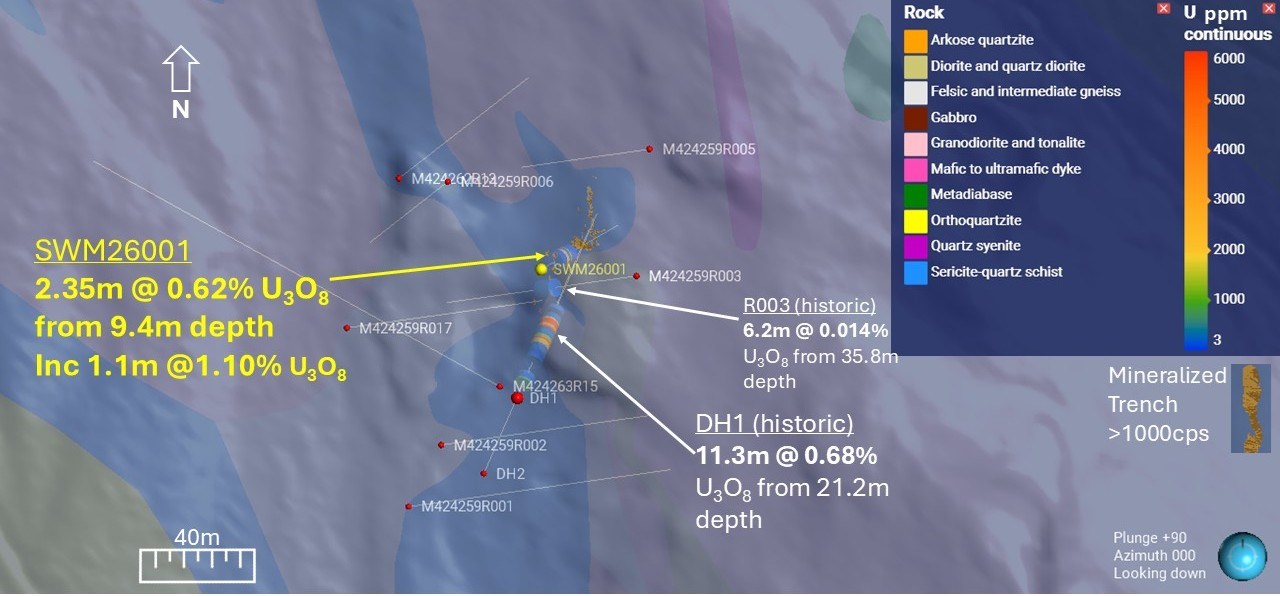
Figure 1. Riutta project map showing the Ristimonttu prospect with historical drilling, mineralized trenches, surface geology and downhole assay results. Historical results shown have not been independently verified by a Qualified Person and should not be relied upon.
To view an enhanced version of this graphic, please visit:
https://images.newsfilecorp.com/files/11951/316440_af4c9cb5d4567965_001full.jpg
To date, the Company has drilled 19 diamond drillholes totalling approximately 995m. The drill program is on track to finish within the next two days and will comprise 20 holes for a total of approximately 1,070m. The drill program has been designed to test three target areas, Ristimonttu, Unimonttu and Kolmosviuhka, prioritised through the integration of historical data including drill logs and analyses, geophysics including detailed IP, geochemical sampling and geological reinterpretation of the project area. All target areas contain historical drill intercepts containing uranium.
NordX's structural interpretation suggests that most historical drilling completed at Riutta by Atomienergia Oy in the late 1950s, Outokumpu Oy in the early 1960s, Geological Survey of Finland ("GTK") in the 1980s and AREVA (now Orano) in 2007 and 2008 did not effectively test the principal parts of the mineralized system, including having been drilled sub-parallel to key uranium-bearing structures. The Company believes these orientations and collar locations limited the effectiveness of earlier drilling in testing geometry and continuity of the uranium-bearing structures. The 2026 program employs revised azimuths based upon this revised interpretation, intended to directly intersect these structures at both the known and new target areas. These new, historically untested targets were generated through the integration of property wide geophysical data, geochemical sampling and structural mapping.
The principal target areas are summarized below (see Figure 2; these historical results have not been independently verified by a Qualified Person and should be viewed with caution):
Ristimonttu: Thirteen holes to test the down-dip and strike extensions of historically documented mineralization of drillhole AREVA DH1, which yielded 11.3m at
0.68% U3O8 from 21.20m downhole including 3.7m grading1.52% U3O8 from 28.30m downhole.Unimonttu: Five holes to test the continuity of a historical intercept, DH-324, that yielded 3.6m at
1.11% U3O8 from 42m downhole including 0.35m at9.79% U3O8 from 42.6m downhole.Kolmosviuhka: Two holes, one targeting historical trench M3-3 where anomalous radiation measurements of up to 65,500 counts per second ("CPS") at surface were obtained using a handheld scintillometer, and a second hole targeting under trench M3-2 where up to 21,500 CPS at surface were obtained using a handheld scintillometer. Scintillometer readings measure total gamma radiation and are not a substitute for laboratory assays; they are only indicative of the presence of radioactive minerals and do not provide a reliable measure of uranium grade. Neither of these locations has ever been drilled.
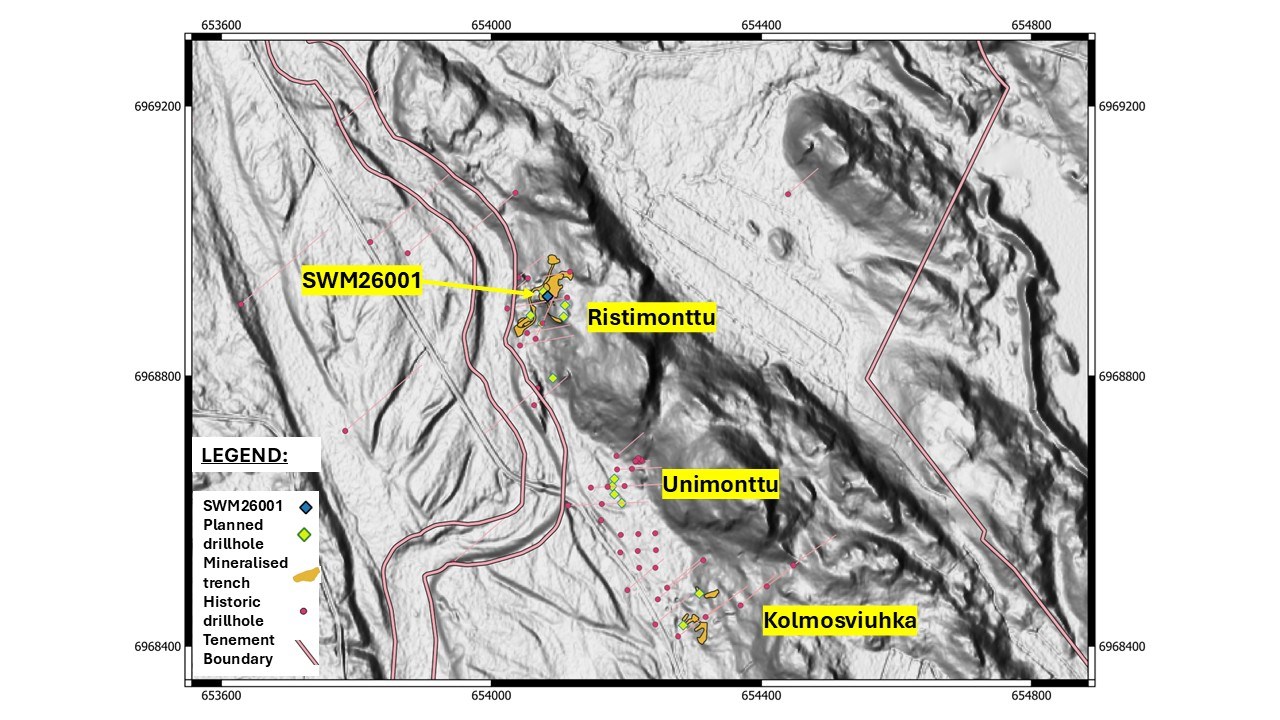
Figure 2. Riutta project map with historical drilling, mineralized trenches and the locations of completed and planned drillholes. Historical results shown have not been verified by a Qualified Person and should not be relied upon.
To view an enhanced version of this graphic, please visit:
https://images.newsfilecorp.com/files/11951/316440_af4c9cb5d4567965_002full.jpg
Riutta Uranium Project History
The Riutta uranium occurrence was discovered in 1958 through radiometric boulder tracing. Four exploration campaigns followed: Atomienergia (1958-59); Outokumpu Oy (1960-63); the Geological Survey of Finland ("GTK") (1983-88); and AREVA (2007-08), totalling 65 drillholes for a total of 6,275m, only 10 of which were drilled since 1988. Over 500 mineralized boulders have been located at Riutta, more than one hundred assaying above
Riutta Uranium Project Mineralization
Uranium mineralization at Riutta occurs as thin pitchblende veins (up to a few mm wide) infilling fractures and micro-breccias within a sericite-quartz schist host rock. The bedrock comprises Archean granitoids and gneisses overlain by Paleoproterozoic quartzitic metasediments, cut by mafic to ultramafic dykes. Riutta is interpreted as a structurally controlled, low-temperature hydrothermal uranium system, with an extensive alteration mineral halo including epidote, chlorite, quartz, sericite, albite, potassium feldspar, carbonate, and clinozoisite.
Sampling Protocol and Assay Method
Drill core was logged and marked to show where core was to be half-core sampled, using an automated diamond-blade saw. Cut sections were bagged, assigned sample IDs, and logged in a sample register. Automatic diamond-blade sawing took place at Palsatech's core logging facility in Kemi, Finland; samples were then transported to CRS Laboratories Oy in Kempele, near Oulu, for preparation and assay. CRS Laboratories Oy is independent of NordX. On receipt, samples were screened for surface radioactive dose rate, and those exceeding 3.0 µSv/h were prepared under CRS's procedure for naturally occurring radioactive material (NORM). At CRS, samples were dried, crushed to 2 mm, split to a 450 g sub-sample using a rotating sample divider attached to the crusher, and pulverised to
CRS Laboratories Oy is a testing laboratory accredited by the Finnish Accreditation Service (FINAS) under EN ISO/IEC 17025 (T342); within method 4A-MS12 the elements in the scope of accreditation are Co, Cu, Mo, Ni, Pb, V and Zn, and uranium results are reported as non-accredited determinations. Results exceeding the upper limit of method 4A-MS12 (10,000 ppm U, equivalent to
A QAQC program monitored sampling, preparation and assay quality throughout the sampling campaign. Two OREAS certified reference standards, one core duplicate and one blank were inserted into the sample stream, together representing four of the 13 samples submitted for analysis (
Uranium assays are reported in this news release as U3O8, converted from the laboratory-reported elemental uranium (U) values using the factor U3O8 = U × 1.17924.
Table 1. Assay Results for Drillhole SWM26001
| Drillhole ID | Sample ID | From (m) | To (m) | Length (m) | QAQC | U3O8 (ppm) |
| SWM26001 | 1501 | 7.4 | 8.4 | 1 | 62.5 | |
| SWM26001 | 1502 | 8.4 | 9.4 | 1 | 69.6 | |
| SWM26001 | 1503 | OREAS-124 | 2,153.3 | |||
| SWM26001 | 1504 | 9.4 | 9.9 | 0.5 | 8,350.2 | |
| SWM26001 | 1505 | 9.9 | 10.5 | 0.6 | 13,183.9 | |
| SWM26001 | 1506 | Blank | 2.4 | |||
| SWM26001 | 1507 | 10.5 | 11.25 | 0.75 | 159.2 | |
| SWM26001 | 1508 | OREAS-124 | 2,063.7 | |||
| SWM26001 | 1509 | 11.25 | 11.75 | 0.5 | 4,842.0 | |
| SWM26001 | 1510 | 11.25 | 11.75 | 0.5 | Core Duplicate | 3,775.9 |
| SWM26001 | 1511 | 11.75 | 12.5 | 0.75 | 102.6 | |
| SWM26001 | 1512 | 12.5 | 13.5 | 1 | 11.8 | |
| SWM26001 | 1513 | 13.5 | 14.5 | 1 | 11.8 |
Qualified Person
The scientific and technical information in this news release has been reviewed and approved by Avrom E. Howard, MSc, PGeo (Ontario), Principal Geologist at Nebu Consulting, LLC, an independent US-based mineral exploration consulting firm. Mr. Howard is independent of NordX, and is a Qualified Person as defined by National Instrument 43-101. Mr. Howard has verified the data disclosed in this news release, including the sampling, analytical and QAQC data, by reviewing the laboratory assay certificates, QAQC results and drill logs. Mr. Howard has not verified the historical data disclosed in this news release, as described under "Riutta Uranium Project History".
About NordX Metals Corp.
NordX is an exploration and development company advancing uranium, lithium, and rare earth projects in politically stable jurisdictions with the infrastructure to support rapid, cost-effective exploration, development, and production.
The Company's consolidated financial statements and related management's discussion and analysis are available on the Company's website at https://nordxmetals.com or under its profile on SEDAR+ at www.sedarplus.ca.
On Behalf of NordX Metals Corp.
"Andrew Bowering"
Interim Chief Executive Officer
Telephone: +1-604-428-6128
Email: ir@nordxmetals.com
The Canadian Securities Exchange has not approved nor disapproved the contents of this news release and does not accept responsibility for the adequacy or accuracy of this release.
Forward-Looking Statements
This news release includes "forward-looking statements" and "forward-looking information" within the meaning of Canadian securities legislation. All statements included in this news release, other than statements of historical fact, are forward-looking statements, including, without limitation, statements regarding the timing, scope and results of the Company's current and future drilling and exploration programs at Riutta, including the anticipated efficacy of revised drilling azimuths in testing uranium-bearing structures; the Company's interpretation of historical drilling, geophysical and geochemical data at Riutta; the Company's expectations regarding the significance of the historical drill results disclosed in this news release; the receipt and timing of assay results for the remaining drillholes; and the expected total metres and completion of the 2026 drill program. Forward-looking statements are often identified by the use of words such as "anticipate", "believe", "plan", "estimate", "expect", "potential", "target", "budget" and "intend" and statements that an event or result "may", "will", "should", "could" or "might" occur or be achieved and other similar expressions, including the negatives thereof.
Forward-looking statements are based on the reasonable assumptions, estimates, analysis and opinions of management made in light of its experience, current conditions and expected developments, as well as other factors management believes to be appropriate in the circumstances. Such statements are subject to known and unknown risks, uncertainties and other factors that may cause actual results or events to differ materially from those expressed or implied by such forward-looking statements. These risks and uncertainties include, but are not limited to, the risk that results from a single drillhole are not representative of the broader mineralized system; the risk that assay results from the remaining drillholes do not confirm the Company's structural interpretation; the risk that historical drill results, which have not been verified by a Qualified Person, are inaccurate or cannot be reproduced; increased measurement uncertainty associated with high-grade samples analysed following additional dilution; laboratory turnaround times; drilling timing and results; risks associated with mineral exploration and development; uranium prices; availability of capital and financing; changes in market conditions; regulatory approvals; environmental and permitting risks; operational and technical difficulties; title matters; competition; fluctuations in interest and exchange rates; and general economic, market and business conditions.
Although the Company believes the assumptions and expectations reflected in the forward-looking statements are reasonable, there can be no assurance that such statements will prove to be accurate. Actual results and future events could differ materially from those anticipated in such statements. Accordingly, readers should not place undue reliance on forward-looking statements. The forward-looking information contained herein is made as of the date of this news release, and the Company does not undertake to update any forward-looking information except in accordance with applicable securities laws.
To view the source version of this press release, please visit https://www.newsfilecorp.com/release/316440
FAQ
AI-generated questions and answers. How Rhea-AI works. Not financial advice.
What did NordX Metals find in the first Riutta drillhole?
Hole SWM26001 intersected 2.35m grading 0.62% U3O8 from 9.4m downhole, including the first 1.1m grading 1.10% U3O8. These are downhole lengths; true widths have not yet been determined.
How large is NordX Metals' current Riutta drilling program?
NordX expects the program to comprise 20 holes totalling approximately 1,070m across Ristimonttu, Unimonttu and Kolmosviuhka. It has completed 19 holes totalling approximately 995m and expects to finish within two days.
How were NordX Metals' Riutta uranium assays measured?
Independent CRS Laboratories used four-acid digestion followed by ICP-MS, an instrument-based elemental analysis method. Elemental uranium values were converted to U3O8 using the factor 1.17924. Samples exceeding 10,000 ppm uranium were re-analysed using an additional dilution step.
What corrective action follows the Riutta assay contamination finding?
The laboratory confirmed that more thorough cleaning between samples will be carried out for the remaining drill-program assays. The blank submitted immediately after the highest-grade sample returned 2.0 parts per million elemental uranium against an expected 0.24 parts per million.