
NordX Metals Finds High-Grade Uranium Mineralization in Outcrop Samples up to 15.2% U3O8 at Flistjärn, Sweden and up to 6.95% U3O8 at the Norr Döttern Project, Sweden
High-grade surface uranium assays at Flistjärn and Norr Döttern advance NordX Metals’ Swedish projects toward future drill-target definition.
Rhea-AI Summary
NordX Metals (NRDMF) reported high-grade uranium assay results from July–August 2026 rock chip sampling at its Flistjärn and Norr Döttern projects in Sweden.
At Flistjärn, 15 samples averaged 3.3% U3O8, ranging from 24 ppm to 16.1% U3O8. Outcrop samples from a single exposure on a lithological contact assayed 15.2% and 11.7% U3O8, and 10 of 15 samples exceeded 0.25% U3O8. A mineralised NE–SW fault was mapped over about 890 m of strike, and historically documented surface uranium occurrences were confirmed and extended.
At Norr Döttern, 39 samples averaged 6,226 ppm U3O8, from 7 ppm to 6.95% U3O8. Four outcrop samples along a 5.5 m by 2 m historical trench (ND2) returned up to 6.95%, 4.64%, 2.28% and 1.97% U3O8. Fourteen of 39 samples exceeded 0.2% U3O8, and multiple historical uranium occurrences and prior drill intercepts were confirmed, though historical data are treated as non‑reliable without verification.
Positive
- Flistjärn rock chips averaged 3.3% U3O8 across 15 samples, with grades up to 16.1% U3O8
- High-grade Flistjärn outcrops at a single exposure returned 15.2% and 11.7% U3O8
- Flistjärn mineralised fault trace extended to approximately 890 m strike length
- Norr Döttern sampling averaged 6,226 ppm U3O8 across 39 samples, up to 6.95% U3O8
- ND2 trench outcrop samples returned 6.95%, 4.64%, 2.28% and 1.97% U3O8 U3O8
- Fourteen of 39 Norr Döttern samples exceeded 0.2% U3O8, indicating project-scale mineralisation
Negative
- None.
AI-generated analysis. How Rhea-AI works. Not financial advice.




Vancouver, British Columbia--(Newsfile Corp. - September 22, 2026) - NordX Metals Corp. (CSE: NRDX) (OTCQB: NRDMF) (FSE: 0UL0) ("NordX" or the "Company") is pleased to announce the receipt of 15 rock chip assay results at its Flistjärn project ("Flistjärn"), and 39 rock chip assay results from its Norr Döttern project ("Norr Döttern"), taken during a sampling campaign in July/August, 2026. Both properties are located in Sweden.
Flistjärn Highlights:
Significant Uranium at Surface: Outcrop samples assayed
15.2% U3O8 and11.7% U3O8 from a single exposure on a lithological contact related to a major interpreted unconformity, and an angular boulder sample collected approximately 420m to the northwest assayed16.1% U3O8;Widespread Mineralization in Outcrop: 14 of the 15 samples were taken directly from outcrop, with 10 of the 15 samples assaying over
0.25% U3O8; andConfirmation and Extension of Historically Documented Uranium Grades: NordX has confirmed the historically documented outcropping mineralised areas and discovered previously unknown extensions of them.
Norr Döttern Highlights:
Significant Uranium Mineralization in Historical Trench: Outcrop samples returned up to
6.95% ,4.64% ,2.28% and1.97% U3O8, respectively, along the strike extent of a 5.5m long by 2m wide historical trench, which has never been drilled;District-Scale Setting: 14 of the 39 samples returned over
0.2% U3O8. Eleven historically documented uranium occurrences are recorded within the tenement, eight of which were located, described and sampled during the 2026 field program; andHistorical Drilling: Over 4,900m were drilled by previous workers across three prospects within the tenement, with grades of up to 11.9m at
0.1% U3O8 from 18.6m downhole and 4m at0.19% U3O8 from 66m downhole at Norr Döttern 1. (The Company cautions that it cannot independently confirm the sampling or analytical methods, sample security, or quality assurance / quality control measures implemented by historical workers, and advises that these historical results should not be relied upon.)
Jon Franklin, President and Director of NordX, commented: "These assay results confirm the potential for high-grade uranium mineralization across our Swedish portfolio, corroborating historical work by the Swedish government in the 1970s-80s. Flistjärn is especially interesting, despite hosting uranium grades up to
Flistjärn Mapping and Sampling Program:
A total of 15 samples (Figure 1, Table 1) were collected in the Flistjärn project area and sent to CRS laboratories for assay. The average grade of the fifteen analysed samples is
- T26436:
15.2% U3O8 - T26435:
11.7% U3O8 - T26443:
2.16% U3O8
The highest-grade sample returned by the program, T26437 at
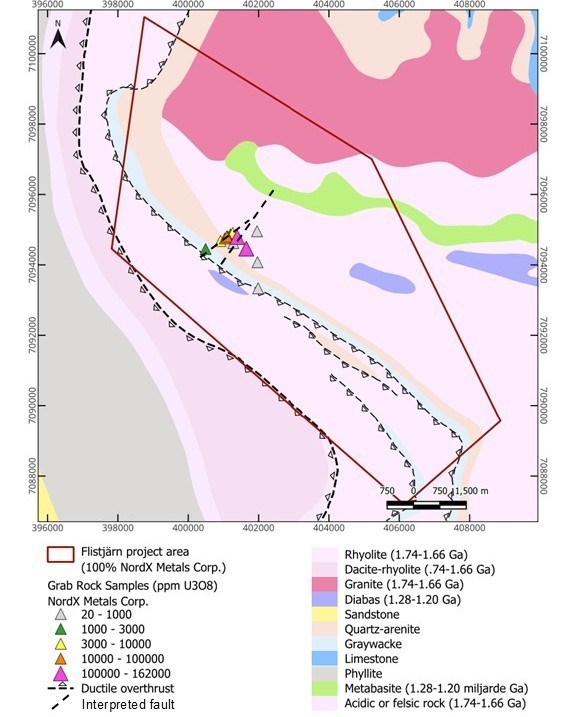
Figure 1. Map of the Flistjärn Project showing uranium assay results of outcrop and boulder samples (collected in July-August 2026) as coloured triangles and the major interpreted unconformity displayed as a dashed line with arrows. The NE-SW oriented mineralised fracture networks as dashed lines (SWEREF 99 TM coordinate system).
To view an enhanced version of this graphic, please visit:
https://images.newsfilecorp.com/files/11951/315358_7ee848e654c7d862_001full.jpg
Table 1. Flistjärn grab sampling geochemical assays (SWEREF 99 TM coordinate system).
| Sample ID | Easting | Northing | Occurrence Type | Laboratory | U3O8 ppm | Mo ppm | Pb ppm | Y ppm | Nb ppm | Zr ppm |
| T26437 | 401382 | 7094790 | Boulder | CRS | 161079 | 125 | 10110 | 1380 | 203 | 706 |
| T26436 | 401641 | 7094459 | Outcrop | CRS | 151881 | 292 | 15720 | 339 | 1210 | 567 |
| T26435 | 401641 | 7094458 | Outcrop | CRS | 116717 | 349 | 20420 | 356 | 849 | 631 |
| T26443 | 401029 | 7094751 | Outcrop | CRS | 21615 | 3816 | 3432 | 68 | 178 | 109 |
| T26441 | 401106 | 7094812 | Outcrop | CRS | 11004 | 4071 | 2758 | 28 | 88 | 164 |
| T26442 | 401085 | 7094802 | Outcrop | CRS | 10470 | 1296 | 909 | 41 | 92 | 173 |
| T26444 | 400908 | 7094679 | Outcrop | CRS | 7036 | 1843 | 2210 | 21 | 104 | 152 |
| T26446 | 401254 | 7094904 | Outcrop | CRS | 6214 | 2029 | 6046 | 36 | 66 | 152 |
| T26449 | 401381 | 7094788 | Outcrop | CRS | 3929 | 180 | 2933 | 239 | 39 | 190 |
| T26447 | 400484 | 7094449 | Outcrop | CRS | 2644 | 4 | 120 | 20 | 38 | 21 |
| T26445 | 401191 | 7094870 | Outcrop | CRS | 1435 | 788 | 1837 | 13 | 60 | 145 |
| T26440 | 401959 | 7094075 | Outcrop | CRS | 724 | 53 | 71 | 20 | 7 | 233 |
| T26439 | 401977 | 7093333 | Outcrop | CRS | 258 | 141 | 214 | 32 | 6 | 98 |
| T26448 | 401273 | 7094618 | Outcrop | CRS | 176 | 53 | 84 | 12 | 13 | 92 |
| T26450 | 401947 | 7094954 | Outcrop | CRS | 24 | 3 | 24 | 18 | 5 | 59 |
About the Flistjärn Project:
The Flistjärn Project is an approved exploration licence located in Jämtland County, Sweden, situated in a 20km-long corridor in the Olden tectonic window that is anomalous in uranium. The mineralization is considered to be granite-related and structurally controlled.
Historical exploration by SGU (1976-1985) and Mawson Resources (2005-2011) mapped the uranium-anomalous corridor. The historically documented uranium occurrences/anomalies have never been drilled.
Norr Döttern Mapping and Sampling Program:
A total of 39 samples (Figure 2, Table 2) were collected in the Norr Döttern project area, with 7 samples sent to ALS Laboratories for assay and the other 32 delivered to CRS laboratories for assay. The average grade of the thirty-nine analysed samples is 6,226 ppm U3O8, and ranged from a low of 7 ppm U3O8 to a high of 69,502 ppm U3O8 (
- T26223:
6.95% U3O8 - T26224:
4.64% U3O8 - T26220:
2.28% U3O8
Two of the three highest-grade samples returned by the program, T26223 at
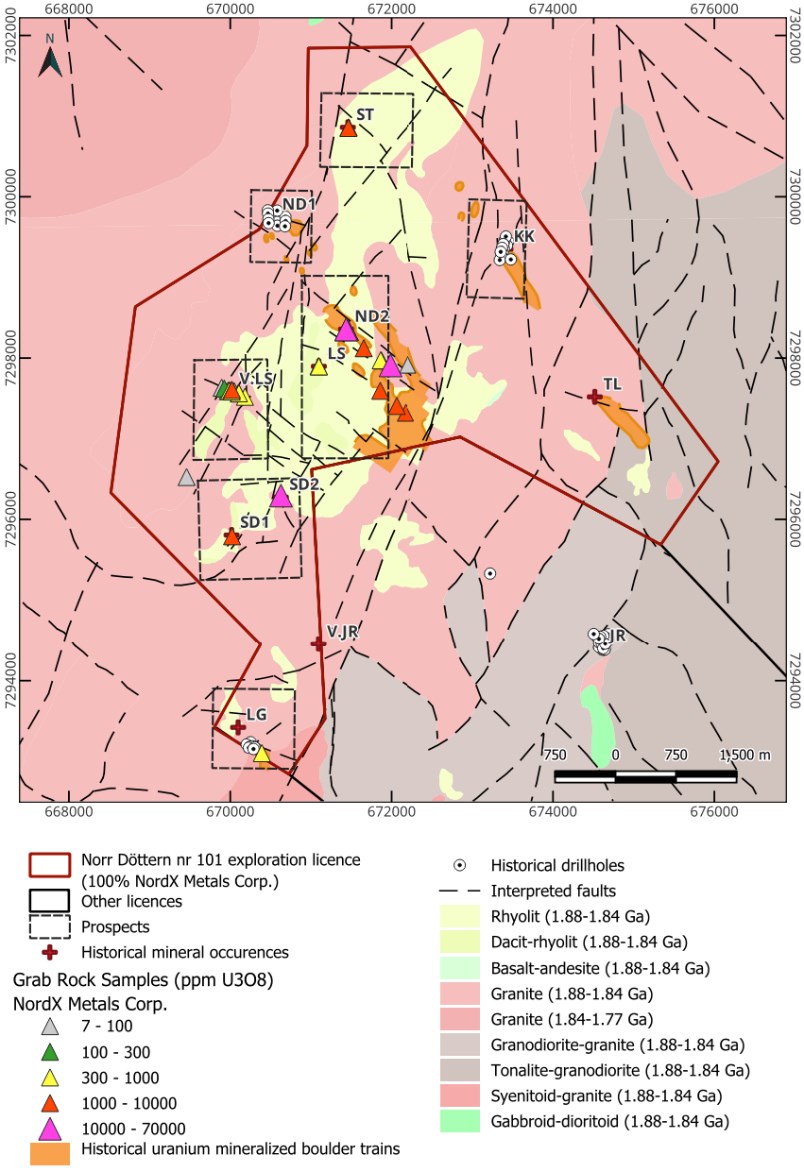
Figure 2. Map of the Norr Döttern Project showing uranium assay results of outcrop and boulder samples (collected in July-August 2026) as coloured triangles and the historically identified prospect areas as dashed rectangles (ND1 - Norr Döttern 1, ND2 - Norr Döttern 2, KK - Kikkejaure Västra, LG - Långträsk, LS - Liessetjåkke, V.LS - Västra Liessetjåkke, SR1 - Sör Döttern 1, SR2 - Sör Döttern 2, ST - Störbacken), as well as historical works (SWEREF 99 TM coordinate system).
To view an enhanced version of this graphic, please visit:
https://images.newsfilecorp.com/files/11951/315358_7ee848e654c7d862_002full.jpg
Table 2. July-August 2026 Norr Döttern outcrop and boulder sampling geochemical assays (SWEREF 99 TM coordinate system).
| Sample ID | Easting | Northing | Occurrence Type | Laboratory | U3O8 ppm | Ag ppm | Zn ppm | Pb ppm | Zr ppm |
| T26223 | 671437 | 7298364 | Outcrop | CRS | 69502 | 1 | 7725 | 20550 | 438 |
| T26224 | 671429 | 7298353 | Outcrop | CRS | 46402 | 3 | 285 | 12520 | 294 |
| T26220 | 671438 | 7298358 | Outcrop | CRS | 22841 | 2 | 3441 | 7825 | 549 |
| ND003 | 671981 | 7297908 | Outcrop | CRS | 21544 | 4 | 235 | 6597 | 3758 |
| T26417 | 670621 | 7296293 | Outcrop | CRS | 19811 | 1700 | 16690 | 12710 | 406 |
| T26222 | 671439 | 7298355 | Outcrop | CRS | 19693 | 1 | 3792 | 4991 | 515 |
| T26412 | 671853 | 7297593 | Boulder | CRS | 9140 | 0 | 70 | 2785 | 1192 |
| ND009 | 671648 | 7298121 | Boulder | CRS | 6096 | 2 | 70 | 2059 | 1319 |
| T26418 | 670015 | 7295788 | Outcrop | CRS | 4495 | 21 | 94 | 3743 | 434 |
| T26410 | 672171 | 7297321 | Boulder | CRS | 4157 | 0 | 58 | 1610 | 1069 |
| T26434 | 671458 | 7300854 | Boulder | CRS | 3658 | 0 | 60 | 297 | 2160 |
| T26433 | 671461 | 7300861 | Boulder | CRS | 3085 | 0 | 87 | 301 | 2057 |
| T26420 | 670013 | 7297605 | Outcrop | CRS | 2637 | 1 | 1299 | 732 | 621 |
| T26411 | 672058 | 7297405 | Boulder | CRS | 2055 | <0.1 | 49 | 742 | 382 |
| ND005 | 671979 | 7297906 | Outcrop | ALS | 1157 | <0.01 | 70 | 136.5 | >500 |
| ND001 | 670384 | 7293085 | Boulder | ALS | 987 | 0.11 | 194 | 109 | >500 |
| T26415 | 671092 | 7297895 | Outcrop | CRS | 906 | <0.1 | 159 | 238 | 975 |
| T26414 | 671089 | 7297898 | Outcrop | CRS | 682 | 0 | 377 | 393 | 432 |
| T26421 | 670013 | 7297603 | Outcrop | CRS | 665 | 0 | 850 | 267 | 368 |
| T26432 | 670011 | 7297584 | Outcrop | CRS | 539 | 0 | 227 | 201 | 559 |
| T26430 | 669979 | 7297589 | Outcrop | CRS | 529 | <0.1 | 175 | 412 | 313 |
| T26425 | 670100 | 7297562 | Outcrop | CRS | 502 | 1 | 80 | 108 | 405 |
| T26424 | 670175 | 7297518 | Outcrop | CRS | 416 | 1 | 123 | 201 | 419 |
| T26431 | 670004 | 7297590 | Outcrop | CRS | 396 | <0.1 | 195 | 218 | 361 |
| ND008 | 671858 | 7297971 | Outcrop | ALS | 301 | 0.64 | 134 | 64.4 | >500 |
| ND007 | 671867 | 7297969 | Outcrop | ALS | 185 | 0.26 | 436 | 163 | >500 |
| T26428 | 669918 | 7297621 | Outcrop | CRS | 114 | 0 | 290 | 89 | 360 |
| T26429 | 669963 | 7297589 | Outcrop | CRS | 66 | <0.1 | 179 | 44 | 388 |
| T26423 | 669974 | 7297600 | Outcrop | CRS | 48 | 0 | 264 | 76 | 459 |
| ND002 | 672199 | 7297918 | Boulder | ALS | 47 | 2.01 | >10000 | 137 | 296 |
| T26416 | 669451 | 7296523 | Outcrop | CRS | 41 | 3 | 75 | 34 | 403 |
| T26426 | 670100 | 7297560 | Outcrop | CRS | 22 | <0.1 | 34 | 24 | 282 |
| T26413 | 671089 | 7297897 | Outcrop | CRS | 21 | <0.1 | 48 | 15 | 689 |
| T26419 | 670042 | 7297589 | Outcrop | CRS | 19 | <0.1 | 49 | 15 | 344 |
| T26221 | 671436 | 7298359 | Outcrop | CRS | 15 | <0.1 | 240 | 52 | 386 |
| ND006 | 671980 | 7297900 | Outcrop | ALS | 13 | 0.02 | 3 | 4.5 | 449 |
| T26422 | 669997 | 7297596 | Outcrop | CRS | 13 | <0.1 | 174 | 14 | 274 |
| ND004 | 671981 | 7297910 | Outcrop | ALS | 8 | 0.11 | 125 | 9.4 | 438 |
| T26427 | 669886 | 7297631 | Outcrop | CRS | 7 | <0.1 | 31 | 5 | 188 |
About the Norr Döttern Project:
The Norr Döttern licence, in Norrbotten County, covers approximately 29 km² over an 8 km NE-SW structural corridor located approximately 25 km northwest of Arvidsjaur. The area was previously explored by state-owned companies SGU and SGAB between 1971-1985, when thirty-five diamond holes were drilled across three of the historically identified prospect areas (Figure 2). Drilling intercepted up to 11.9m grading
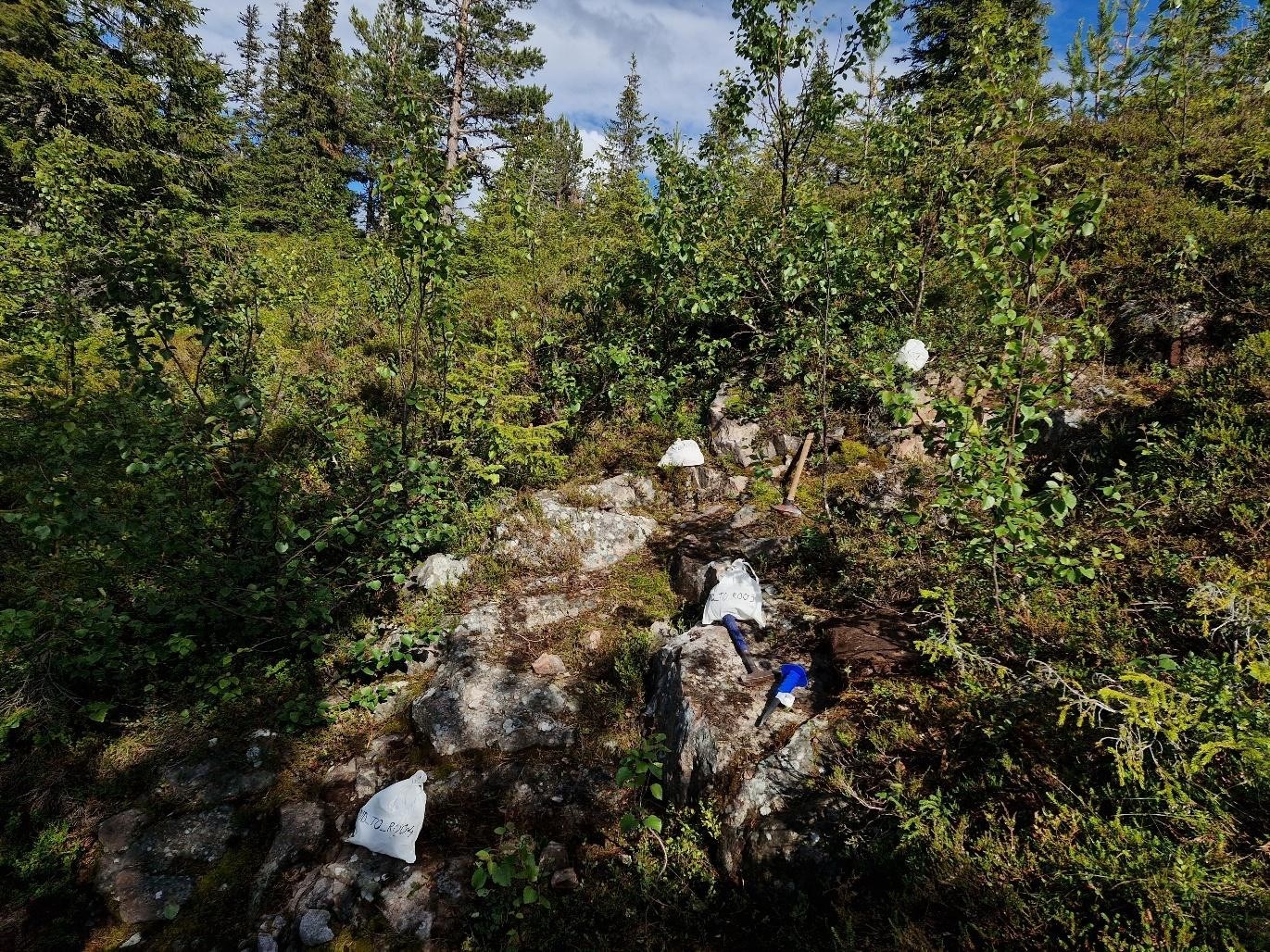
Figure 3. Historic Trench ND2 showing sample bags on the precise locations of the respective grab samples T26220 grading
To view an enhanced version of this graphic, please visit:
https://images.newsfilecorp.com/files/11951/315358_7ee848e654c7d862_003full.jpg
Sampling, Analytical Method and Quality Control
Boulder and outcrop samples reported in this news release were collected by manual rock chip sampling, typical of early-stage prospecting. Rock chip and grab samples are selective in nature and the grades reported are not necessarily representative of the mineralization hosted on the properties. Boulder sample values do not establish in-situ mineralization, as they are transported glacial till indicating a potential bedrock source proximal in the up-ice direction. Because the sampling was non-systematic and intended only for early-stage geochemical indications, no QA/QC measures such as blanks, standards, or field duplicates were inserted into the sample stream by the Company, which has relied on the internal quality control procedures of the analytical laboratories.
All 15 Flistjärn samples and 32 of the 39 Norr Döttern samples were logged, photographed, sealed, and transported under chain-of-custody protocols to CRS Laboratories Oy ("CRS") in Kempele, Finland. On receipt, samples were screened for surface dose rate, and those exceeding 3.0 µSv/h were prepared under CRS's procedure for naturally occurring radioactive material (NORM). At CRS, samples were dried, crushed to 2 mm, split to a 450 g sub-sample using a rotating sample divider attached to the crusher, and pulverised to
CRS Laboratories Oy is a testing laboratory accredited by the Finnish Accreditation Service (FINAS) under EN ISO/IEC 17025 (T342); within method 4A-MS12 the elements in the scope of accreditation are Co, Cu, Mo, Ni, Pb, V and Zn, and uranium results are reported as non-accredited determinations. Results exceeding the upper limit of method 4A-MS12 (10,000 ppm U, equivalent to
The remaining seven Norr Döttern samples (ND001, ND002 and ND004 to ND008) were logged, photographed, sealed, and shipped under chain-of-custody protocols to ALS Laboratories ("ALS"). At ALS, samples were dried, crushed, and pulverised to industry-standard specifications before multielement analysis using the ME-MS61 method. ALS is an internationally recognized ISO/IEC 17025-accredited laboratory relied upon by mining and mineral exploration companies worldwide.
Uranium assays are reported in this news release as U3O8, converted from the laboratory-reported elemental uranium (U) values using the factor U3O8 = U × 1.17922.
Qualified Person
The scientific and technical information in this news release has been reviewed and approved by Avrom E. Howard, MSc, PGeo (Ontario), Principal Geologist at Nebu Consulting, LLC, an independent US-based mineral exploration consulting firm. Mr. Howard is independent of NordX, and is a Qualified Person as defined by National Instrument 43-101.
About NordX Metals Corp.
NordX is an exploration and development company advancing uranium, lithium, and rare earth projects in politically stable jurisdictions with the infrastructure to support rapid, cost-effective exploration, development, and production.
The Company's consolidated financial statements and related management's discussion and analysis are available on the Company's website at https://nordxmetals.com or under its profile on SEDAR+ at www.sedarplus.ca.
On Behalf of NordX Metals Corp.
"Andrew Bowering"
Interim Chief Executive Officer
Telephone: +1-604-428-6128
Email: Ir@nordxmetals.com
The Canadian Securities Exchange has not approved nor disapproved the contents of this news release and does not accept responsibility for the adequacy or accuracy of this release.
Forward-Looking Statements
This news release includes "forward-looking statements" and "forward-looking information" within the meaning of Canadian securities legislation. All statements included in this news release, other than statements of historical fact, are forward-looking statements, including, without limitation, statements regarding the timing, scope and results of the Company's current and future exploration and drilling programs at Flistjärn and Norr Döttern, including its plans to convert the surface sampling results disclosed in this news release into drill-ready targets; the Company's interpretation of the rock chip sampling results and historical drilling, geophysical and geochemical data at Flistjärn and Norr Döttern; and the Company's expectations regarding the significance of the results disclosed in this news release. Forward-looking statements are often identified by the use of words such as "anticipate", "believe", "plan", "estimate", "expect", "potential", "target", "budget" and "intend" and statements that an event or result "may", "will", "should", "could" or "might" occur or be achieved and other similar expressions, including the negatives thereof.
Forward-looking statements are based on the reasonable assumptions, estimates, analysis and opinions of management made in light of its experience, current conditions and expected developments, as well as other factors management believes to be appropriate in the circumstances. Such statements are subject to known and unknown risks, uncertainties and other factors that may cause actual results or events to differ materially from those expressed or implied by such forward-looking statements. These risks and uncertainties include, but are not limited to, the risk that boulder (float) samples may not be sourced from or proximal to a bedrock source and that drilling may not locate in-situ mineralization; permit title, transfer, validity and renewal risk; survey and drilling timing and results; risks associated with mineral exploration and development; metal and mineral prices; availability of capital and financing; changes in market conditions; regulatory approvals; environmental and permitting risks; operational and technical difficulties; title matters; competition; fluctuations in interest and exchange rates; and general economic, market and business conditions.
Although the Company believes the assumptions and expectations reflected in the forward-looking statements are reasonable, there can be no assurance that such statements will prove to be accurate. Actual results and future events could differ materially from those anticipated in such statements. Accordingly, readers should not place undue reliance on forward-looking statements. The forward-looking information contained herein is made as of the date of this news release, and the Company does not undertake to update any forward-looking information except in accordance with applicable securities laws.

To view the source version of this press release, please visit https://www.newsfilecorp.com/release/315358
FAQ
AI-generated questions and answers. How Rhea-AI works. Not financial advice.
How many samples were collected at each project and how were they distributed between laboratories?
At Flistjärn, 15 rock chip samples were collected and all were analysed by CRS Laboratories. At Norr Döttern, 39 rock chip samples were collected; 32 were analysed by CRS and 7 (ND001, ND002 and ND004 to ND008) were analysed by ALS Laboratories.
How representative are these rock chip and grab assay results of the overall uranium mineralization?
The samples were collected as manual rock chip and grab samples typical of early-stage prospecting and are selective in nature. The company notes that the reported grades are not necessarily representative of the mineralization on the properties, and boulder samples do not establish in-situ mineralization because they are glacially transported.
What quality control measures were used for the 2026 sampling programs?
The company did not insert blanks, standards or field duplicates, stating that the work was non-systematic and for early-stage geochemical indications. It relied on the internal quality control procedures of CRS and ALS, both accredited laboratories. CRS used four-acid digestion with ICP-MS (method 4A-MS12), and ALS used ME-MS61. Uranium values were converted from elemental U to U3O8 using a factor of 1.17922.
How does NordX treat historical drilling and sampling data at Norr Döttern?
Historical drilling by state-owned explorers reported intervals such as 11.9 m at 0.1% U3O8 and 4 m at 0.19% U3O8 at certain prospects. The company cautions that it cannot independently confirm historical sampling methods, analytical techniques, sample security or QA/QC, and advises that these historical results should not be relied upon without further verification.
What stage of exploration are the Flistjärn and Norr Döttern projects currently in?
Both projects are in the early exploration stage. At Flistjärn, historically mapped uranium-anomalous zones and an interpreted unconformity have been sampled but never drilled. At Norr Döttern, multiple historical prospects and a high-grade trench (ND2) with associated mineralised boulder trains remain undrilled, and current work focuses on mapping and rock chip sampling.