
IQM Announces Novel Quantum Error Correction Approach Toward Fault-Tolerant Quantum Computing
Key Terms
quantum error-correcting code technical
logical error rates technical
physical qubits technical
quantum low-density parity-check (QLDPC) codes technical
superconducting qubits technical
PIPE financial




New approach delivers cutting edge performance, while significantly reducing hardware complexity
MUNICH & ESPOO,
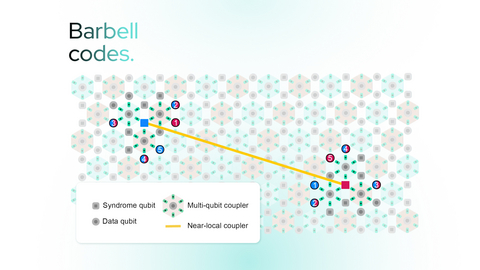
IQM´s breakthrough technology, called barbell codes.
Unlike many alternative high-performance quantum error-correction approaches, the new code also maintains a comparatively low hardware complexity, marking a significant advancement toward scalable fault-tolerant quantum computing.
Quantum error correction remains one of the defining challenges in the race toward practical quantum computing. Errors introduced by noise must be corrected faster than they accumulate, a requirement that previous approaches demanded either complex hardware or significant performance trade-offs, which IQM's codes address both constraints simultaneously.
IQM´s breakthrough technology, called barbell codes, is a family of quantum low-density parity-check (QLDPC) codes tailored to IQM's Constellation, a unique quantum processor topology with enhanced planar connectivity where each qubit can natively interact to 12 other qubits; vs. four qubits in a conventional square grid topology, but only requiring three couplers for the computational qubits and six for the central elements.
By exploiting qubit connectivity and requiring only a single long coupler connection for every other qubit, barbell codes make high-performance error correction with dramatically reduced hardware complexity a reality.
The development details and numerical performance analysis published by the IQM team on arXiv demonstrate a major advancement in quantum computing. Barbell codes are constructed by connecting two sites of standard planar Constellation connectivity with a single long coupler for every second qubit, thereby providing the capability for generating entanglement between such pairs.
Therefore, this unique design eliminates the need for additional long-range crossing couplers on open boundary conditions — simplifying fabrication without compromising performance. The result is a solution engineered not for ideal laboratory conditions, but for the practical realities of superconducting qubit manufacturing.
“We are pioneering the next chapter in quantum computing,” said Jan Goetz, CEO and Co-founder of IQM Quantum Computers. "Our approach offers a highly competitive path to scalable quantum error correction with superconducting qubits, paving the way for large-scale, fault-tolerant quantum computers."
IQM has sold more quantum systems than any other manufacturer and will deploy 150-qubit systems to customers later this year. The company has further announced IQM Halocene, an advanced quantum computer for error correction codes.
The barbell codes approach aligns with the company's development roadmap, positioning IQM on a credible path to fault-tolerant quantum systems with hundreds of high-precision logical qubits and possibility of quantum advantage across multiple industries.
IQM recently announced increased commitments to its PIPE, driven by upsized investor demand ahead of its planned Nasdaq listing through a merger with Real Asset Acquisition Corp. (Nasdaq: RAAQ).
About IQM Quantum Computers
IQM Quantum Computers is a global leader in superconducting quantum computers, delivering full-stack quantum computers and cloud platform access to research institutions, universities, high-performance computing centers, national laboratories and enterprises worldwide. IQM's on-premises deployment model gives customers direct ownership and control of their quantum infrastructure. Founded in 2018, headquartered in Finland with major operations in Munich, it has over 400 employees. IQM operates across Europe, Asia, and North America. IQM has filed an F-4 registration statement to the SEC with the intention to become the first publicly listed European quantum company on Nasdaq Global Exchange in the U.S by merging with Real Asset Acquisition Corp. (Nasdaq: RAAQ).
View source version on businesswire.com: https://www.businesswire.com/news/home/20260609533201/en/
Media contact:
Email: press@iqm.tech
Mobile: +358 (0) 50 479 0845
Source: IQM Quantum Computers