
PBS Biotech Industrializes Cell Therapy Development with Rockwell Automation
Early adopter ARMI said Rockwell controls streamlined integration between the platform and other manufacturing-line systems.
Sentiment and the balance of points
Rhea-AI Sentiment reads the wording of the document, how positive or negative its language is on a 1 to 5 scale. The balance of points shown with the takes weighs what the document actually discloses, so the two can disagree, for example when a trial that missed its main goal is described in upbeat language.
Rhea-AI Summary
Rockwell Automation (ROK) said PBS Biotech embedded its automation technology in a bioreactor platform for cell therapy development.
PBS Biotech's MiniPRO platform uses Rockwell's FactoryTalk software and Process Library for process control and visibility across up to 24 independently controlled bioreactors. It can integrate with PlantPAx, a control system used to automate an entire cell-therapy facility. PBS Biotech has demonstrated process performance on MiniPRO consistent with its larger-scale Vertical-Wheel bioreactors. The companies intend the shared automation environment to help developers carry process data and controls from development toward clinical and commercial manufacturing.
AI-generated analysis. How Rhea-AI works. Not financial advice.




Leading bioreactor manufacturer accelerates time-to-results and simplifies global deployment with standardized automation
Advanced Therapeutic Medicinal Products (ATMP) organizations face growing pressure to accelerate process development while enabling scalability, reproducibility and regulatory readiness. Across the industry, low-throughput, iterative workflows, manual processes, non-standardized environments and dependence on proprietary or PC-based systems slow progress, introduce variability and increase risk as therapies advance toward commercialization.
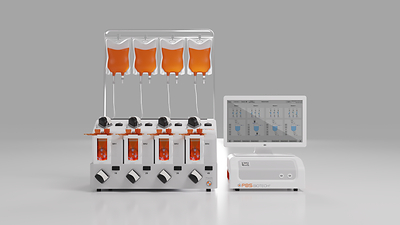
To help its customers overcome these challenges, PBS Biotech partnered with Rockwell Automation to embed standardized, globally recognized automation in its MiniPRO™ platform — a closed, automated bioreactor system with up to 24 independently controlled bioreactors that enables parallel process development. The platform uses FactoryTalk® software and the Process Library to deliver integrated, real-time process control and visibility within a scalable automation environment that can seamlessly integrate into a larger PlantPAx® distributed control system (DCS) used to automate an entire cell-therapy facility.
"Rockwell technologies let us provide industrial-grade control of critical process parameters, so users are generating high-quality process data in an environment that looks and feels like commercial manufacturing," said Sharon Harvey, director of product management and strategy, PBS Biotech. "That's really advantageous because developers are able to introduce this during the product development stage and then evolve towards clinical and commercial manufacturing with history and control."
The Advanced Regenerative Manufacturing Institute (ARMI), a member-based, nonprofit organization whose mission is to advance the bioeconomy of
"Typically, you don't see this control in a system as small as the MiniPRO," said Tom Bollenbach, chief technology officer at ARMI. "With our first integrated manufacturing line, our biggest challenge was getting the process control system to sequentially hand off between subsystems. Because the MiniPRO has Rockwell controls, system integration is streamlined. When we talk to the supervisory system that makes hand-offs happen, it's very easy to get them to talk to each other. That enables us to build bigger manufacturing lines."
PBS Biotech has demonstrated that process performance on the MiniPRO is consistent with its larger-scale Vertical-Wheel® bioreactors, allowing developers to generate manufacturing-relevant data as programs advance. That continuity, combined with the platform's compatibility with widely used automation environments, supports more predictable transfer into Good Manufacturing Practice (GMP) settings.
"As cell therapy programs advance, seamless tech transfers between development outputs and manufacturing requirements help reduce risk during scale-up," said Matt Weaver, vice president, global industry - life sciences, Rockwell Automation. "By introducing a widely used automation platform during process development, the MiniPRO helps teams preserve process knowledge and control as they progress toward clinical and commercial manufacturing."
To read the full PBS Biotech case study, click here.
About Rockwell Automation
Rockwell Automation, Inc. (NYSE: ROK), is a global leader in industrial automation and digital transformation. We connect the imaginations of people with the potential of technology to expand what is humanly possible, making the world more productive and more sustainable. Headquartered in
About PBS Biotech ("PBS")
PBS Biotech is a leading manufacturer of single-use bioreactor systems and provider of process development services. The Company's proprietary Vertical-Wheel® technology enables scalable, low-shear mixing for a wide range of cell therapy and cell culture applications. PBS Biotech's vision is to become the world's standard manufacturing platform for allogeneic cell-based therapies. To learn more, visit pbsbiotech.com.

 View original content to download multimedia:https://www.prnewswire.com/news-releases/pbs-biotech-industrializes-cell-therapy-development-with-rockwell-automation-302892985.html
SOURCE Rockwell Automation, Inc.