
Stellantis Reports Q1 2026 Estimated Consolidated Shipments of 1.4 Million Units, +12% y-o-y
Rhea-AI Summary
Stellantis (NYSE: STLA) reported estimated Q1 2026 consolidated shipments of 1.4 million units, up 12% y-o-y for the three months ended March 31, 2026. Growth was led by Enlarged Europe and North America, with notable increases at Leapmotor and Smart Car platform nameplates.
Company noted volumes are unaudited and may be adjusted; reporting now treats Maserati shipments on a “where sold” basis and includes Leapmotor International volumes.
Positive
- Consolidated shipments +12% y-o-y to 1.4M units
- North America shipments +17% (~+54k units)
- Enlarged Europe shipments +12% (~+69k units)
- Smart Car platforms (FIAT/Opel/Citroën) +85% (~+48k units)
- Leapmotor shipments increased by 22k to ~27k units
Negative
- Gulf Cooperation Council shipments fell by more than 50% to ~3k units
- Argentina shipments down 19% (~-8k units)
- Consolidated shipment figures are unaudited and may be adjusted
News Market Reaction – STLA
In the Apr 15 session, STLA gained 1.72%, reflecting a mild positive market reaction. Our momentum scanner triggered 4 alerts that day, indicating moderate trading interest and price volatility.
Data tracked by StockTitan Argus on the day of publication.
Key Figures
Historical Context
| Date | Event | Sentiment | 24h Move | Catalyst |
|---|---|---|---|---|
| Apr 12 | Jeep special editions | Positive | -0.8% | Launch of retro-inspired Jeep Wrangler and Gladiator Rewind special editions. |
| Apr 01 | US sales update | Positive | +4.8% | FCA US reported Q1 U.S. sales up 4% year over year. |
| Apr 01 | Sales correction note | Positive | +4.8% | Corrected release reaffirmed 4% Q1 U.S. sales growth and brand gains. |
| Apr 01 | Dodge model launch | Positive | +4.8% | Debut of 2026 Dodge Durango GT America250 edition with new features. |
| Apr 01 | Chrysler model refresh | Positive | +4.8% | Reveal of refreshed 2027 Chrysler Pacifica with updated styling and tech. |
24h Move is the share-price change in the day after each event; other market factors may also have contributed.
Recent product and sales announcements with positive tone often coincided with modestly positive price reactions, though there is at least one instance of a small selloff on upbeat product news.
Over the past months, Stellantis has focused on product launches and sales updates. On April 1, 2026, multiple FCA US and brand-specific announcements highlighted higher U.S. sales and new Dodge and Chrysler models, with shares rising about 4.8%. A positive Jeep special-edition news on April 12, 2026 saw a small −0.75% reaction. Today’s Q1 1.4 million-unit shipment update extends the narrative of strengthening volumes after a difficult 2025.
Key Terms
consolidated shipments financial
battery electric vehicles medical
adjusted operating income financial
industrial free cash flows financial
hybrid bonds financial
AI-generated analysis. How Rhea-AI works. Not financial advice.




Stellantis Reports Q1 2026 Estimated Consolidated Shipments of 1.4 Million Units, +
- Growth in all regions, led by North America and Enlarged Europe
AMSTERDAM, April 15, 2026 – Stellantis N.V. today released its Q1 2026 estimated consolidated shipments. The term “shipments” describes the volume of vehicles delivered to dealers, distributors, or directly from the Company to retail and fleet customers, which generally drive revenue recognition.
Consolidated shipments for the three months ending March 31, 2026, were an estimated 1.4 million units, up
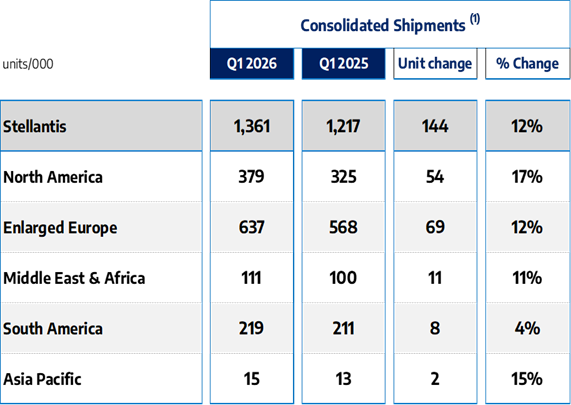
- In North America, Q1 shipments grew by approximately 54 thousand units compared to the same period in 2025, representing a
17% y-o-y increase. This improvement reflects increased momentum in the region, with shipments of the Ram 1500 (light-duty) HEMI® V8, refreshed Jeep® Grand Wagoneer, and the all-new Jeep® Cherokee accounting for more than100% of y-o-y growth, partially offset by Jeep® Compass shipments which were lower due to the ramp-up of Jeep® Cherokee, also produced at the Toluca plant. - In Enlarged Europe, Q1 shipments increased by approximately 69 thousand units, up
12% y-o-y. LCV volumes were stable at approximately 135 thousand units. Passenger car volume growth was driven by new launches. FIAT, Opel/Vauxhall and Citroën brands shipments benefited from the performance of Smart Car platform nameplates (Citroën C3, C3 Aircross, Opel/Vauxhall Frontera, Fiat Grande Panda) which increased by approximately 48 thousand units, or85% y-o-y. Leapmotor-branded vehicles gained commercial momentum, with shipments increasing by 22 thousand units to approximately 27 thousand units; supported by the success of the T03, in the BEV entry-price segment across Europe, particularly in Italy. - In Middle East & Africa, shipments increased by approximately 11 thousand units (+
11% y-o-y) mainly driven by Türkiye (+ approximately 12 thousand units). This significant improvement reflects the benefit of the normalized inventory dynamics and improving commercial performance in Türkiye, mainly due to the introduction of new Citroën and Opel Smart Cars. Algeria also contributed positively with the continued ramp‑up of local production. Shipments in Gulf Cooperation Council countries decreased by more than half to approximately three thousand units. - In South America, shipments increased by approximately eight thousand units (+
4% y-o-y), driven by Brazil, where shipments rose by approximately 17 thousand units (+11% y-o-y), reflecting an improved market trend. This was partially offset by a decline in shipments in Argentina of approximately eight thousand units (-19% y-o-y) due to industry decline, and pressure from new Chinese entrants. Stellantis maintained its leadership in regional shipments as well as in its two main markets, Brazil and Argentina.
NOTES
(1) Consolidated shipments only include shipments by Company’s consolidated subsidiaries, which represent new vehicles invoiced to third party (dealers/importers or final customers). Consolidated shipment volumes for Q1 2026 presented here are unaudited and may be adjusted.
With effect from January 1, 2026, our Maserati reportable segment has been eliminated and its shipments are reported consistently with our other brands in that transactions are treated on a “where sold” basis. Comparative information has been restated.
Consolidated shipments include shipments for Leapmotor International, which is a jointly established, Stellantis-controlled company created in 2024 and owned 51 percent by Stellantis and 49 percent by Leapmotor, to distribute Leapmotor-branded vehicles outside of China.
# # #
About Stellantis
Stellantis N.V. (NYSE: STLA / Euronext Milan: STLAM / Euronext Paris: STLAP) is a leading global automaker, dedicated to giving its customers the freedom to choose the way they move, embracing the latest technologies and creating value for all its stakeholders. Its unique portfolio of iconic and innovative brands includes Abarth, Alfa Romeo, Chrysler, Citroën, Dodge, DS Automobiles, FIAT, Jeep®, Lancia, Maserati, Opel, Peugeot, Ram, Vauxhall, Free2move and Leasys. For more information, visit www.stellantis.com
| @Stellantis | Stellantis | Stellantis | Stellantis | |||||
For more information, contact: investor.relations@stellantis.com Fernão SILVEIRA +31 6 43 25 43 41 – fernao.silveira@stellantis.com communications@stellantis.com www.stellantis.com | ||||||||
Stellantis Forward-Looking Statements
This document, in particular references to “FY 2026 Financial Guidance”, contains forward looking statements. In particular, statements regarding future financial performance and the Company’s expectations as to the achievement of certain targeted metrics, including revenues, industrial free cash flows, vehicle shipments, capital investments, research and development costs and other expenses at any future date or for any future period are forward-looking statements. These statements may include terms such as “may”, “will”, “expect”, “could”, “should”, “intend”, “estimate”, “anticipate”, “believe”, “remain”, “on track”, “design”, “target”, “objective”, “goal”, “forecast”, “projection”, “outlook”, “prospects”, “plan”, or similar terms. Forward-looking statements are not guarantees of future performance. Rather, they are based on the Company’s current state of knowledge, future expectations and projections about future events and are by their nature, subject to inherent risks and uncertainties. They relate to events and depend on circumstances that may or may not occur or exist in the future and, as such, undue reliance should not be placed on them.
Actual results may differ materially from those expressed in forward-looking statements as a result of a variety of factors, including: the Company’s ability to maintain vehicle shipment volumes; changes in the global financial markets, general economic environment and changes in demand for automotive products, which is subject to cyclicality; changes in trade policy, the imposition of global and regional tariffs targeted to the automotive industry; the Company’s ability to accurately predict the market demand for electrified vehicles; the Company’s ability to offer innovative, attractive products; a significant malfunction, disruption or security breach compromising information technology systems or the electronic control systems contained in the Company’s vehicles; the Company's ability to attract and retain experienced management and employees; exchange rate fluctuations, interest rate changes, credit risk and other market risks; increases in costs, disruptions of supply or shortages of raw materials, parts, components and systems used in the Company’s vehicles; changes in local economic and political conditions; the enactment of tax reforms or other changes in tax laws and regulations; the level of governmental economic incentives available to support the adoption of battery electric vehicles; the impact of increasingly stringent regulations regarding fuel efficiency and greenhouse gas and tailpipe emissions; various types of claims, lawsuits, governmental investigations and other contingencies, including product liability and warranty claims and environmental claims, investigations and lawsuits; material operating expenditures in relation to compliance with environmental, health and safety regulations; the level of competition in the automotive industry, which may increase due to consolidation and new entrants; exposure to shortfalls in the funding of the Company’s defined benefit pension plans; the Company’s ability to provide or arrange for access to adequate financing for dealers and retail customers; risks related to the operations of financial services companies; the Company’s ability to access funding to execute its business plan; the Company’s ability to realize anticipated benefits from joint venture arrangements; disruptions arising from political, social and economic instability; risks associated with the Company’s relationships with employees, dealers and suppliers; the Company’s ability to maintain effective internal controls over financial reporting; developments in labor and industrial relations and developments in applicable labor laws; earthquakes or other disasters; and other risks and uncertainties.
Any forward-looking statements contained in this document speak only as of the date of this document and the Company disclaims any obligation to update or revise publicly forward looking statements. Further information concerning the Company and its businesses, including factors that could materially affect the Company’s financial results, is included in the Company’s reports and filings with the U.S. Securities and Exchange Commission and AFM.
Attachment
