
Elevated Style Meets Modern Power in the Next Generation 2027 Toyota Highlander
Toyota (NYSE:TM) unveiled the all-new 2027 Highlander, its first U.S.-assembled three-row battery-electric vehicle.
Sentiment and the balance of points
Rhea-AI Sentiment reads the wording of the document, how positive or negative its language is on a 1 to 5 scale. The balance of points shown with the takes weighs what the document actually discloses, so the two can disagree, for example when a trial that missed its main goal is described in upbeat language.
Rhea-AI Summary
Toyota (NYSE:TM) unveiled the all-new 2027 Highlander, its first U.S.-assembled three-row battery-electric vehicle. The Highlander offers seating for up to seven, standard BEV powertrains across XLE and Limited grades, and manufacturer-estimated ranges up to 320 miles on 95.8-kWh AWD models.
Key production notes: assembled in Georgetown, Kentucky; batteries sourced from Toyota Battery Manufacturing North Carolina (a $13.9 billion plant) and a U.S. supplier partner. Sales begin late 2026 into early 2027; MSRP to be announced.
Positive
- First U.S. three-row BEV for Toyota and first Toyota BEV assembled in America
- Up to 320-mile manufacturer-estimated range on 95.8-kWh AWD models
- $13.9 billion battery assembly investment in North Carolina for U.S. supply
- NACS port standard for broad access to DC fast chargers nationwide
- Vehicle-to-load (V2L) capability, enabling external device and backup power use
Negative
- MSRP not disclosed, creating near-term pricing and margin uncertainty for investors
- On-sale timing spans late 2026 into early 2027, which may delay revenue recognition
Details
News Market Reaction – TM
On Feb 11, the first trading day after this news, TM closed 1.92% above the previous close.
Data tracked by StockTitan Argus for the Feb 11 session.
Key Figures
- Rear cargo volume
- Over 45 cubic feet
- 2027 Highlander with third row folded flat
- Seating capacity
- Up to seven seats
- 2027 Highlander three-row configuration
- Battery capacity
- 77.0-kWh
- 2027 Highlander XLE FWD standard battery
- Battery capacity
- 95.8-kWh
- 2027 Highlander XLE AWD and Limited AWD battery option
- Driving range
- 320-mile
- Manufacturer-estimated range for 95.8-kWh AWD models
- System horsepower
- 338 hp
- Net combined system output on AWD models
- Torque
- 323 lb.-ft.
- Max torque on AWD equipped models
- Battery plant investment
- $13.9 billion
- Toyota battery assembly plant in Liberty, North Carolina
Historical Context
-
Super Bowl LX ads featuring 2026 RAV4 and Team Toyota athletes.
-
Glow Up Classic flag football event and support for youth athletes.
-
Recognition of Team Toyota winter and ski & snowboard athlete ambassadors.
-
Tacoma named Truck of Texas with record 2025 sales and hybrid powertrain.
-
Next-gen navigation system with Mapbox for RAV4 and future models.
24h Move is the share-price change in the day after each event; other market factors may also have contributed.
Key Terms
battery electric vehicle technical
bev technical
vehicle-to-load (v2l) technical
north american charging system (nacs) technical
dc fast charging technical
head up display (hud) technical
plug & charge technical
sustainability bond financial
AI-generated analysis. How Rhea-AI works. Not financial advice.




- Highlander Reimagined for 2027, with All-New, Head-Turning Style, Elevated Comfort, and All-Electric Powertrain
- Spacious Three-Row SUV with Seating for Up to Seven and Over 45-Cubic Feet of Rear Storage with Third Row Folded Flat
- Equipped with The Latest Toyota Audio Multimedia and Toyota Safety Sense Systems
- Assembled in the
U.S. at Toyota Motor Manufacturing Kentucky - Battery Modules Assembled at the Newly Opened Toyota Battery Manufacturing North Carolina (TBMNC) Battery Plant and Partner Supplier in the
U.S. - Vehicle-To-Load Technology, Making Highlander Capable of Powering External Devices or Serving as a Backup Power Source in Case of Emergency (Purchase of Bi-Directional Accessories Required)
- Fourth BEV in the
U.S. Toyota Lineup and Toyota's First Three-Row BEV Model in theU.S. - Two Grades, Limited or XLE, with Available Front- or All-Wheel Drive
- XLE AWD and Limited AWD Models Equipped with 95.8-kWh Battery Have 320-Mile Manufacturer Estimated Total Driving Range Rating*
- Equipped with North American Charging System (NACS) Port for Wide Access to Thousands of DC Fast Charging Stations in the
U.S. - Powerful Drive with up to 338 Combined System Horsepower and 323 lb.-ft. of Torque
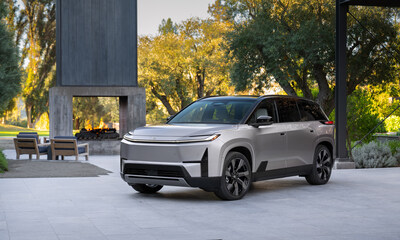
"This new Highlander is designed to be a stylish, high-tech leader in the midsize SUV segment," said David Christ, group vice president of marketing for Toyota. "Its sleek new look, spacious interior, and cutting‑edge technology, make it a great addition to Toyota's growing lineup of BEV's."
The new Highlander's modern new look features clean lines, broad fenders, full-length LED daytime running lights, and flush door handles for an aerodynamic appeal. Inside, a tech-forward cabin with a large 14-inch touchscreen, 12.3-inch driver's display, customizable ambient lighting, and ample device charging in every row give it comfort and convenience. It will also have an available fixed glass panoramic roof that will be the largest in the Toyota lineup, adding an open, bright feeling to the cabin.
The 2027 Highlander will have a Battery Electric powertrain standard and be available in two grades, the well-appointed XLE or the top-of-the-line Limited. The XLE grade will be available in front- or electronic all-wheel drive (FWD or AWD); XLE FWD models will have a 77.0-kWh battery, standard; XLE AWD models will have a choice of 77.0-kWh or 95.8-kWh battery. The Limited grade will have AWD and 95.8-kWh battery, standard. AWD equipped models will also have features like Multi-Terrain Select and Crawl Control. All grades will have the latest in safety and entertainment, with Toyota Safety Sense 4.0 (TSS 4.0) and Toyota Audio Multimedia, standard.
Designed to provide a comfortable space for the whole crew, the 2027 Highlander has a spacious interior with three-row seating for up to seven when equipped with an available bench seat. Its cabin has an elevated feel, with standard SofTex®-trimmed seating, soft-touch materials on the dash and doors, and customizable interior lighting to set the mood. Heated front seats come standard, with ventilated front seats and heated second row seats available. When extra space is required, the third-row folds flat for a rear cargo area with more than 45 cubic feet of storage.
At the forefront of technology, the new Highlander can also serve as a mobile power source with vehicle-to-load (V2L) technology, a first for a Toyota model sold in
A standout characteristic of BEV's is their fun-to-drive nature, thanks to a low center of gravity and the instant torque that electric motors can deliver. So, Toyota engineers focused on designing an all-electric Highlander that is both efficient and powerful. "Our goal with the new Highlander was to develop a BEV that fits customers' lives and brings a smile to their faces with sharp acceleration feel and a quiet ride," said Highlander chief engineer Yoshinori Futonagane. To accomplish that aim, the new Highlander has 338 net combined system horsepower and a satisfying 323 lb.-ft. max torque on AWD equipped models. FWD equipped models have 221 net combined system horsepower and 198 lb.-ft. max torque.
The 2027 Highlander joins the Toyota bZ, bZ
*Estimate only. Actual range will vary depending on weather, driving style, and other factors. |
Highlander Through the Years
The Toyota Highlander has been an integral part of many families' lives for more than 25 years. First revealed at the New York International Auto Show in April 2000, the first-generation 2001 Toyota Highlander used a modified version of the same unibody platform used on the Toyota Camry. At the time, this innovation set it apart from other SUVs since a body-on-frame design was the norm for trucks and sport utility vehicles. As Toyota's first step into the midsize unibody SUV category, the Highlander had good road manners, a spacious interior, and rugged style that was appealing to customers.
The Highlander Hybrid model was revealed in 2005 for the 2006 model year and was the Toyota brand's first hybrid-powered SUV. Additionally, it was the second Toyota model after the Prius to offer a hybrid powertrain. The model quickly earned honors, like an "Automotive Excellence" award from Popular Mechanics in 2006 and a "Top Pick" from Consumer Reports in the Midsize SUV category in 2007.
The Second-Generation Highlander was introduced soon thereafter and featured a more refined exterior design, improved interior materials, and advanced safety features like a rearview camera and an optional navigation system. It was also the first generation assembled in the
Over the years, the Highlander evolved in size and style and took on a refined crossover SUV appearance. The third-generation model, revealed in 2013, brought a more aggressive design and a suite of active safety technologies and advanced driver-assistance features that included Toyota Safety Sense. The fourth-generation model was revealed in 2019 with a more spacious interior, an upgraded hybrid powertrain, and accentuated body lines along the doors and fenders. The 2027 model kicks off the model's fifth generation and carries forward Highlander's push to continually evolve its style, everyday usability, elevated comfort, and efficiency.
Distinctive Design
When Toyota designers and engineers set out to reinvent Highlander as a battery electric vehicle, they wanted to make a model that captured a sense of sophisticated adventure. To achieve this, they coined the term "Best Experience Vehicle" with a focus on building a new Highlander that helps support efficient, safe and comfortable travel for the family.
"Our design mission was to create a new Highlander that pursued the robust proportions of an SUV while also capturing the sophisticated, high-tech aspects of all-electric performance," said Chief Designer Masayuki Yamada. "To accomplish that goal, we designed a model that balanced aerodynamics, interior space, and capability so it is equally suited for elegant urban or outdoor enthusiast lifestyles."
The 2027 Highlander is built on a modified Toyota Next Generation Architecture-K (TNGA-K) platform that was newly developed to house Highlander's high-capacity battery and maximize passenger space. The platform also uses underfloor covers on the front and back end to benefit underfloor airflow as well as front and rear spats to minimize air turbulence generated around the tires. Measures taken to minimize noise and vibration include noise absorbing material on the front and rear door trim, front pillar, wheel wells, roof, and underfloor. Acoustic glass on the front windshield and front side glass is also used.
Toyota's designers also changed the proportions of Highlander to achieve a modern look and confident stance by lowering its overall height and increasing its width and wheelbase. The overall height of 67.3 inches lowers the roofline by 0.8 inch versus the outgoing model; overall width increased to 78.3 inches for an added 2.3 inches; and the wheelbase becomes 120.1 inches, up from 112 inches. Altogether, the new exterior dimensions allowed designers to give the model a planted, agile appearance, with the wheels set closer to the corners, while also maximizing interior space.
From the front, the new Highlander emphasizes Toyota's signature hammerhead design with the use of slim daytime running lights (DRL) that are housed separately from the main headlights. The linear-shaped DRL is integrated into the vehicle's front end for a look that evokes strength and simplicity with broad surfaces, a thick sweptback grill, and geometric bumper corners that encompass the headlamps for a modern impression.
The sophisticated appeal continues along the side of the vehicle. The new Highlander's profile sweeps rearward from the front end through a sleek, tapered cabin with large windows. Its front and rear end have broad fenders that exude confidence and drivability. Along the side, smooth door panels complement the broad fenders to emphasize its robust image and semi-flush door handles with a newly adopted electronic latch, a rear spoiler that is smoothly integrated into the rear pillar, and black painted window trim that gives it a simple-yet-refined style.
Available exterior paint colors on the new Highlander further its expressive nature. Single tone colors include the all-new Spellbound, along with Wind Chill Pearl, Heavy Metal, Everest, Reservoir Blue, and Midnight Black Metallic. Two tone paint combinations are also available, pairing Spellbound, Wind Chill Pearl, Heavy Metal, or Everest with a black roof. Interior colors are clean and modern, with Black, Portobello, and an all-new Misty Gray available.
Elevated Interior
On the inside, the all-new Highlander aims to create a comfortable cabin by giving it an open feeling, refined comfort, and tech-forward design. The cockpit is driver-focused and centers around an LED digital gauge cluster with customizable settings, temperature controls with adjustability via hard buttons, and a large slim bezel touchscreen. A Head Up Display (HUD) is available. Ambient lighting is standard, with 64 different color choices to set the perfect mood for a night out on the town. It is also thoughtfully integrated into the Safe Exit Assist system with ambient lights on the doors that will flash in case of an issue.
Seating is made of durable materials and stylish patterns that add beauty to the interior. All grades will have new-look SofTex-trimmed seating with heated first row seating standard. The Limited grade adds unique textured patterns, front seat ventilation function, and second row heat. Second-row captain's chairs come standard, with an available bench seat for the XLE AWD grade. The third-row seat provides ample room for two adults and is easily accessible via an electronically assisted one-touch fold button on the second-row seats.
The interior space is thoughtfully fashioned to help maximize usability. The center console has a standard dual Qi wireless charging tray that is cleverly angled to prevent slipping and is trimmed in a synthetic-suede material. The USB-C chargers are also located throughout the cabin, with ports located on the rear of the front seats for second row passengers and on the rear window ledges for the third row. Rear HVAC controls, accessible on the rear of the center console, are easily within reach for second row passengers. Rear window shades are also available for a more private sense of space.
Storage is also cleverly designed. The multi-function center console features a small item storage tray, cup holders, and an under-tray storage, with the console storage box providing an additional place for valuables. Storage slots for tablets and/or phones in the standard second row console, and third row cupholders provide thoughtful places for passengers to stash electronics. Ample cup holders are placed throughout, with 18 total locations. A standard hands-free power liftgate provides easy access to the rear cargo area. When extra storage is required, folding the third-row flat is as simple as pulling a lever on the rear seats.
Electrifying Efficiency
Within the 2027 Highlander lineup, customers will be able to choose from driving range and battery options that best fit their needs, options include:
- XLE FWD with 77.0-kWh battery with a manufacturer-estimated 287-mile total driving range rating*
- XLE AWD with 77.0-kWh battery with a manufacturer-estimated 270-mile total driving range rating*
- XLE AWD with 95.8 -kWh battery with a manufacturer-estimated 320-mile total driving range rating*
- Limited AWD with 95.8 -kWh battery with a manufacturer-estimated 320-mile total driving range rating*
It will have a standard North American Charging System (NACS) port that is compatible with thousands of Level 3 DC charging stations nationwide. Under ideal conditions when using DC fast charging, it is capable of charging from
A Battery Preconditioning feature is also equipped**. This system is designed to bring the battery to an optimal temperature for DC fast charging, which can enable faster charging.
This feature can be activated manually using system settings or can be automatically activated through an active Drive Connect trial or subscription by setting the navigation system to a fast-charging station**. It will also have Plug & Charge*** capability, an industry standard protocol that allows automatic identification, authentication, and authorization on selected charging networks, reducing the need for multiple mobile charging applications.
*Estimate only. Actual range will vary depending on weather, driving style and other factors. |
Advanced Technology
The 2027 Highlander also receives the latest-generation Toyota Audio Multimedia. Developed in
Paired with the touchscreen display, the Toyota Audio Multimedia system will provide customers with choice thanks to standard wireless Apple CarPlay® and Android Auto™ compatibility, and simultaneous dual Bluetooth® phone connectivity. To read the full news release about the latest Toyota Audio Multimedia system, click here.
The new system also has enhanced entertainment with the introduction of SiriusXM® with 360L® and newly available integrated streaming with Spotify® (separate subscriptions required). The native turn-by-turn navigation now displays full screen on the digital gauge cluster, a first for Toyota Audio Multimedia.
The 2027 Highlander also has a standard built-in Drive Recorder, a dashcam-style feature that utilizes the vehicle's exterior cameras to capture 20-second clips of both manual and triggered events when operating.
The 2027 Highlander also comes with a host of Connected Services* trials that include Drive Connect with Intelligent Assistant, Cloud Navigation with 3D Maps and Destination Assist; Safety Connect and Service Connect. Customers can also use the Toyota mobile application to stay connected to their Highlander with Remote Connect**, which also enables remote charging capabilities to check charging status, start/stop charging when the vehicle is already plugged in and even edit charging schedules The Toyota app also provides an easy-to-use map to find charging station locations near you or along your route, making it easier than ever for customers to managing their charging needs.
*All trials begin on the purchase or lease date of new vehicle with the exception of Wi-Fi Connect for which trial begins at time of activation. |
Safety & Convenience
The 2027 Toyota Highlander comes with the recently updated Toyota Safety Sense (TSS 4.0) system. The new version of Toyota's standard active safety suite and convenience technologies brings updates to its hardware and detection capabilities and has the following features:
- Pre-Collision System with Pedestrian Detection (PCS w/PD) is designed to help detect a vehicle, pedestrian, bicyclist or motorcyclist and provide an audio/visual forward-collision warning under certain circumstances. If you don't react, the system is designed to provide automatic emergency braking.
- Full-Speed Range Dynamic Radar Cruise Control (DRCC) is an adaptive cruise control system that is designed to be set at speeds above 20 mph. DRCC uses vehicle-to-vehicle distance control to help maintain a preset distance from the vehicle ahead.
- Lane Departure Alert with Steering Assist (LDA w/SA) detects lane markings or the road's edge at speeds above 30 mph. LDA w/SA is designed to provide an audible/visual warning if an inadvertent lane departure is detected. If no corrective action is taken, Steering Assist is designed to provide gentle corrective steering for lane-keeping assistance.
- Automatic High Beams (AHB) are designed to detect headlights of oncoming vehicles and taillights of preceding vehicles. AHB automatically toggles between high and low beams as appropriate.
- Lane Tracing Assist (LTA) is designed to help keep the vehicle in the center of a lane. LTA assists the driver with steering control while DRCC is in use.
- Road Sign Assist (RSA) uses the forward-facing camera to recognize specific road signs such as speed limits and stop signs. RSA provides road sign information to the driver via the Multi-Information Display.
- Proactive Driving Assist (PDA) uses the vehicle's camera and radar, when system operating conditions are met, to provide gentle braking and/or steering to support driving tasks such as distance control between your vehicle and a preceding vehicle
In addition to TSS 4.0, the 2027 Highlander is equipped with Toyota's Star Safety System, which includes Enhanced Vehicle Stability Control (VSC), Traction Control (TRAC), Electronic Brake-force Distribution (EBD), Brake Assist (BA), Anti-lock Braking System (ABS) and Smart Stop Technology (SST). Front and Rear Parking Assist with Automatic Braking (PKSB) is also standard. Other available convenience technologies include Panoramic View Monitor and Advanced Park.
The 2027 Highlander also has great standard convenience features like a rear seat reminder system, backup camera with dynamic gridlines, smart key with push button start, Blind Spot Monitor with Rear Cross-Traffic Alert, Tire Pressure Monitor System (TPMS) with direct pressure read-out and individual tire location alert, and Hill Start Assist Control.
Two Well-Equipped Grades
The 2027 Toyota Highlander will be available in two grades, with great features across the lineup, select standard features include:
XLE Grade
- Full-width LED DRL
- Front acoustic glass
- 19-inch wheel with full aero cap
- Semi-flush electronic door handles
- 14-inch touchscreen with Toyota Audio Multimedia
- 6-speaker audio system
- 12.3-inch digital gauge cluster
- 64-color customizable ambient lighting
- SofTex-trimmed seating
- Heated front seats and steering wheel
- Second row seats with 1-touch fold
- Paddle shifters with regenerative braking
- NACS charging port for DC fast charging compatibility
- 11-kW onboard AC charger
- 120V/240V dual-voltage charging cable
- TSS 4.0
- Drive recorder
Limited Grade (adds to or replaces XLE features)
- Side view mirrors with memory and reverse tilt function
- Head up display
- Ventilated front seats
- Heated second row seats
- Rear sunshades
- Advanced Park
- Traffic Jam Assist*
- Panoramic View Monitor
- Lane Change Assist
- Front Cross Traffic Alert
*Requires an active Drive Connect trial or subscription. 5G network dependent. |
Select available features include:
- Bench seating (XLE AWD only)
- Panoramic roof (All Grades)
- JBL® Premium Audio system with 11 speakers, subwoofer and amplifier (XLE AWD and Limited)
- Two-tone paint (Limited)
- 22-inch wheels (Limited)
Key Specifications
Grades | XLE, Limited | |
Available Drivetrains | XLE: FWD/AWD Limited: AWD | |
Powertrain | Battery Electric | |
Available Battery/Range Options & Manufacturer | • XLE FWD with 77.0-kWh battery with a manufacturer- • XLE AWD with 77.0-kWh battery with a manufacturer- • XLE AWD with 95.8 -kWh battery with a manufacturer- • Limited AWD with 95.8 -kWh battery with a manufacturer- | |
Horsepower (Total System Output) | XLE FWD: 221 hp XLE AWD: 338 hp Limited AWD: 338 hp | |
Torque | XLE FWD: 198 lb.-ft. XLE AWD: 323 lb.-ft. Limited AWD: 323 lb.-ft. | |
Dimensions | Overall Length | 198.8-in. |
Overall Width | 78.3-in. | |
Overall Height | 67.3-in. | |
Wheelbase | 120.1-in. | |
Cargo Volume (3rd row folded down) | 45.6 -ft3 | |
Cargo Volume (3rd row up) | 15.9-ft3 | |
*Manufacturer-estimated total driving range ratings. Mileage will vary for many reasons |
Limited Warranty
Toyota's 36-month/36,000-mile basic new-vehicle warranty applies to all components other than normal wear and maintenance items. Additional 60-month warranties cover the powertrain for 60,000 miles and corrosion with no mileage limitation. The Electric Vehicle Driving Components, including the traction battery, are covered for 8 years or 100,000 miles, whichever comes first. Toyota dealers have complete details on the limited warranty.
The 2027 Toyota Highlander also comes with ToyotaCare, a plan covering normal factory-scheduled maintenance, for 1 year or 10,000 miles, whichever comes first, and 24/7 Roadside Assistance for 2 years/unlimited mileage. ToyotaCare valid only in the continental
About Toyota
Toyota (NYSE:TM) has been a part of the cultural fabric in the
Toyota directly employs nearly 48,000 people in the
For more information about Toyota, visit www.ToyotaNewsroom.com.
MEDIA CONTACT
Paul Hogard
paul.hogard@toyota.com
469-292-6791

 View original content to download multimedia:https://www.prnewswire.com/news-releases/elevated-style-meets-modern-power-in-the-next-generation-2027-toyota-highlander-302684459.html
SOURCE Toyota Motor North America
FAQ
AI-generated questions and answers. How Rhea-AI works. Not financial advice.