New Omdia Research States That Cellular IoT Data Traffic Will Reach 218.6 Exabytes by 2035
New Omdia Research States That Cellular IoT Data Traffic Will Reach 218.6 Exabytes by 2035
Omdia research forecasts that global cellular IoT data traffic will reach 218.6 exabytes by 2035, driven mainly by automotive infotainment and firmware updates.
Rhea-AI Sentiment reads the wording of the document, how positive or negative its language is on a 1 to 5 scale. The balance of points shown with the takes weighs what the document actually discloses, so the two can disagree, for example when a trial that missed its main goal is described in upbeat language.
LONDON--(BUSINESS WIRE)--
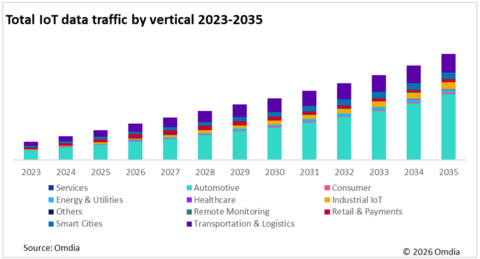
Data traffic from cellular IoT connections is expected to rise to 218.6 exabytes (EB) by 2035, according to Omdia’s latest research. This increase is fueled by a growing demand for data that can be analyzed, with the goal of improving operational efficiency and creating new revenue opportunities for businesses.
Total IoT data traffic by vertical, 2023-2035
The research revealed that the majority of cellular IoT data traffic will come from the automotive sector, with key use cases including infotainment services such as video and audio streaming, as well as firmware over-the-air updates. Over the forecast between 2025 to 2035, automotive data traffic will rise from 30.7 EB to 135.4 EB, driven by the integration of infotainment systems in newer vehicles and rising consumer adoption of these services, many of which are expected to rely on 5G connectivity. According to the report, transport and logistics are poised to become the next major sector for cellular IoT data traffic, while all other sectors combined will contribute less than 29% of the total traffic beyond 2025.
Alexander Thompson, Senior Analyst for IoT at Omdia stated, “The rising number of vehicles with smart features, particularly infotainment, will cause cellular IoT data traffic to boom over the next decade. Other video-based use cases will also generate significant amounts of data.”
“While cellular IoT data traffic remains dominated by use cases that require mobility, such as automotive and logistics, emerging trends like remote vision, which enables cameras to be added in a wide range of devices, from delivery robots to industrial machinery, and agentic AI, driving growth in peer-to-peer machine traffic, are increasing demand for greater edge processing power and accelerating 5G adoption. Together, these trends are creating additional data traffic demand that did not exist several years ago," added Andrew Brown, Practice Lead for IoT at Omdia.
The report also emphasizes that Asia & Oceania will produce the highest amount of cellular IoT data traffic, comprising 50.6% of global cellular IoT data traffic in 2025. The region has traditionally been an early adopter of new technology and also has a significant number of video cameras installed, which will help drive traffic growth.
ABOUT OMDIA
Omdia, part of TechTarget, Inc. d/b/a Informa TechTarget (Nasdaq: TTGT), is a technology research and advisory group. Our deep knowledge of tech markets grounded in real conversations with industry leaders and hundreds of thousands of data points, make our market intelligence our clients’ strategic advantage. From R&D to ROI, we identify the greatest opportunities and move the industry forward.
Cellular IoT means internet-connected devices that use mobile phone networks (like LTE, NB‑IoT, LTE‑M or 5G) to send and receive data rather than relying on Wi‑Fi or wired connections. For investors, it matters because these devices create steady service and data-usage revenue, scale across wide geographies like a mobile phone plan, and tie a company’s costs and growth to carrier coverage, subscription pricing and network technology upgrades.
exabytestechnical
An exabyte is a unit of digital information equal to about one billion gigabytes, used to measure extremely large amounts of data. For investors, exabytes signal the scale of storage, processing and network capacity companies need; rising exabyte volumes can point to growth opportunities for cloud providers, data-center builders and chipmakers, or to rising costs for firms that must store and analyze massive data sets.
firmware over-the-airtechnical
Firmware over-the-air is the process of sending low-level software updates wirelessly to devices—like phones, cars, or industrial equipment—without needing a physical connection. Investors care because it lets companies fix bugs, add features, and patch security issues quickly and cheaply, reducing recall risk and support costs while extending product lifecycles and enabling new services that can protect or grow revenue.
5gtechnical
5G is the fifth generation of wireless technology that provides faster internet connections, lower latency, and greater capacity than previous networks. It enables quicker downloads, smoother streaming, and more reliable connections for devices. For investors, 5G represents a significant upgrade in technology infrastructure that can drive growth in related industries such as smartphones, smart cities, and the Internet of Things.
remote visiontechnical
Remote vision is the ability to capture, transmit and analyze visual information from a distance using cameras, sensors and software so people can see and assess places or situations without being there in person. For investors, it matters because companies that offer reliable remote vision can reduce costs, speed decision-making, enable services like telehealth or security monitoring, and create recurring revenue, much like a set of electronic eyes that extend a business’s reach.
agentic aitechnical
Agentic AI refers to computer systems that can make their own decisions and take actions without needing someone to tell them what to do each time. It's like giving a robot a degree of independence to solve problems or achieve goals on its own, which matters because it could change how we work and interact with technology in everyday life.
edge processingtechnical
Edge processing is the practice of running data analysis and decision-making on devices close to where data is created—such as sensors, phones, or factory machines—instead of sending everything to a distant central server. For investors, it matters because it can cut delays, lower ongoing cloud costs, improve privacy, and enable new real-time products and services, so companies that adopt it can gain efficiency and competitive advantage much like handling a problem on the spot instead of mailing it to headquarters.