Rhea-AI Sentiment reads the wording of the document, how positive or negative its language is on a 1 to 5 scale. The balance of points shown with the takes weighs what the document actually discloses, so the two can disagree, for example when a trial that missed its main goal is described in upbeat language.
LONDON--(BUSINESS WIRE)--
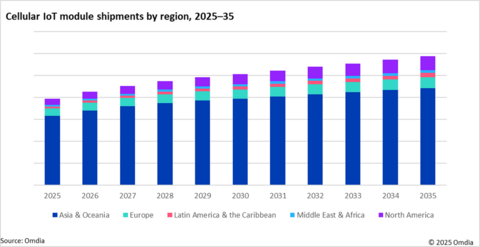
The cellular IoT market is poised for significant growth in the coming years, with connections expected to surge to 5.9 billion by 2035, as revealed by new research from Omdia.
Cellular IoT module shipments by region, 2025-35
This in-depth study highlights the transformative impact of 5G technologies on the cellular IoT landscape, identifying three pivotal technologies as primary growth drivers: 5G RedCap, 5G Massive IoT, and 4G LTE Cat-1bis modules.
5G eRedCap: Launch momentum to build in 2026
The research highlights 5G RedCap as a transformative development, with adoption projected to gain momentum starting in 2025. Positioned as the optimal mid-tier connectivity solution, RedCap caters to 5G devices that do not require the advanced specifications of Ultra-Reliable Low Latency Communications (uRLLC) or Enhanced Mobile Broadband (eMBB). Additionally, RedCap offers critical futureproofing benefits as the industry transitions toward phasing out 4G networks beyond 2030.
The study notes that while initial deployment of RedCap has been slower than expected, 2025 has showed some promise with the launch of the latest Apple Watch range that incorporates RedCap technology. Complementing this growth, eRedCap module launches are expected to begin in 2026, further expanding mid-tier connectivity options and driving adoption across a broader range of use cases.
"The implementation of 5G RedCap in the latest range of Apple Watches has signalled the starting gun for RedCap adoption," explains Alexander Thompson, Senior Analyst for IoT at Omdia. "Going forward, enterprises will have a wider and wider selection of connectivity technologies to benefit any application. The expected launch of 5G eRedCap modules in 2026 will provide further cellular IoT connection growth over the next decade.”
Automotive will comprise one in five cellular IoT connections in 2035
The automotive segment will rise from 500m connections to around 1.2bn over the next ten years, increasing its market share from 13% to 21%. Most of this connection growth will originate from Asia & Oceania, which will see its automotive segment rise due to increasing consumer demand for intelligent vehicles with 5G connectivity.
“The rapid rise of software-defined vehicles, the fundamental need for over-the-air updates, regulatory mandates and vehicle-to-everything, are all made possible by cellular connected vehicles, which is why we expect to see vehicles represent 1 in 5 cellular connections by 2025,” added Andrew Brown, IoT Practice Lead at Omdia.
Omdia's Cellular IoT Market Tracker 2021-2035 highlights the latest trends in the cellular IoT market, providing key analysis by region, air interface and application of module shipments, module revenues, connections (installed base) and connectivity revenues.
ABOUT OMDIA
Omdia, part of Informa TechTarget, Inc. (Nasdaq: TTGT), is a technology research and advisory group. Our deep knowledge of tech markets grounded in real conversations with industry leaders and hundreds of thousands of data points, make our market intelligence our clients’ strategic advantage. From R&D to ROI, we identify the greatest opportunities and move the industry forward.
Cellular IoT means internet-connected devices that use mobile phone networks (like LTE, NB‑IoT, LTE‑M or 5G) to send and receive data rather than relying on Wi‑Fi or wired connections. For investors, it matters because these devices create steady service and data-usage revenue, scale across wide geographies like a mobile phone plan, and tie a company’s costs and growth to carrier coverage, subscription pricing and network technology upgrades.
5g redcaptechnical
A 5G RedCap (short for “reduced capability”) is a streamlined version of 5G cellular technology designed for lower-cost, lower-power devices such as wearables, sensors, and simple IoT gadgets. It trims advanced features to make chips and modems cheaper and batteries last longer, like an economy-class seat that still gets you to the destination. For investors, RedCap can expand the addressable market for device makers and carriers by enabling mass adoption of connected products while shifting revenue and cost dynamics across the 5G ecosystem.
5g massive iottechnical
5G Massive IoT describes using 5G networks to connect very large numbers of simple, low-cost devices—think sensors, smart meters, and trackers—that send small amounts of data infrequently and need long battery life. It matters to investors because it creates a broad, steady market for network upgrades, specialized chips, and subscription services much like adding millions of low-cost mailboxes that generate ongoing fees and new business opportunities for infrastructure and service providers.
4g lte cat-1bistechnical
4G LTE Cat-1bis is a lower-speed, lower-power variant of the 4G mobile standard built for simple Internet-of-Things devices like meters, trackers and environmental sensors. Think of it as a reliable backroad rather than a multi-lane highway: it moves small, occasional data efficiently and at lower cost and energy use. Investors pay attention because Cat-1bis can reduce device and connectivity costs, extend battery life, and open volume markets that influence sales, service revenues and network investment needs.
Ultra-reliable low latency communications (URLLC) is a class of network service that guarantees extremely fast data delivery with very little delay and near-perfect reliability, so information arrives almost instantly and without dropping. Think of it as a reserved, traffic-free fast lane for critical digital messages—essential for real-time uses like remote surgery, industrial robots, autonomous vehicles, and emergency systems. For investors, URLLC matters because it enables high-value applications, drives demand for upgraded networks and specialized equipment, and can create new revenue streams while changing where companies invest in infrastructure and services.
urllctechnical
Ultra-Reliable Low-Latency Communications (URLLC) is a class of wireless networking that guarantees extremely fast data transfer with almost no delays and very high reliability, designed for mission-critical uses like remote surgery, factory automation, and autonomous vehicles. For investors, URLLC matters because its deployment drives demand for specialized network equipment, chips, software and services—similar to upgrading a road from gravel to a high-speed highway that allows new types of vehicles and businesses to operate safely and predictably, creating new revenue opportunities and competitive advantages.
enhanced mobile broadbandtechnical
Enhanced mobile broadband is the upgraded form of wireless internet service that delivers much faster download and upload speeds, more capacity, and lower delay for smartphones, tablets, and other portable devices. It matters to investors because it fuels higher consumer use, supports new services like high-definition video and virtual reality, and drives spending on network upgrades, devices, and apps—similar to how adding lanes and better pavement to a highway lets more cars travel faster and supports new businesses along the route.
vehicle-to-everythingtechnical
Vehicle-to-everything (V2X) is technology that lets a car communicate bidirectionally with other vehicles, road infrastructure, mobile devices and the electric grid, turning the vehicle into an active node on a network. For investors it matters because V2X can materially change revenue and cost structures across automakers, suppliers, telecoms, utilities and insurers by enabling new services (safety systems, traffic management, remote updates, or using parked electric vehicles as grid storage) that affect competitiveness and future cash flows.