
Omdia: Global XR headwear shipments fall 39% in 1H26 as XR glasses growth fails to offset headset decline
Omdia data show a steep 1H26 XR headwear shipment decline, even as lighter XR glasses gain share and Greater China’s market presence grows.
Sentiment and the balance of points
Rhea-AI Sentiment reads the wording of the document, how positive or negative its language is on a 1 to 5 scale. The balance of points shown with the takes weighs what the document actually discloses, so the two can disagree, for example when a trial that missed its main goal is described in upbeat language.




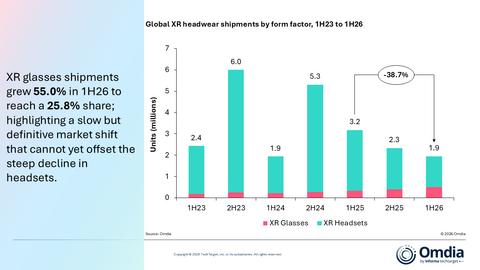
Global XR headwear shipments by form factor, 1H23 to 1H26
In 1H26, XR glasses expanded their share of total shipments to
“XR glasses are gaining momentum because consumers are increasingly willing to trade some immersion for less friction,” said Qiran Ju, Senior Analyst at Omdia. “Lighter designs and familiar use cases such as video viewing and gaming are lowering the barriers to adoption.”
Meta, meanwhile, retained the overall market lead despite its share dropping sharply from
“Meta poured massive resources into headsets, but has struggled to replicate the breakout success of the Quest 2,” said George Jijiashvili, Senior Principal Analyst at Omdia. “Despite the Quest 3 and 3S offering better specs at accessible prices, they have failed to drive a major upgrade cycle or meaningfully expand the audience. The ongoing slump across the headset market reinforces that bulky headwear remains a tough sell beyond a core enthusiast base.”
From a regional perspective,
“The next phase of XR evolution will be less about requiring people to enter isolated virtual environments, and more about embedding AI and spatial capabilities naturally into everyday wear,” noted Jijiashvili. “Moving away from occasional, closed-off sessions to frequent, light-touch interactions will be the key to breaking out of the current enthusiast niche.”
ABOUT OMDIA
Omdia, part of TechTarget, Inc. d/b/a Informa TechTarget (Nasdaq: TTGT), is a technology research and advisory group. Our deep knowledge of tech markets grounded in real conversations with industry leaders and hundreds of thousands of data points, make our market intelligence our clients’ strategic advantage. From R&D to ROI, we identify the greatest opportunities and move the industry forward.
View source version on businesswire.com: https://www.businesswire.com/news/home/20260903768294/en/
Media Contact:
Fasiha Khan: fasiha.khan@omdia.com
Eric Thoo: eric.thoo@omdia.com
Source: Omdia