Omdia: Mainland China’s Cloud Infrastructure Market Returns to Over 20% Growth in Q2 2025
Omdia: Mainland China’s Cloud Infrastructure Market Returns to Over 20% Growth in Q2 2025
Mainland China cloud infrastructure (Q2 2025) reached $12.4 billion, growing 21% YoY, the first above-20% growth since early 2024, driven mainly by AI.
Rhea-AI Sentiment reads the wording of the document, how positive or negative its language is on a 1 to 5 scale. The balance of points shown with the takes weighs what the document actually discloses, so the two can disagree, for example when a trial that missed its main goal is described in upbeat language.
LONDON--(BUSINESS WIRE)--
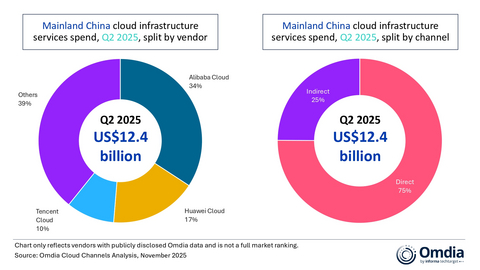
According to Omdia, mainland China’s cloud infrastructure services market reached $12.4 billion in Q2 2025, up 21% year on year, marking the first return to above-20% growth since early 2024. AI remained the primary growth engine. As AI foundation model capabilities continue to advance and toolchains mature, enterprise demand is shifting beyond basic model invocation toward more business-aligned use cases, including industry-specific models and early exploration of AI agent-based applications. Cloud providers remain optimistic on AI-driven demand and are accelerating capital investment in AI infrastructure. In Q2 2025, Alibaba Cloud, Huawei Cloud and Tencent Cloud held market shares of 34%, 17% and 10%, respectively.
Mainland China cloud infrastructure services spend, Q2 2025
Mainland China’s cloud infrastructure services market grew by more than 20% in Q2 2025, supported by exceptionally strong AI-driven customer demand. As foundation models continue to advance, enterprises are increasingly leveraging these enhanced capabilities to develop new AI-native applications. Some are also beginning to shift portions of traditional CPU-driven logic processing and data workflows to model inference engines to gain greater flexibility and automation.
“Beyond the rapid iteration of foundation model providers, we are also seeing rising demand from enterprises training their own bespoke models using proprietary data,” said Rachel Brindley, Senior Director at Omdia. “In this phase of AI transformation, sustained investment in long-term capability building is more valuable than protecting short-term margins. China’s hyperscale cloud providers are accelerating their commitments in cloud and AI infrastructure, aligning with global investment trends.”
Alibaba Cloud’s capital expenditure reached CNY 38.6 billion ($5.4 billion) in Q2, and the company plans to invest CNY 380 billion ($52.9 billion) over the next three years to expand its cloud and AI infrastructure footprint. Tencent Cloud’s capital expenditure rose 149% year on year to CNY 17.9 billion ($2.5 billion), driven primarily by increased procurement of GPUs and servers.
At the same time, as the market explores more mature pathways for AI productization, application paradigms are rapidly shifting from simple conversational interfaces to action-capable intelligent agents. To support scalable, end-to-end agent delivery, cloud vendors are accelerating the build-out of AI platforms, including Alibaba Cloud’s Agent Bay, Huawei Cloud’s Versatile and Tencent Cloud’s Agent Development Platform 3.0.
“AI agents are emerging as a meaningful extension to foundation-model capabilities,” said Yi Zhang, Senior Analyst at Omdia. “While adoption is still early, the growing availability of agent platforms is encouraging ecosystem partners to expand their roles, from simple model consumption to participating in workflow automation and task-oriented application development.”
In Q2 2025, partner-driven cloud revenue accounted for 25% of the market. This share is expected to grow as ecosystem collaboration becomes a key enabler for turning AI capabilities into business value.
Alibaba Cloud retained its lead in China’s cloud infrastructure market with a 34% share, while year-on-year growth strengthened to 26%. AI-related revenue has posted triple-digit growth for eight consecutive quarters and has supported a broader rebound in its core infrastructure services. Following a series of comprehensive upgrades across the Qwen3 family in July and a wave of multimodal and toolchain enhancements in August, Alibaba Cloud introduced its flagship foundation model, Qwen3-Max, in September. With over one trillion parameters and purpose-built for complex analysis and agent-driven workloads, Qwen3-Max represents a significant advancement in its frontier-model portfolio and its ability to support enterprise-scale AI. The company also launched Agent Bay, offering a cloud-based execution environment and toolset that enables AI agents to carry out real operational tasks. Internationally, Alibaba Cloud announced plans to establish new regions in Brazil, France and the Netherlands.
Huawei Cloud maintained its position as the second-largest provider in China’s cloud infrastructure market in Q2 2025, delivering stable performance with 17% year-on-year revenue growth and an 17% market share. Its CloudMatrix architecture expanded from 384 to 8,192 GPUs, supported by new services such as AI Token Service and EMS to optimize inference-level compute and costs. In September, backed by full-stack investments in AI capabilities, Huawei Cloud continued to advance industry-specific adoption and support infrastructure across sectors such as manufacturing, finance, public sectors and automotive. To strengthen developers’ AI-native application capabilities, Huawei Cloud also enhanced ModelArts Versatile, its enterprise-grade agent platform, with full lifecycle support and seamless MCP tool integration. According to the company, this integration can increase agent development efficiency by up to 40% and reduce deployment costs by around 30%.
Tencent Cloud held a 10% share of China’s cloud infrastructure market in Q2 2025, with revenue growth accelerating as customers increased their use of GPUs and AI-related API tokens to support new workloads. In August, the company released four compact Hunyuan models (0.5B, 1.8B, 4B and 7B parameters), fully open-sourced on platforms such as GitHub and HuggingFace and designed for deployment across diverse computing environments. In September, it introduced Agent Development Platform 3.0 (ADP 3.0), an end-to-end upgrade spanning model invocation through full-chain agent development, with enhanced capabilities in reasoning, knowledge integration, workflows, multi-agent collaboration and enterprise-grade operations. Internationally, Tencent Cloud announced a $150 million investment to build its first Middle East data center in Saudi Arabia, alongside plans for a third data center in Osaka.
Omdia defines cloud infrastructure services as the sum of bare metal as a service (BMaaS), infrastructure-as-a-service (IaaS), platform-as-a-service (PaaS) and container-as-a-service (CaaS) and serverless that are hosted by third-party providers and made available to users via the Internet.
ABOUT OMDIA
Omdia, part of Informa TechTarget, Inc. (Nasdaq: TTGT), is a technology research and advisory group. Our deep knowledge of tech markets grounded in real conversations with industry leaders and hundreds of thousands of data points, make our market intelligence our clients’ strategic advantage. From R&D to ROI, we identify the greatest opportunities and move the industry forward.
A GPU (graphics processing unit) is a specialized computer chip designed to handle many calculations at once, originally for rendering images and video but now widely used for tasks like artificial intelligence, data analysis and high-performance computing. Investors watch GPU demand and prices because strong sales often signal growth for chip makers and their customers, affect profit margins and capital spending, and can forecast wider trends in gaming, AI adoption and cloud services.
bare metal as a service (bmaas)technical
A on-demand service that provides dedicated physical servers (no shared virtualization) through a self-service interface, like renting a private car instead of sharing a taxi. It matters to investors because it combines the performance and control of owning hardware with the flexibility and recurring revenue of a cloud service, making it attractive for customers with heavy compute or security needs and influencing capital costs, pricing power, and growth prospects for providers.
infrastructure-as-a-service (iaas)technical
Infrastructure-as-a-service (IaaS) is a cloud model that delivers virtual computers, storage and networking over the internet so businesses can run software without buying and maintaining physical servers. Investors watch IaaS because it converts large one-time hardware costs into ongoing, pay-as-you-go revenue, fuels fast customer growth and recurring sales for providers, and concentrates market power and operational risk among major cloud operators.
platform-as-a-service (paas)technical
Platform-as-a-service (PaaS) is a cloud offering that supplies developers with ready-made servers, storage, software tools, and runtime environments so they can build, test, and run applications without managing hardware or underlying system software. For investors, PaaS matters because it often produces recurring subscription revenue, scales with customer usage, and hinges on developer adoption and uptime—think of renting a fully equipped workshop instead of owning and maintaining one.
container-as-a-service (caas)technical
Container-as-a-service (CaaS) is a cloud offering that lets companies run and manage software packaged in lightweight, portable containers—like renting small, standardized shipping boxes for applications instead of moving whole warehouses. For investors, CaaS matters because it helps businesses deploy updates faster, scale capacity up or down cheaply, and shift fixed IT costs into predictable service fees, which can boost growth, margins and recurring revenue for providers.
serverlesstechnical
A cloud computing model where a company writes and runs pieces of application code while a cloud provider automatically handles the underlying computers and scaling, so the company doesn’t manage servers themselves. Think of it like ordering meals from a restaurant instead of stocking, cooking and cleaning a kitchen: it can lower upfront costs, speed product launches and scale with demand, but it also shifts control and dependence to the provider—factors investors watch for impacts on costs, growth and risk.
api tokenstechnical
API tokens are digital keys—short pieces of code given to software programs—to prove identity and grant access when one system talks to another. They matter to investors because they control who can access trading systems, customer data, and automated workflows; weak or compromised tokens can cause outages, data breaches or regulatory fines that hurt a company’s operations and value.
agent platformtechnical
An agent platform is a software system that hosts and coordinates autonomous software “agents” — small programs that carry out tasks like answering customer questions, routing requests, or executing trades without constant human direction. For investors it matters because these platforms can scale services quickly, create recurring revenue and competitive advantages like network effects, but they also bring operational, security and regulatory risks that affect profitability and valuation.