
Tower Begins Drilling at Rabbit North Following Logistical Delays
Tower Resources (OTCQB:TWRFF) began a new drilling program at its Rabbit North gold project near Kamloops, B.C., after logistical delays.
Sentiment and the balance of points
Rhea-AI Sentiment reads the wording of the document, how positive or negative its language is on a 1 to 5 scale. The balance of points shown with the takes weighs what the document actually discloses, so the two can disagree, for example when a trial that missed its main goal is described in upbeat language.
Rhea-AI Summary
Tower Resources (OTCQB:TWRFF) began a new drilling program at its Rabbit North gold project near Kamloops, B.C., after logistical delays. The campaign targets untested segments of the 2.7 km Thunder–Blue Sky mesothermal orogenic gold structure, with about ten holes planned to extend and better define key zones.
Positive
- New drilling program underway at Rabbit North after earlier logistical delays
- About ten drill holes planned along the Thunder–Blue Sky gold trend
- Present program will test an additional 400 m of the 2.7 km structure
- Every drilled cross-section of the structure has returned significant Au intersections to date
- Thunder–Blue Sky showing strong gold grades over notable widths from shallow drilling
- Orogenic Au system suggests potential mineralization to depths of 2–3 km
Negative
- Drilling start was postponed from late April due to logistical delays
- Extension of Hole 073 deferred because of current access restrictions near a seasonal creek
AI-generated analysis. How Rhea-AI works. Not financial advice.




Vancouver, British Columbia--(Newsfile Corp. - June 3, 2026) - Tower Resources Ltd. (TSXV: TWR) ("Tower" or the "Company") is pleased to report that the drilling program previously scheduled for late April (see April 23, 2026 press release) to advance the Company's major orogenic Au discovery on its Rabbit North property near Kamloops, B.C. (see Fig. 1) is now underway following logistical delays related to the unusually high level of exploration activity in the province.
Thunder – Blue Sky Trend: A Long, Mesothermal Orogenic Au Structure
Tower is currently focusing its drilling at Rabbit North on untested segments of the Thunder-Blue Sky trend, an ENE trending, gold-rich, mesothermal orogenic structure that the Company discovered in 2023 and has traced by drilling and till gold grain sampling for 2.7 km (see Fig. 1). Only 600 metres of the structure have been drilled to date, and every hole crossing it has returned a long and/or high-grade Au intersection (see Fig. 2). The present program will test an additional 400 m of the structure.
Expected Deep Au Potential
With 2.1 km of the Thunder – Blue Sky structure not yet tested, the Company is still focused on the top 250 metres. However, orogenic Au systems are generally subvertical and run much deeper than porphyry and epithermal systems (see Fig. 3) because the Au-scavenging fluids originate in the mantle and rise through thick, accreted continental crust (see Figs. 3b, c) rather than thin oceanic crust (see Fig. 3a), stripping Au from the crustal rocks and precipitating it within 10 km of surface as they flow through the 2 to 3 km thick mesothermal temperature-pressure window (see Fig. 3c). As a result, the depths of mesothermal Au deposits commonly reach 2 to 3 km and in many cases are greater than their lengths.
Many of the world's top Au deposits are of this type irrespective of their ages. They include the 2 to 3 km deep mines at Timmins and Kirkland in the Archean Abitibi greenstone belt and the much younger (Cretaceous) Bralone deposit in B.C. which was mined to 1.9 km, yielded 4.1 Moz of Au at a very high average grade of 0.5 opt, and remains open at depth. While the Thunder - Blue Sky structure is notable for its exceptional 2.7 km length and has consistently yield strong gold grades over attractive widths from shallow drilling, its full potential is expected to be realized at depth.
Current Drilling Focused on Two Untested Gaps in the Thunder – Blue Sky Trend
As explained in the April 23 press release, approximately ten holes are planned, mainly to extend the Thunder gold zone southwest toward the Durand Creek Fault and partially close the untested gap between the Thunder North and Blue Sky zones (see Fig. 2).
The first hole, No. 074 on the Thunder zone, has intersected at least two strongly deformed and pyritized intervals (see Fig. 4) typical of both this zone and Thunder North.
A planned extension to Hole 073, which was started at Thunder North at the end of the December 2025 drilling program, has been deferred until a study of current access restrictions along a seasonal creek in this area has been completed. Drilling closer to the creek should then be possible, allowing for shorter and better placed holes in the Company's next drilling program.
Methods and Qualified Person
The technical content of this news release has been reviewed and approved by Stuart Averill, P.Geo., a director of the Company and a Qualified Person as defined by National Instrument 43-101.
About Tower Resources
Tower is a Canadian based mineral exploration company focused on the discovery and advancement of economic mineral projects in the Americas. The Company's key exploration assets, all in B.C., are the Rabbit North orogenic gold and porphyry copper-gold project located between the New Afton copper-gold and Highland Valley copper mines in the Kamloops mining district, the Nechako porphyry-associated gold-silver project near Artemis' Blackwater project and the More Creek epithermal gold project on the critical "red line" structural zone connecting the mineral deposits of the Golden Triangle.
On behalf of the Board of Directors
Tower Resources Ltd.
Joe Dhami, President and CEO
(778) 996-4730
www.towerresources.ca
Reader Advisory
This news release may contain statements which constitute "forward-looking information", including statements regarding the plans, intentions, beliefs and current expectations of the Company, its directors, or its officers with respect to the future business activities of the Company. The words "may", "would", "could", "will", "intend", "plan", "anticipate", "believe", "estimate", "expect" and similar expressions, as they relate to the Company, or its management, are intended to identify such forward-looking statements. Investors are cautioned that any such forward-looking statements are not guarantees of future business activities and involve risks and uncertainties, and that the Company's future business activities may differ materially from those in the forward-looking statements as a result of various factors, including, but not limited to, fluctuations in market prices, successes of the operations of the Company, continued availability of capital and financing and general economic, market or business conditions. There can be no assurances that such information will prove accurate and, therefore, readers are advised to rely on their own evaluation of such uncertainties. The Company does not assume any obligation to update any forward-looking information except as required under the applicable securities laws.
Neither TSX Venture Exchange nor its Regulation Services Provider (as that term is defined in policies of the TSX Venture Exchange) accepts responsibility for the adequacy or accuracy of this release.
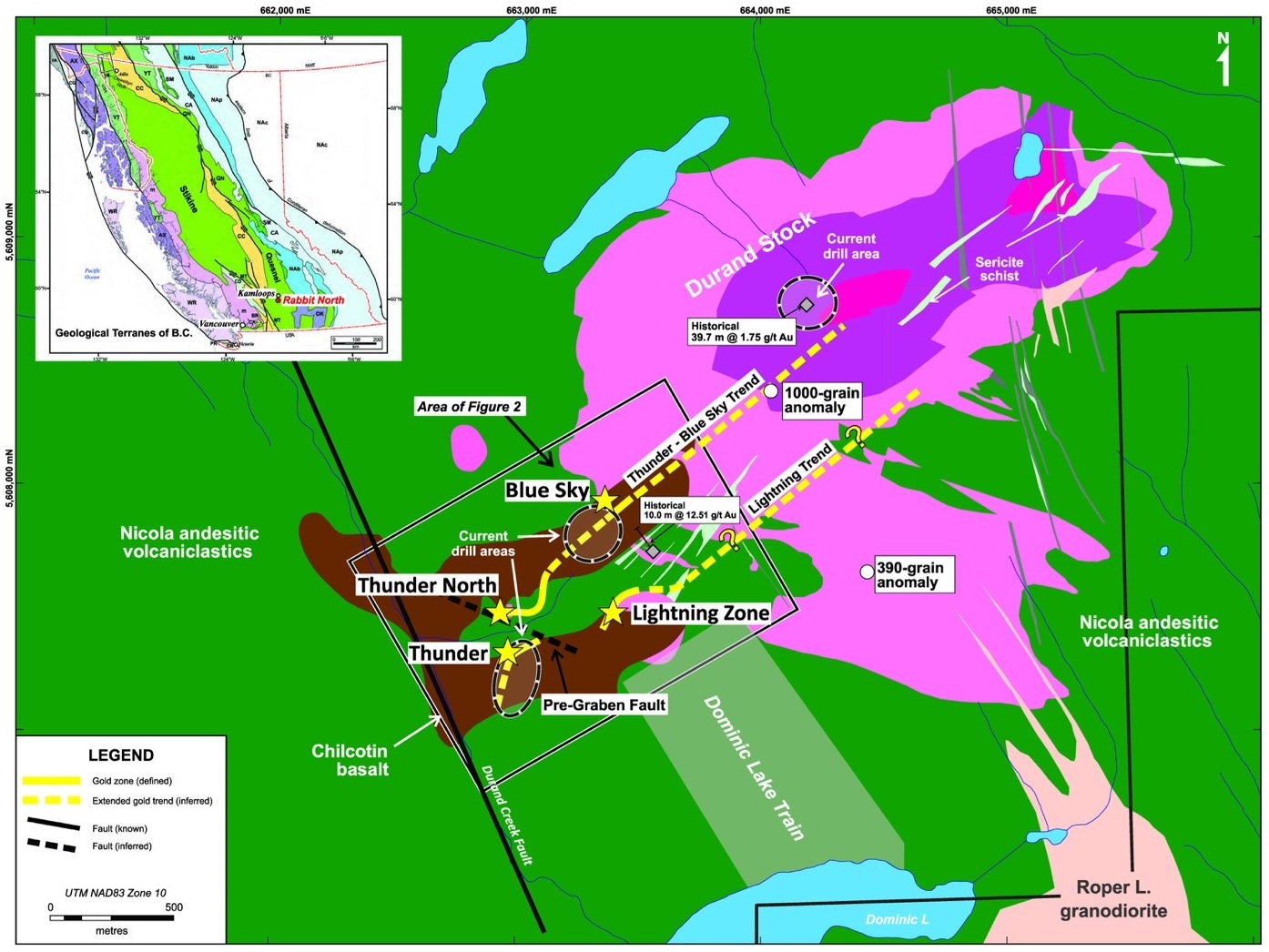
Figure 1 – Location of the Rabbit North property showing the geology of the central part and the major shear structures controlling Tower's gold discoveries. These shear zones are roughly coincident with more recent graben fault valleys that have been infilled by Chilcotin basalt flows. The yellow stars mark the locations of the main Au intersections in the initial discovery holes on the gold zones. Areas targeted in the current drill program are highlighted.
To view an enhanced version of this graphic, please visit:
https://images.newsfilecorp.com/files/5023/299917_twr-1.jpg
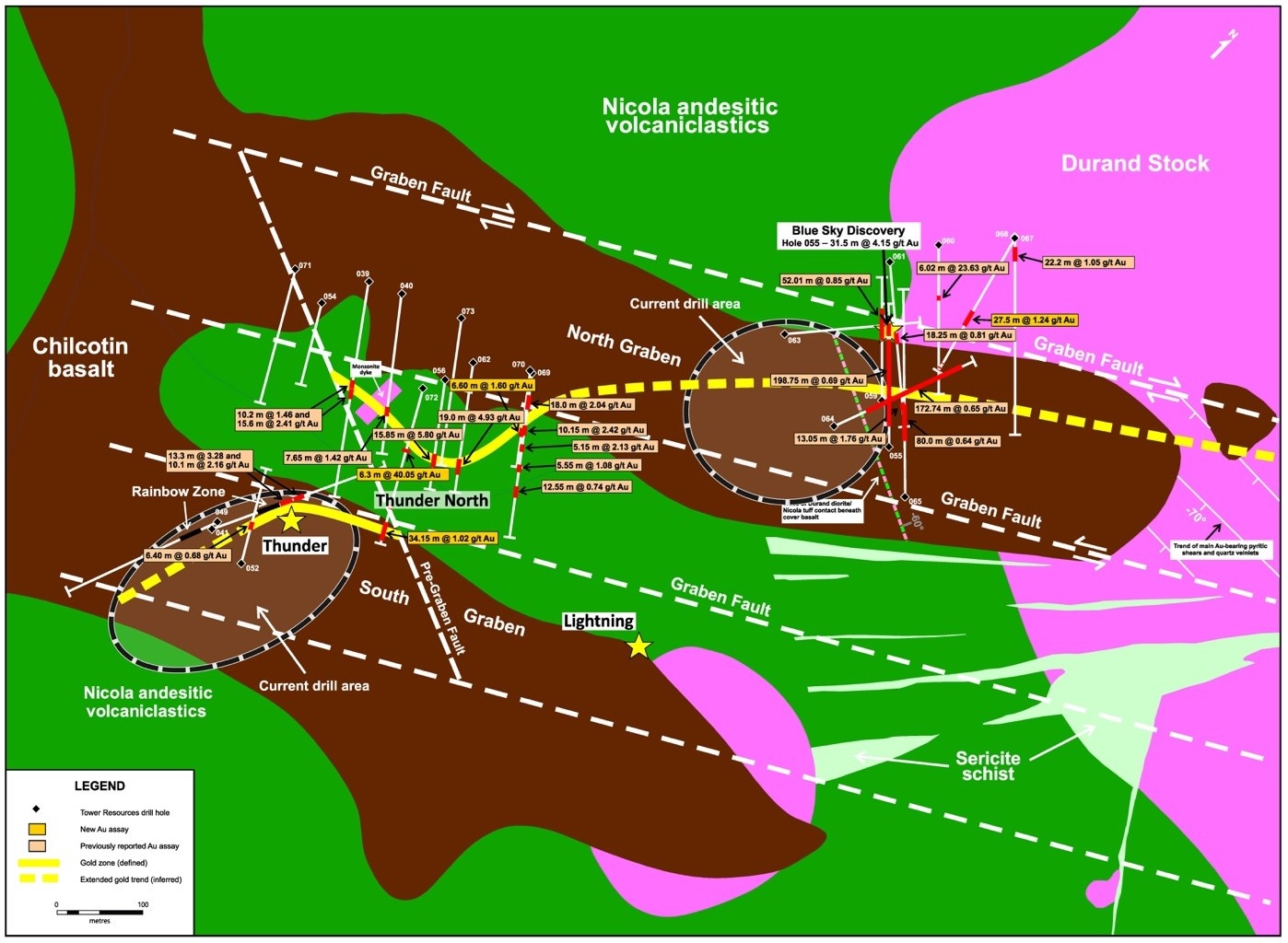
Figure 2 – Significant gold intersections in the Thunder and Thunder North zones. Areas targeted in the current drill program are highlighted. See Fig. 1 for bedrock lithologies and expanded legend.
To view an enhanced version of this graphic, please visit:
https://images.newsfilecorp.com/files/5023/299917_twr-2.jpg
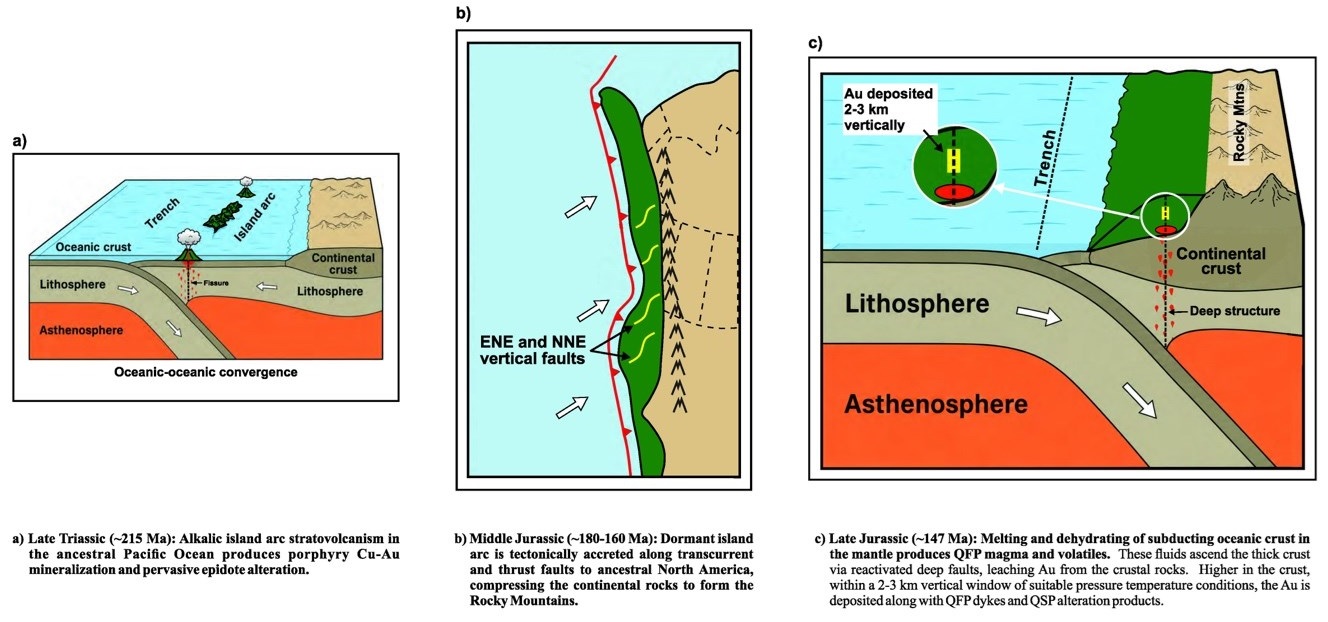
Figure 3 – Schematic block model depicting the evolution of the geology and mineral deposits of the Rabbit North property.
To view an enhanced version of this graphic, please visit:
https://images.newsfilecorp.com/files/5023/299917_twr-3.jpg
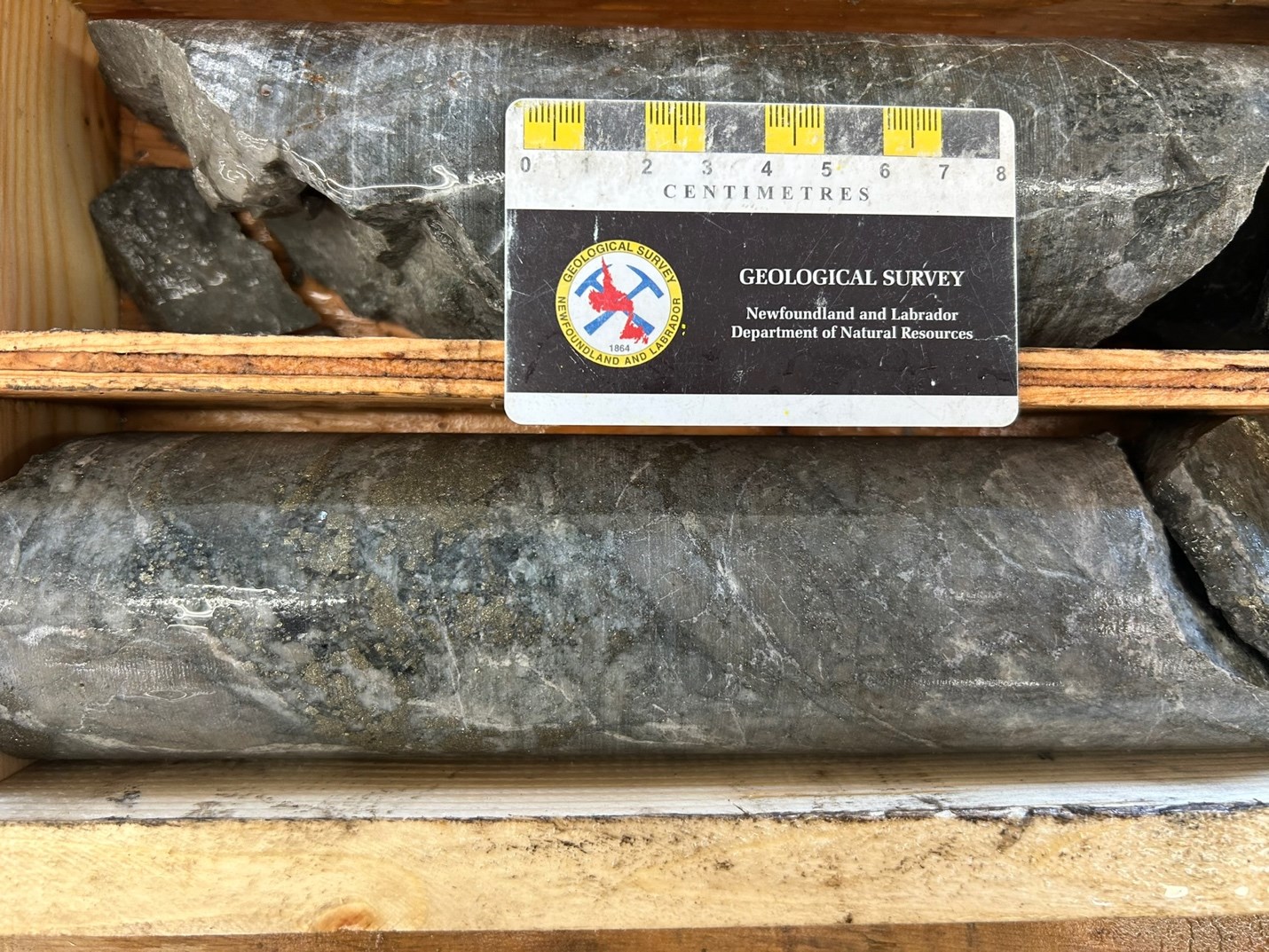
Figure 4 – Deformed and quartz-sericite-pyrite (QSP) altered core from ~138.5 m down-hole in Hole RN26-074. Such deformation and alteration are typical of the the Thunder and Thunder North gold zones.
To view an enhanced version of this graphic, please visit:
https://images.newsfilecorp.com/files/5023/299917_6eb91c0bc4811b66_004full.jpg
To view the source version of this press release, please visit https://www.newsfilecorp.com/release/299917
FAQ
AI-generated questions and answers. How Rhea-AI works. Not financial advice.