
Tower Obtains Five Strong Gold Intersections up to 12.5 m Wide in Hole 081 at Thunder North and Discovers Fourth Cu-Au Breccia Pipe
The archaeological survey opens previously restricted ground for more effective drill placement and testing of upper gold zones.
Sentiment and the balance of points
Rhea-AI Sentiment reads the wording of the document, how positive or negative its language is on a 1 to 5 scale. The balance of points shown with the takes weighs what the document actually discloses, so the two can disagree, for example when a trial that missed its main goal is described in upbeat language.
Rhea-AI Summary
Tower Resources (TWRFF) reported five gold intersections in Hole 081 at Thunder North and discovered a fourth copper-gold breccia pipe.
At Rabbit North in British Columbia, Hole 081 returned 26.1 grams per tonne (g/t) gold over 1.2 metres, 6.10 g/t over 4.1 metres and 2.90 g/t over 5.5 metres. Two broader intervals returned 1.40 g/t over 12.5 metres and 1.38 g/t over 12.2 metres. Holes 079 and 080 intersected the new pipe, including 0.16% copper and 0.16 g/t gold over 68.5 metres in Hole 080, but each yielded only one moderately mineralized gold section along Blue Sky.
Tower considers the four pipes evidence of a possible copper-gold deposit roughly 1 kilometre deeper, but plans to prioritize near-surface gold exploration. An archaeological survey reduced potentially sensitive areas where drilling was restricted by approximately 95%.
How this balance works
Rhea-AI gives every point it takes from this document a weight. Minor counts 1, Moderate 3 and Major 9, so one Major point outweighs several Minor ones. The bar adds up the weights on each side, and when neither side holds more than 65% of the total the balance reads Mixed.
It reads the document as published, with the same rules for every company, and it does not look at what the market expected or at how the stock traded, so a point can be objectively good on a day the stock falls.
Rhea-AI Sentiment measures something else, the tone of the wording.
Hollow bars mark forward-looking points. How the balance works
Positive
- Moderate pointHole 081 returned 26.1 g/t gold over 1.2 metres at Thunder North.
- Moderate pointFour pipes within 1 square kilometre suggest a possible deeper copper-gold deposit, in Tower's assessment.
- Minor pointHole 081 returned 6.10 g/t gold over 4.1 metres, including 20.40 g/t over 1.10 metres.
- Minor pointHole 081 returned 2.90 g/t gold over 5.5 metres in an upper interval.
- Minor pointHole 081 intersected 1.40 g/t gold over 12.5 metres.
10 minor points
- Minor pointHole 081 intersected 1.38 g/t gold over 12.2 metres.
- Minor pointHole 079 intersected 2.82 g/t gold over 3.1 metres in Lower Blue Sky.
- Minor pointHole 080 intersected 0.91 g/t gold over 5.5 metres in Upper Blue Sky.
- Minor pointFourth copper-gold pipe discovery included 0.10% copper and 0.20 g/t gold over 18 metres in Hole 079.
- Minor pointHole 080's pipe interval returned 0.16% copper and 0.16 g/t gold over 68.5 metres.
- Minor pointHole 080's deeper pipe section returned 0.41% copper and 0.21 g/t gold over 8.8 metres.
- Minor point. Forward-looking: it has not happened yet and may not happen.Tower plans to expand near-surface gold discoveries and demonstrate their economic potential.
- Minor pointArchaeological survey reduced potentially sensitive areas restricting drilling by approximately 95%, enabling better drill placement.
- Minor point. Forward-looking: it has not happened yet and may not happen.Completed drone LIDAR terrain survey is expected to identify previously unrecognized mineralization-related structures.
- Minor pointCompleted mapping and prospecting found high-grade gold samples in transported boulders and in-situ diorite outcrops.
Negative
- Minor point. Forward-looking: it has not happened yet and may not happen.Blue Sky Holes 079 and 080 each encountered only one moderately mineralized gold section; further drilling is required.
- Minor pointHole 080's copper-gold pipe was cut off by a 39.2-metre-wide dyke.
- Minor pointAssay reporting was delayed by unavailable experienced core cutters; remaining core cutting finished in late September.
AI-generated analysis. How Rhea-AI works. Not financial advice.


Highlights include 6.10 g/t Au over 4.1 m, 26.1 g/t Au over 1.2 m and 2.90 g/t Au over 5.5 m; four breccia pipes within a 1 km² area indicate the possible presence of a significant porphyry Cu-Au deposit at depth
Vancouver, British Columbia--(Newsfile Corp. - November 5, 2026) - Tower Resources Ltd. (TSXV: TWR) ("Tower" or the "Company") is pleased to report assay results from the final three holes, Nos. 079, 080 and 081, of the June diamond drilling program on the Company's Rabbit North property near Kamloops, B.C. (see Fig. 1), notably five Au intersections up to 12.5 m wide at a minimum Au grade of 1.4 g/t in Hole 081 on the Thunder North Zone, including three high-grade intervals of 6.10 g/t Au over 4.1 m, 26.1 g/t Au over 1.2 m and 2.90 g/t Au over 5.5 m.
In addition, Holes 079 and 080 intersected a new Cu-Au breccia pipe near the Blue Sky gold zone ‒ the fourth such pipe discovered by the Company piercing the Nicola volcaniclastic rocks within a 1 km2 area west of the Durand Stock (see Fig. 1), indicating the former existence at depth of a large hydrothermal reservoir primed with Cu and Au, and thus the possible presence of a significant, wholly preserved porphyry Cu-Au deposit ~1 km below the current drill holes.
To further guide the next drilling programs, the Company recently completed a drone LIDAR survey and detailed geological mapping and boulder prospecting along the Thunder North ‒ Blue Sky trend.
Drilling Summary
The Company's June drilling program comprised eight holes totaling 2303.5 m, all targeting extensions of the Company's Thunder, Thunder North and Blue Sky gold discoveries. The results from the first three holes, Nos. RN26-074 to 076 west of Thunder, were released promptly (see August 13, 2026 press release) but those from the remaining five holes were delayed because less than half of the core in three holes had been cut and assayed due to unavailability of experienced core cutters. The remaining core was cut in late September. The assays for Holes 077 and 078 west of the Blue Sky zone were reported in an October 15, 2026 press release. The remaining assays, for Holes 079 and 080 further west of Blue Sky and Hole 081 at Thunder North, are presented herein.
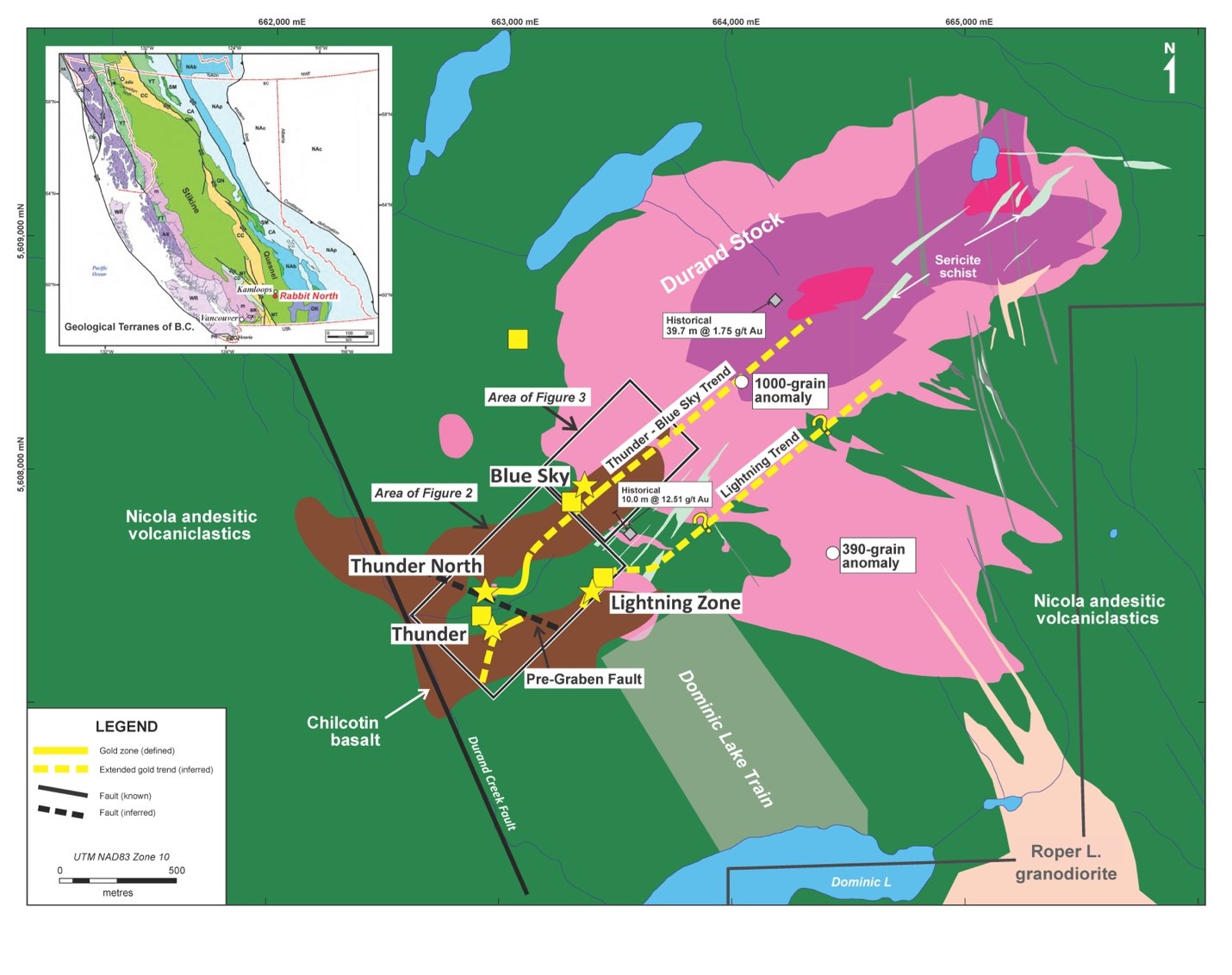
Figure 1 ‒ Location of the Rabbit North property showing the geology of the central part and the major shear structures controlling Tower's gold discoveries. These shear zones are roughly coincident with more recent graben fault valleys that have been infilled by Chilcotin basalt flows. The yellow stars mark the locations of the main Au intersections in the initial discovery holes on the gold zones. Intersected Cu-Au breccia pipes are shown as yellow squares.
To view an enhanced version of this graphic, please visit:
https://images.newsfilecorp.com/files/5023/322526_06560eb554f1aa8c_001full.jpg
Hole 081, Thunder North
Hole 081 was drilled to on the eastern part of the Thunder North Zone to replace Hole 073 of the December, 2025 drilling program which was stopped short of the gold zone for the holiday break (see March 18, 2026 press release). The five significant Au intersections obtained from the replacement hole include three within a 52 m span centered on the Thunder North structure and two higher in the hole near the Chilcotin cover basalts. In plan view (see Fig. 2), this gold distribution pattern is suggestive of a fold with its nose ~50 m to the northeast and the shallow gold intersections on the northwestern limb and deeper intersections on the southeastern limb. Alternatively, since the cover basalts occupy a fault-controlled paleovalley, it could be due to fault repetition of a single gold zone.
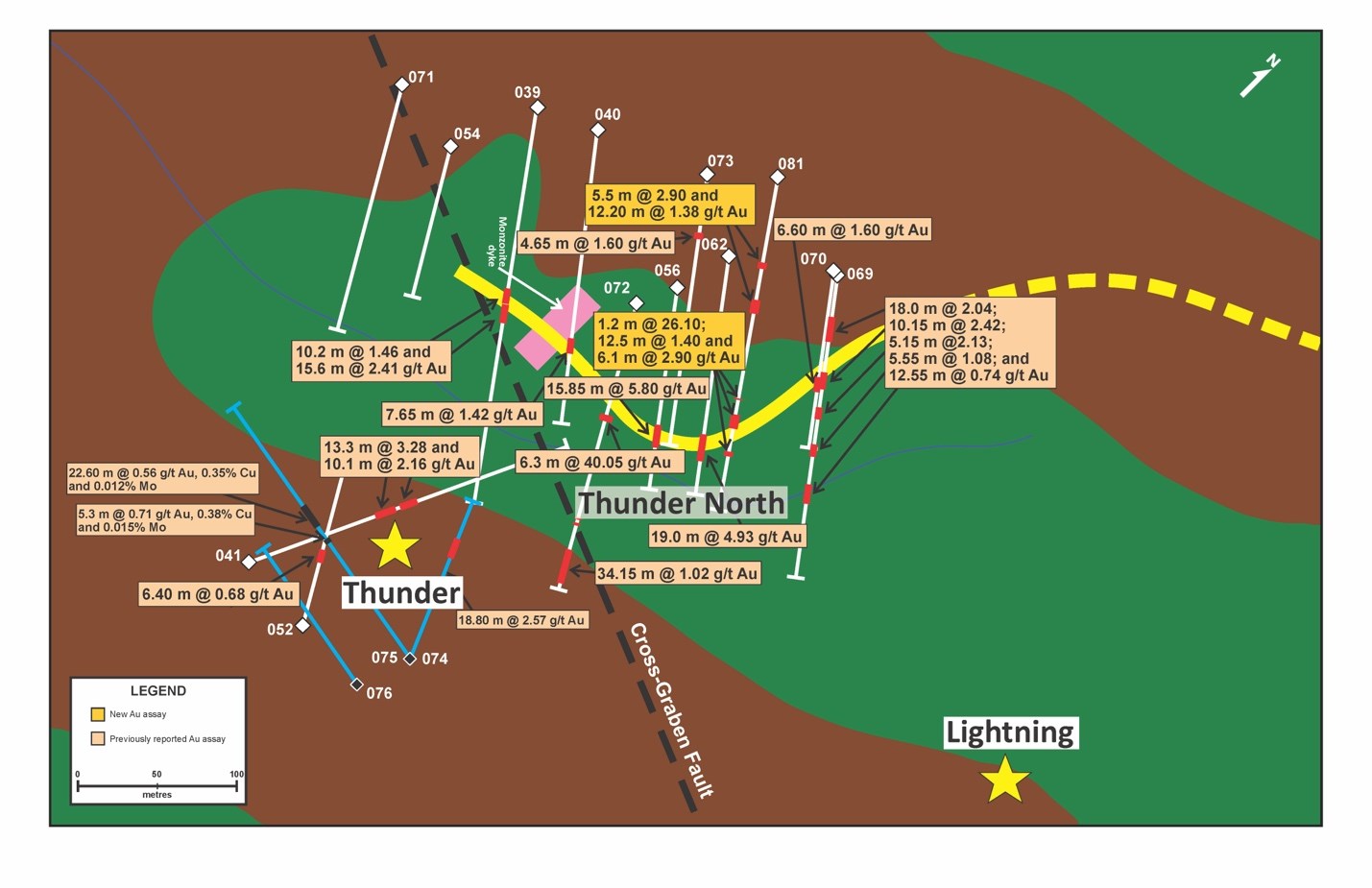
Figure 2 ‒ Significant gold intersections in Hole 081 relative to previously reported intersections of the Thunder and Thunder North zones. See Fig. 1 for bedrock lithologies and expanded legend.
To view an enhanced version of this graphic, please visit:
https://images.newsfilecorp.com/files/5023/322526_06560eb554f1aa8c_002full.jpg
The upper two gold intersections, beginning 44 and 77 m below the basalt, averaged 2.90 g/t Au over 5.5 m and 1.38 g/t Au over 12.2 m, respectively (see Table 1). A third, potentially significant intersection closer to the basalt averaged 0.86 g/t Au over 4.2 m. Most of the earlier holes to the west did not intersect these upper gold horizons (see Fig. 2), apparently because the holes were collared too far southeast.
The three deeper gold intervals, beginning 198.8, 213.3 and 246.0 m down-hole, averaged 26.1 g/t Au over 1.2 m, 1.40 g/t Au over 12.5 m and 6.10 g/t Au over 4.1 m, respectively.
| Total Depth (m) | Mineralized Interval(s) | Cu (%) | Average Au Grade (g/t) | Au x m | ||||||||
| Hole No. | Easting (m) | Northing (m) | Azimuth (°) | Dip (°) | Mineralized Zone(s) | From (m) | To (m) | Length (m) | ||||
| RN-25-079 | 663362 | 5607786 | 315.20 | -59.2 | 270.00 | Upper Blue Sky | 69.70 | 105.50 | 35.80 | 0.17 | ||
| Upper Blue Sky | 119.00 | 141.00 | 24.00 | 0.18 | ||||||||
| Cu-Au breccia pipe | 143.00 | 161.00 | 18.00 | 0.10 | 0.20 | |||||||
| Lower Blue Sky | 230.60 | 233.70 | 3.10 | 2.82 | ||||||||
| RN-25-080 | 663331 | 5607744 | 314.47 | -69.9 | 287.00 | Upper Blue Sky | 59.50 | 65.00 | 5.50 | 0.91 | ||
| Cu-Au breccia pipe | 136.50 | 205.00 | 68.50 | 0.16 | 0.16 | |||||||
| RN-25-081 | 663010 | 5607639 | 145.16 | -44.4 | 299.00 | Thunder North | 47.00 | 51.20 | 4.20 | 0.86 | ||
| Thunder North | 77.00 | 82.50 | 5.50 | 2.90 | 16 | |||||||
| Thunder North | 110.50 | 122.70 | 12.20 | 1.38 | 17 | |||||||
| Thunder North | 198.80 | 200.00 | 1.20 | 26.10 | 31 | |||||||
| Thunder North | 213.30 | 225.80 | 12.50 | 1.40 | 18 | |||||||
| Thunder North | 246.60 | 250.70 | 4.10 | 6.10 | 25 | |||||||
| including | 248.50 | 249.60 | 1.10 | 20.40 | ||||||||
Table 1 ‒ Significant orogenic Au and pre-orogenic Cu-Au intercepts from Rabbit North Holes 079, 080 and 081. Gold grade (in g/t) x core width (in metres) greater than 10 are also shown. Gold values are uncut. Samples with Au grades greater than 15 g/t are shown individually. True widths have not been determined. See Figure 2 for hole locations.
Holes 079 and 080, Blue Sky
Holes 079 and 080 were drilled 50 and 100 m southwest along the Blue Sky gold trend from Holes 077 and 078 which had successfully extended the Blue Sky Zone by 50 m with intersections of up to 20.3 m of 3.13 g/t Au from the Upper Domain of the zone and 134 m of 0.65 g/t Au from the Lower Domain (see Fig. 3 and October 15, 2026 press release).
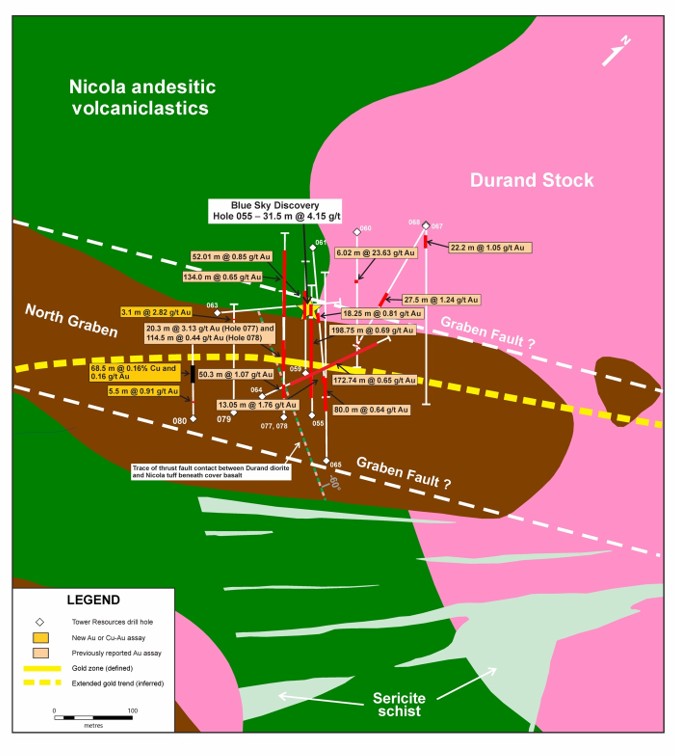
Figure 3 ‒ Locations of Holes 079 and 080 relative to the Blue Sky gold zone. See Fig. 1 for bedrock lithologies and expanded legend.
To view an enhanced version of this graphic, please visit:
https://images.newsfilecorp.com/files/5023/322526_3.jpg
As expected, both holes intersected the Blue Sky gold trend with its characteristic syn-mineralization quartz-feldspar porphyry (QFP) dykes, quartz-sericite-pyrite (QSP) alteration and wide intervals of strongly anomalous Au values, especially in Hole 079 (38.5 m of 0.17 g/t Au and 24 m of 0.18 g/t Au; see Table 1). However, each hole encountered only a single, moderately mineralized section (3.1 m of 2.82 g/t Au in Hole 079, 5.5 m of 0.91 g/t Au in Hole 080). More drilling is required to determine whether this is due to the apparent folding of the Blue Sky Zone into a more northerly direction noted at Holes 077 and 078 in the October 15, 2026 press release, thus bypassing Holes 079 and 080, or is just an example of the local variability seen in most orogenic gold deposits.
Both holes did, however, intersect a pre-orogenic Cu-Au breccia pipe, adding to the three pipes previously intersected by the Company. The Hole 079 intersection is 18 m wide and averages
Next Steps
Although the potential for a significant, pre-orogenic porphyry Cu-Au deposit at a depth of roughly 1 km appears to be high, the Company's immediate plans are to maintain its current focus on expanding and demonstrating the economic potential of its near-surface Au discoveries.
The next drilling program will benefit from three initiatives recently completed by the Company:
An archaeological survey, which successfully reduced by ~
95% the potentially sensitive areas where drilling was previously restricted. This will allow more effective and efficient placement of the drill holes, including short holes to measure the Au resources within the previously untested uppermost levels of the Thunder North and Blue Sky Zones.A drone LIDAR survey that, through its capacity to accurately map the terrain surface through forest cover, is expected to reveal previously unrecognized structural lineaments associated with the orogenic Au mineralization. Delivery of the LIDAR maps is expected shortly.
Detailed geological mapping and boulder prospecting along the eastern projection of the Blue Sky gold trend through the Durand Stock. The just-received Au assays reveal high grades in samples of both transported boulders and in-situ diorite outcrops, reinforcing the strong gold-grain anomalies (up to 1001 grains per sample; see November 3, 2025 press release) obtained from the boulder-bearing glacial till that covers most of the bedrock surface. The results are currently being assessed and will be presented in a separate press release.
Methods and Qualified Person
The drill core was logged at Tower's leased, fully equipped core facility near Kamloops under the direction Matthew Husslage, P.Geo. Mr. Husslage has managed or co-managed all of Tower's Rabbit North diamond drilling programs since the discovery of the Lightning Zone in December 2021.
Split samples of the core, generally 1.0 or 1.5 m in length, were delivered directly to Activation Laboratories (ActLabs) in Kamloops, BC, a laboratory certified as ISO/IEC 17025 Accredited (Lab 790) by the Standards Council of Canada. QA/QC samples including blanks and standards were inserted regularly into the sample sequence at a ratio of approximately 1:20.
The samples were analyzed for Au by fire assay and ICP-OES and for Ag and 36 additional elements by ICP-OES using a four-acid, near-total digestion. Any over-limit (>5 g/t) Au analyses were repeated using the same fire assay procedure but with a gravimetric rather than ICP finish.
The technical content of this news release has been reviewed and approved by Stuart Averill, P.Geo., a director of the Company and a Qualified Person as defined by National Instrument 43-101.
About Tower Resources
Tower is a Canadian based mineral exploration company focused on the discovery and advancement of economic mineral projects in the Americas. The Company's key exploration assets, all in B.C., are the Rabbit North orogenic gold and porphyry copper-gold project located between the New Afton copper-gold and Highland Valley copper mines in the Kamloops mining district, the Nechako porphyry-associated gold-silver project near Artemis' Blackwater project and the More Creek epithermal gold project on the critical "red line" structural zone connecting the mineral deposits of the Golden Triangle.
On behalf of the Board of Directors
Tower Resources Ltd.
Joe Dhami, President and CEO
(778) 996-4730
www.towerresources.ca
Reader Advisory
This news release may contain statements which constitute "forward-looking information", including statements regarding the plans, intentions, beliefs and current expectations of the Company, its directors, or its officers with respect to the future business activities of the Company. The words "may", "would", "could", "will", "intend", "plan", "anticipate", "believe", "estimate", "expect" and similar expressions, as they relate to the Company, or its management, are intended to identify such forward-looking statements. Investors are cautioned that any such forward-looking statements are not guarantees of future business activities and involve risks and uncertainties, and that the Company's future business activities may differ materially from those in the forward-looking statements as a result of various factors, including, but not limited to, fluctuations in market prices, successes of the operations of the Company, continued availability of capital and financing and general economic, market or business conditions. There can be no assurances that such information will prove accurate and, therefore, readers are advised to rely on their own evaluation of such uncertainties. The Company does not assume any obligation to update any forward-looking information except as required under the applicable securities laws.
Neither TSX Venture Exchange nor its Regulation Services Provider (as that term is defined in policies of the TSX Venture Exchange) accepts responsibility for the adequacy or accuracy of this release.
To view the source version of this press release, please visit https://www.newsfilecorp.com/release/322526
FAQ
AI-generated questions and answers. How Rhea-AI works. Not financial advice.
What gold grades did Tower Resources report in Thunder North Hole 081?
Hole 081 returned 26.1 g/t gold over 1.2 metres, 6.10 g/t over 4.1 metres, 2.90 g/t over 5.5 metres, 1.40 g/t over 12.5 metres and 1.38 g/t over 12.2 metres. These are core intervals; true widths have not been determined.
What did Tower Resources discover in the new Rabbit North copper-gold pipe?
Holes 079 and 080 intersected a fourth copper-gold breccia pipe. Hole 079 returned 0.10% copper and 0.20 g/t gold over 18 metres; Hole 080 returned 0.16% copper and 0.16 g/t gold over 68.5 metres.
How does Tower Resources interpret the gold distribution in Hole 081?
Tower considers folding or fault repetition possible explanations for the gold distribution. The fold interpretation places its nose approximately 50 metres northeast, with shallow and deeper intersections on different limbs. Alternatively, faulting could have repeated a single gold zone.
Why does Tower Resources need more drilling at Blue Sky?
Further drilling is needed to distinguish between a change in the zone's direction and local gold variability. Tower suggests the apparent folding toward a more northerly direction could have caused the zone to bypass Holes 079 and 080, rather than their results simply reflecting local variability.