
Vertiv Brings Converged Physical Infrastructure to NVIDIA Vera Rubin DSX AI Factories
Vertiv (NYSE: VRT) announced collaboration with NVIDIA on converged physical infrastructure for the NVIDIA Vera Rubin DSX AI factory and Omniverse DSX Blueprint on March 16, 2026.
Rhea-AI Summary
Vertiv (NYSE: VRT) announced collaboration with NVIDIA on converged physical infrastructure for the NVIDIA Vera Rubin DSX AI factory and Omniverse DSX Blueprint on March 16, 2026. Vertiv will supply simulation-ready DSX SimReady power and cooling assets, validated interfaces, and repeatable building blocks based on 12.5MW OneCore modules to speed deployment and reduce integration risk.
The design approach integrates power, cooling, controls, digital continuity, and lifecycle support to help scale from small clusters to gigawatt-scale AI factories and improve confidence before physical buildout.
Positive
- Simulation-ready DSX SimReady power and cooling assets for AI factories
- Standardized 12.5MW OneCore infrastructure blocks supporting scalable deployments
- Validated interfaces and repeatable building blocks to reduce integration risk and speed deployment
- Design supports scaling from small clusters to gigawatt-scale AI factories
Negative
- No commercial terms, customer contracts, or financial impacts disclosed in the announcement
- No timelines or firm deployment commitments provided for specific customer projects
Details
News Market Reaction – VRT
In the Mar 17 session, VRT gained 1.39%, reflecting a mild positive market reaction.
Data tracked by StockTitan Argus on the day of publication.
Key Figures
- Share price
- $264.74
- As of latest pre-news market data
- Daily move
- 3.11%
- Price change over prior 24 hours
- Trading volume
- 7,301,882 shares
- Today vs 20-day average 6,909,321
- 52-week high
- $276.78
- High over last 52 weeks
- 52-week low
- $53.60
- Low over last 52 weeks
- 200-day MA
- $164.44
- 200-day moving average level
- Infrastructure block size
- 12.5 MW
- Standardized Vertiv OneCore integrated modular block
- Senior notes offering
- $2.1 billion
- Senior unsecured notes completed Mar 3, 2026
Previous AI Reports
-
Introduced high-capacity double-stack busway for AI and dense data centers.
-
Launched Vertiv Next Predict AI-powered predictive maintenance managed service.
-
Published Vertiv Frontiers report on AI-driven data center design trends.
-
Showcased OCP-compliant racks, power, cooling for high-density AI deployments.
-
Highlighted modular AI/HPC power and cooling ecosystem at OCP Global Summit.
24h Move is the share-price change in the day after each event; other market factors may also have contributed.
AI-generated analysis. How Rhea-AI works. Not financial advice.




Simulation-ready power and cooling infrastructure models, designed to accelerate deployment and reduce execution risk
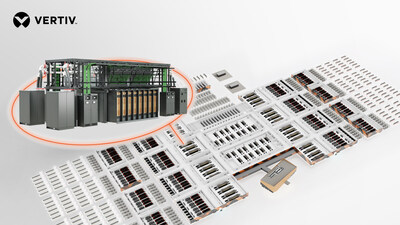
As AI factories scale in density, complexity, and power demand, operators are under pressure to compress time to deployment, improve infrastructure utilization, and reduce integration risk. A new infrastructure design approach that reduces complexity, improves confidence before buildout, and accelerates time to capacity is now available to meet these evolving needs. Through its work with NVIDIA, Vertiv is contributing simulation-ready, or DSX SimReady digital power and cooling assets, validated interfaces, and repeatable infrastructure building blocks designed to help customers deploy AI factories faster and with greater operational assurance.
This work reflects an expansion of Vertiv's established approach to converged physical infrastructure—a system-level model that integrates power, cooling, controls, and services into interdependent designs optimized across the full power train and thermal chain. This approach is enabled through five foundational elements: repeatable building blocks, defined interfaces, system orchestration, digital continuity, and lifecycle support. Together, these elements support more scalable AI factory execution by helping reduce design complexity, strengthen coordination across infrastructure domains, and improve confidence from initial design through deployment and operation.
At the core of this approach is a scalable building block architecture designed around the standardized 12.5MW infrastructure blocks of Vertiv™ OneCore integrated modular solutions that can be combined, configured, and extended to support deployments ranging from smaller AI clusters to gigawatt-scale AI factories. By establishing repeatable block-level designs with validated interfaces, Vertiv aims to simplify scaling while improving deployment consistency, system coordination, and operational performance.
"AI factories are forcing a fundamental change in how digital infrastructure is designed, validated, and deployed," said Scott Armul, chief product and technology officer at Vertiv. "Vertiv's role is to help turn complex AI infrastructure from a collection of separate products into converged, simulation-ready physical systems. Working with NVIDIA, we are helping customers move faster from design to deployment. By combining our power and cooling portfolio with validated interfaces and digital models, we can help customers accelerate development, improve operational confidence, and unlock better output per watt."
Vertiv's collaboration supports the development of digitally validated AI factory infrastructure using real-time simulation and system-level modeling before physical deployment begins. This approach is designed to help customers:
- reduce deployment complexity and field integration risk,
- accelerate time to operational readiness,
- improve infrastructure coordination across power, cooling, and controls,
- and optimize performance from grid connection through chip-level thermal management and heat-reuse pathways.
Vertiv's contribution is grounded in its ability to bring together one of the industry's most complete portfolios of critical power, thermal management, integrated controls, and lifecycle services into a cohesive converged physical infrastructure. Unlike conventional modular or prefabricated approaches that primarily compress schedule, converged physical infrastructure is intended to deliver both deployment speed and compounding system-level gains. By standardizing interfaces and creating repeatable building blocks, Vertiv aims to support more scalable AI factory execution while enabling improved performance, efficiency, and reliability.
"As AI factories scale to unprecedented levels of power and density, enterprises require a converged approach to physical infrastructure that unifies power, cooling, and digital twin simulation to reduce deployment risk," said Vladimir Troy, vice president of AI Infrastructure at NVIDIA. "By integrating simulation-ready infrastructure models into the NVIDIA Vera Rubin DSX design, Vertiv is providing the repeatable building blocks and validated interfaces necessary to accelerate the path from design to operational readiness."
This collaborative output, Vertiv™ OneCore Rubin DSX, is a design outcome grounded in converged physical infrastructure that Vertiv will continue to iterate for multiple compute generations ahead. It is intended to support AI factory builders with parameterized infrastructure models and deployment-ready building blocks that span power, cooling, controls, and lifecycle services.
Vertiv expects this work to inform future converged infrastructure offerings across hyperscale, colocation, enterprise, and emerging AI deployment environments.
For more information on Vertiv solutions for AI infrastructure, visit Vertiv.com.
About Vertiv
Vertiv (NYSE: VRT) brings together hardware, software, analytics and ongoing services to enable its customers' vital applications to run continuously, perform optimally and grow with their business needs. Vertiv solves the most important challenges facing today's data centers, communication networks and commercial and industrial facilities with a portfolio of power, cooling and IT infrastructure solutions and services that extends from the cloud to the edge of the network. Headquartered in
Forward-looking statements
This release contains forward-looking statements within the meaning of the Private Securities Litigation Reform Act of 1995, Section 27 of the Securities Act, and Section 21E of the Securities Exchange Act. These statements are only a prediction. Actual events or results may differ materially from those in the forward-looking statements set forth herein. Readers are referred to Vertiv's filings with the Securities and Exchange Commission, including its most recent Annual Report on Form 10-K and any subsequent Quarterly Reports on Form 10-Q for a discussion of these and other important risk factors concerning Vertiv and its operations. Vertiv is under no obligation to, and expressly disclaims any obligation to, update or alter its forward-looking statements, whether as a result of new information, future events or otherwise.
VERTIV MEDIA CONTACT
Vertiv@ruderfinn.com

 View original content to download multimedia:https://www.prnewswire.com/news-releases/vertiv-brings-converged-physical-infrastructure-to-nvidia-vera-rubin-dsx-ai-factories-302715164.html
SOURCE Vertiv Holdings Co
FAQ
AI-generated questions and answers. How Rhea-AI works. Not financial advice.