
Eco Wave Power Reports March 2026 Production Results at Jaffa Port, Highlighting Potential to Power Coastal AI Infrastructure
Eco Wave Power (NASDAQ: WAVE) reported March 2026 production from its EWP-EDF One pilot at Jaffa Port, Israel.
Rhea-AI Summary
Eco Wave Power (NASDAQ: WAVE) reported March 2026 production from its EWP-EDF One pilot at Jaffa Port, Israel. The system ran continuously, producing more than 1,200 kWh across roughly six days of moderate (1–2m) waves.
The release highlights zero downtime since early 2025, pilot-scale durability, and potential to power coastal AI data centers using predictable nearshore wave energy.
Positive
- Produced >1,200 kWh during March operational days
- Zero downtime since early 2025 at Jaffa Port pilot
Negative
- Pilot-scale array with a limited number of small floaters limits immediate capacity
- Production cited for approximately six moderate-wave days, indicating variable monthly output
Details
News Market Reaction – WAVE
On Apr 7, the day this news came out, WAVE closed 2.48% below the previous close.
Data tracked by StockTitan Argus for the Apr 7 session.
Key Figures
- Current price
- $6.04
- Before reaction to March 2026 Jaffa Port production news
- 52-week range
- $4.41–$9.87
- Price is 38.8% below 52-week high, 36.96% above low
- Electricity generated
- more than 1,200 kWh
- March 2026, around six operational days with 1–2 meter waves
- Wave height
- 1–2 meters
- Moderate sea states during March 2026 production period
- Operational continuity
- zero downtime
- Since beginning of 2025 in wave conditions of 1 meter and above
- Volume vs. average
- 8,091 vs. 12,633
- Today’s volume vs. 20-day average before this news
- Market cap
- $34,525,671
- Equity value before incorporating impact of this announcement
- Form type
- 6-K
- Filed 2026-04-07 reporting March 2026 Jaffa Port production
Previous AI Reports
-
NVIDIA GTC keynote digital twin showcasing AI-driven modeling of wave systems.
-
NVIDIA GTC video featuring Eco Wave Power’s role in powering AI-era demand.
24h Move is the share-price change in the day after each event; other market factors may also have contributed.
Key Terms
kwh technical
digital twin technical
capacity factors technical
AI-generated analysis. How Rhea-AI works. Not financial advice.




Tel Aviv, Israel--(Newsfile Corp. - April 7, 2026) - Eco Wave Power Global AB (NASDAQ: WAVE) ("Eco Wave Power" or the "Company"), a global leader in onshore wave energy technology, today announced its wave energy production results for March 2026 at its EWP-EDF One pilot project located at Jaffa Port, Israel.
During March 2026, the system operated continuously, with approximately six days experiencing moderate wave conditions in the range of 1 to 2 meters. During these days, the project generated more than 1,200 kWh of clean, renewable electricity.
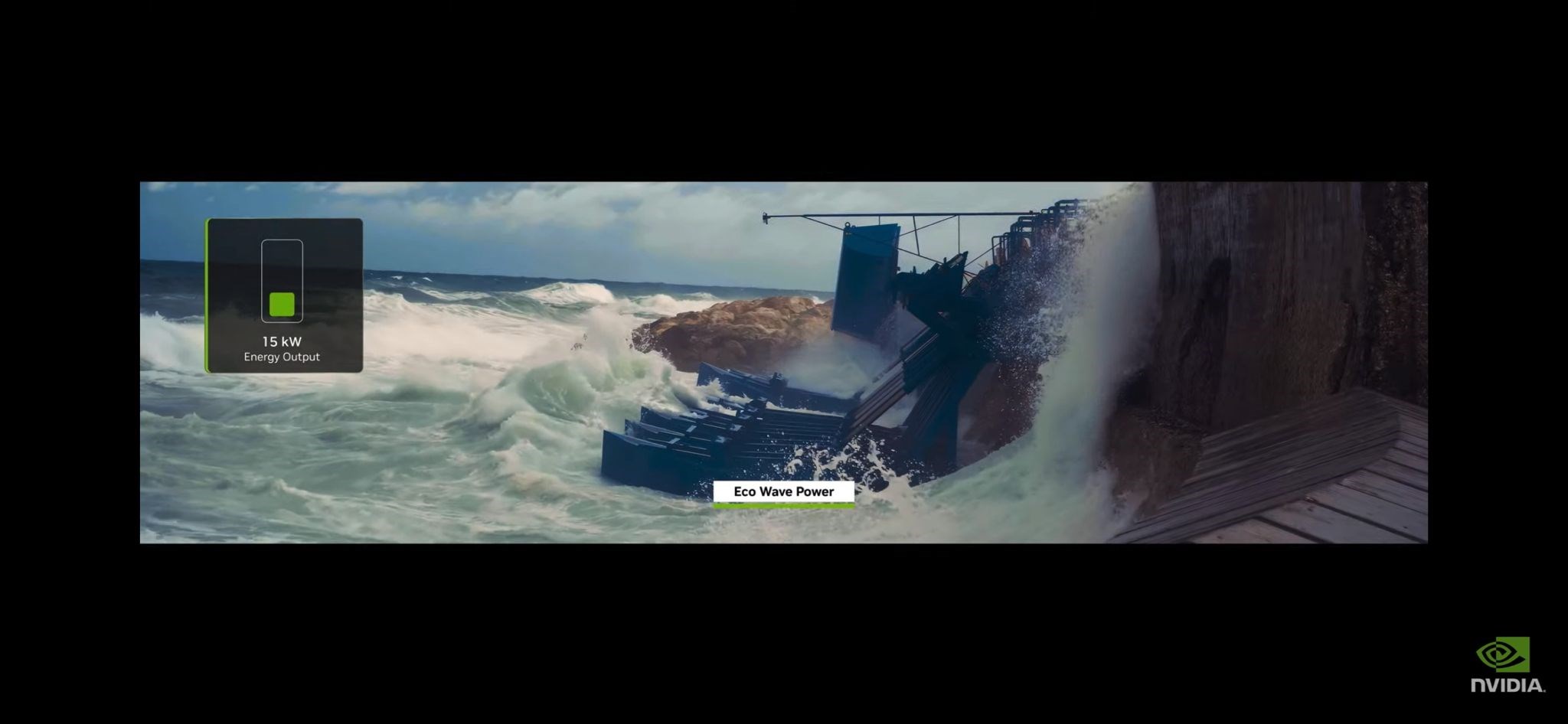
Eco Wave Power installation in Israel, as presented by Nvidia at GTC
To view an enhanced version of this graphic, please visit:
https://images.newsfilecorp.com/files/11247/291303_84d19a4594085a7d_001full.jpg
The March results are particularly notable as they reflect energy generation achieved during a limited number of operational days with moderate wave conditions, demonstrating the system's ability to efficiently convert commonly occurring sea states into electricity.
Since the beginning of 2025, the EWP-EDF One system at Jaffa Port has maintained zero downtime, with stable operation recorded in wave conditions of 1 meter and above. The March performance further validates the resilience, safety mechanisms, and production scalability of Eco Wave Power's proprietary onshore wave energy technology.
The ability to generate electricity under moderate and frequently occurring wave conditions also highlights the potential role of wave energy as a reliable power source for coastal infrastructure, including data centers.
As global demand for artificial intelligence infrastructure continues to accelerate, energy is increasingly emerging as a key constraint on growth. In a recent blog published ahead of NVIDIA's GTC conference, Jensen Huang, CEO of NVIDIA, described AI as a "five-layer cake," with energy forming its foundation. Every unit of intelligence generated in real time is ultimately dependent on continuous electricity supply, as computation, cooling, and data processing all require significant power.
Following this publication, Eco Wave Power's technology was also featured during NVIDIA GTC in the keynote presentation delivered by Jensen Huang, further highlighting the growing relevance of innovative renewable energy solutions within the AI ecosystem.
As AI models become more advanced and widely deployed, the limiting factor is no longer only algorithms or hardware, but increasingly the availability of scalable and reliable energy sources. The growing adoption of open-source models is further accelerating demand for energy across the entire AI infrastructure stack.
In this context, Eco Wave Power's ability to generate clean electricity from moderate and predictable wave conditions near shorelines positions its technology as a logical and extremely relevant solution for powering coastal data centers and supporting the next generation of AI infrastructure.
The EWP-EDF One installation at Jaffa Port is a pilot-scale demonstration array, consisting of a limited number of small-scale floaters, designed primarily to validate system durability, grid integration, and real-world production performance under varying marine conditions.
Future commercial deployments are expected to utilize significantly larger floaters and a substantially greater number of units, which are anticipated to materially enhance energy capture and increase overall capacity factors compared to pilot-scale installations.
"March continued to demonstrate the consistency and efficiency of our system, even during a limited number of operational days under moderate wave conditions," said Inna Braverman, CEO and Founder of Eco Wave Power. "The ability to generate meaningful electricity from common sea states strengthens our belief that wave energy can play an important role in supporting energy demand from rapidly growing sectors such as AI and data centers."
Eco Wave Power continues to systematically collect and analyze real-world operational data at Jaffa Port to optimize system performance and support its global project pipeline.
About Eco Wave Power Global AB (publ)
Eco Wave Power Global (NASDAQ: WAVE) is a leading onshore wave energy company that converts ocean and sea waves into clean, reliable, and cost-efficient electricity using its patented and intelligent technology. By generating renewable power directly from existing coastal infrastructure such as breakwaters, jetties, and piers, Eco Wave Power enables sustainable electricity production in close proximity to coastal cities, ports, and energy-intensive infrastructure.
As global electricity demand continues to rise with the growth of artificial intelligence, digital infrastructure, and next-generation data centers, Eco Wave Power's technology is designed to help provide renewable energy near shorelines where many data centers, industrial facilities, and population centers are located.
With a mission to accelerate the global transition to renewable energy while supporting the next generation of digital and industrial infrastructure, Eco Wave Power developed and operates Israel's first grid-connected wave energy power station, recognized as a "Pioneering Technology" by the Israeli Ministry of Energy and co-funded by EDF Power Solutions. In the United States, the Company recently launched the first-ever onshore wave energy pilot station at the Port of Los Angeles, in collaboration with Shell Marine Renewable Energy.
Eco Wave Power is expanding globally with projects planned in Portugal, Taiwan, and India, representing a project pipeline of 404.7 MW. The Company has received international recognition and support from organizations including the European Union Regional Development Fund, Innovate UK, and the EU Horizon 2020 program, and was honored with the United Nations Global Climate Action Award.
Eco Wave Power's American Depositary Shares (ADSs) are traded on the Nasdaq Capital Market under the ticker symbol "WAVE."
For more information, please visit:
www.ecowavepower.com
Press inquiries:
info@ecowavepower.com
Note: Information available on or through the websites mentioned herein does not form part of this press release.
Forward-Looking Statements
This press release contains forward-looking statements within the meaning of the "safe harbor" provisions of the U.S. Private Securities Litigation Reform Act of 1995 and other Federal securities laws. For example, the Company is using forward-looking statements in this press release when it discusses that Future commercial deployments are expected to utilize significantly larger floaters and a substantially greater number of units, which are anticipated to materially enhance energy capture and increase overall capacity factors compared to pilot-scale installations, and the belief that wave energy can play an important role in supporting energy demand from rapidly growing sectors such as AI and data centers. Forward-looking statements can be identified by words such as: "anticipate," "intend," "plan," "goal," "seek," "believe," "project," "estimate," "expect," "strategy," "future," "likely," "may," "should," "will", or variations of such words, and similar references to future periods. These forward-looking statements and their implications are neither historical facts nor assurances of future performance and are based on the current expectations of the management of Eco Wave Power and are subject to a number of factors, uncertainties and changes in circumstances that are difficult to predict and may be outside of Eco Wave Power's control that could cause actual results to differ materially from those described in the forward-looking statements. Therefore, you should not rely on any of these forward-looking statements. Except as otherwise required by law, Eco Wave Power undertakes no obligation to publicly release any revisions to these forward-looking statements to reflect events or circumstances after the date hereof or to reflect the occurrence of unanticipated events. More detailed information about the risks and uncertainties affecting Eco Wave Power is contained under the heading "Risk Factors" in Eco Wave Power's Annual Report on Form 20-F for the fiscal year ended December 31, 2025 filed with the SEC on March 12, 2026, which is available on the on the SEC's website, www.sec.gov, and other documents filed or furnished to the SEC. Any forward-looking statement made in this press release speaks only as of the date hereof. References and links to websites have been provided as a convenience and the information contained on such websites is not incorporated by reference into this press release.
To view the source version of this press release, please visit https://www.newsfilecorp.com/release/291303
FAQ
AI-generated questions and answers. How Rhea-AI works. Not financial advice.