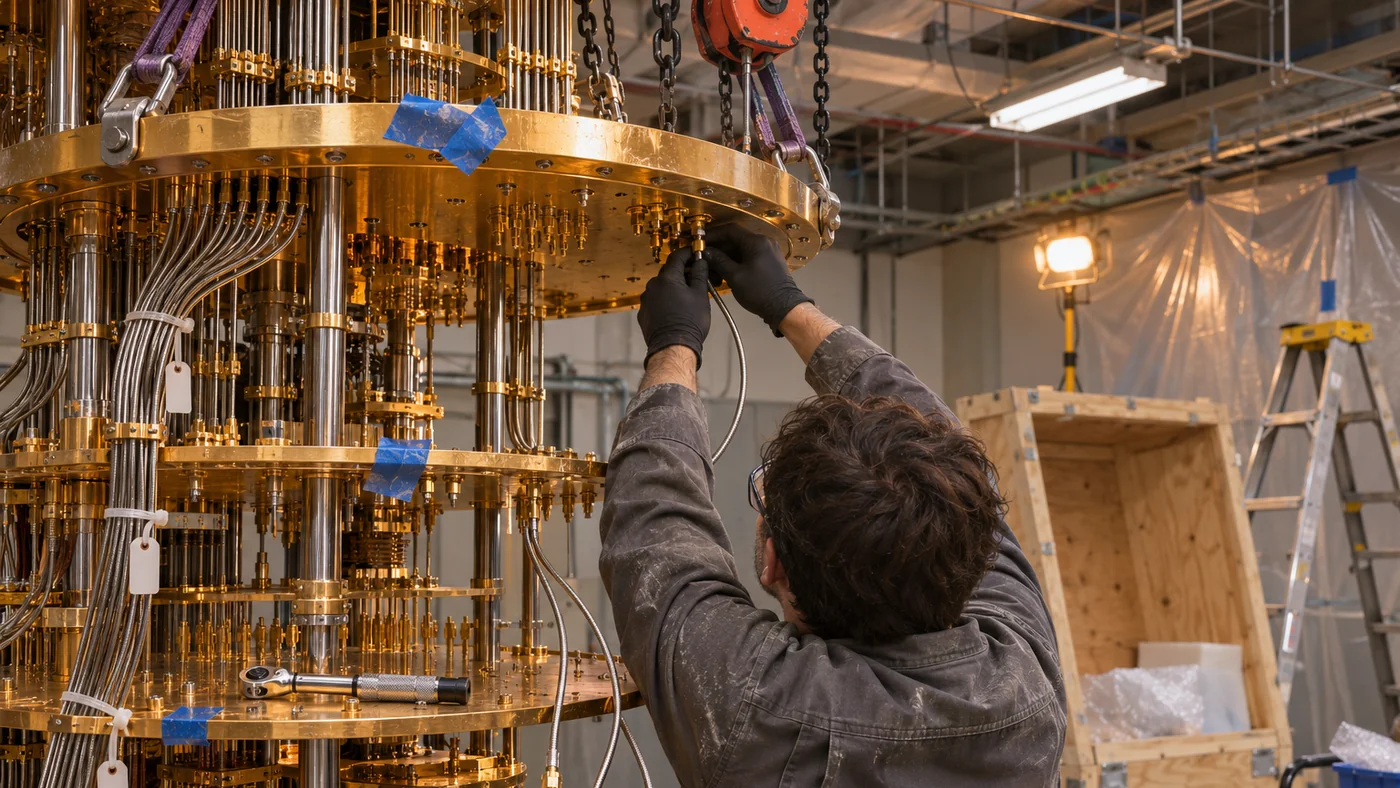
D-Wave Quantum’s third quarter 2026 revenue was $4.5 million, up from $3.7 million a year earlier, and its net loss was $0.13 a share. Operating expenses were $55.9 million including stock awards, many times its sales, while a $20 million machine it sold to Florida Atlantic University waits to be installed.
The short answer. D-Wave, a maker of quantum computers with paying customers today, again had costs many times its sales. That matters beyond its shareholders, because D-Wave’s sales show whether businesses will pay for quantum computing before the technology is fully proven. In the third quarter, operating expenses were about 12 times revenue, up from about 8 times a year earlier.
D-Wave Quantum’s third quarter of 2026 in three numbers
Revenue, Q3 2026
$4.5M
Q3 2025: $3.7M
Operating expenses, Q3 2026
$55.9M
Q3 2025: $30.4M
Cash and investments, Sep 30, 2026
$503.4M
June 30: $546.2M
D-Wave’s operating expenses were many times its revenue in the third quarter of 2026. Figures from D-Wave third quarter 2026 results release, as of November 10, 2026.
Sec.01What D-Wave earnings show about sales and costs
D-Wave brought in $4.5 million from customers in the quarter and had $55.9 million of operating expenses. Its costs were many times its sales, a gap that widened over the past year as it took on a second kind of quantum computer.
Revenue for the three months to September 30 was $4.5 million, up from $3.7 million a year earlier, according to the third quarter release. Operating expenses were $55.9 million.
The costs grew because D-Wave got bigger. It bought Quantum Circuits, a developer of gate model quantum computers, and closed the deal on January 20, 2026. The largest part of the third quarter rise, D-Wave said, was $12.3 million more in staff costs. Stock awards and amortization also grew, amortization being the cost of the technology it bought spread over several years. Before that deal, in the third quarter of 2025, operating expenses were $30.4 million.
Set side by side, the two lines have moved apart. In the third quarter of 2026, operating expenses were about 12 times revenue, up from about 8 times a year earlier.
Under standard accounting (GAAP), the net loss was $48.2 million, or $0.13 a share. The company’s own adjusted measure, which leaves out stock pay, depreciation, amortization and one-time costs, showed an Adjusted EBITDA loss of $37.7 million.
Each dollar of sales also kept less money than a year earlier. Gross margin, the share of revenue left after the direct cost of delivering it, fell to 52.9% from 71.4%. D-Wave put that down mainly to more professional services in the mix, which carry a lower margin.
Show the data
Quarter
Revenue ($M)
Operating expenses ($M)
Net loss ($M)
Q3 2025
3.7
30.4
140.0
Q4 2025
2.8
36.6
42.3
Q1 2026
2.9
56.5
18.4
Q2 2026
3.1
55.0
48.0
Q3 2026
4.5
55.9
48.2
Source: D-Wave quarterly results releases, statements of operations. The Q3 2025 net loss includes $121.9 million of charges tied to its warrants (rights to buy shares); the Q1 2026 net loss is after a $28.5 million tax benefit from the Quantum Circuits deal.
Sec.02D-Wave annealing and gate model progress
D-Wave sells one kind of quantum computer today, an annealing machine built to pick the best answer from a huge number of options, such as a delivery schedule. It is also building a second, gate model kind, with a first small system due in 2026.
The machine it sells is Advantage2, with more than 4,400 qubits, the basic units of a quantum computer. The next one, Advantage3, would join several chips together. D-Wave’s target is a 20,000-qubit system in 2029 and 100,000 qubits by 2031.
The gate model plan changed shape this year. In May, D-Wave aimed at about 175 qubits by the end of 2028. At its Investor Day on June 1, 2026, it added two nearer steps: a 17-qubit system in 2026 and a 49-qubit system in 2027. Its long goal stayed at 100 logical qubits by 2032, where a logical qubit is a group of qubits working together to catch each other’s errors.
Plan stated May 12, 2026
Plan stated June 1, 2026
2026
No milestone named
17-qubit system delivered
2027
No milestone named
49-qubit system
2028
About 175 qubits by year end
181-qubit system
2030
1,000 qubits with 10 logical qubits
10 logical qubits
2032
100 logical qubits
100 logical qubits
D-Wave's gate model plan as stated in May 2026 and at its June 1, 2026 Investor DayThe June plan added two nearer steps, a 17-qubit system in 2026 and a 49-qubit system in 2027, and kept the 2032 goal of 100 logical qubits.Figures from D-Wave first quarter 2026 results release, as of May 12, 2026; D-Wave gate model roadmap release, as of June 1, 2026.
The third quarter release did not update the 2026 goal for the 17-qubit system. It announced a test program for a simulator, software that imitates D-Wave’s gate model design, with outside users such as the bank BBVA. In August, a paper in the journal Nature showed D-Wave’s two-qubit gate at about 99.9% fidelity, the share of operations that come out right, according to the company.
Sec.03D-Wave orders waiting to become sales
Bookings are the orders customers have signed. A machine becomes revenue bit by bit while it is installed, and a service as it is delivered, so D-Wave has signed far more than it has counted so far.
D-Wave booked $1.9 million of new orders in the quarter, 19% less than a year earlier. Signed orders not yet counted as revenue stood at $38.3 million at quarter end, and the company expected about 59% of that to become revenue within 12 months. The company calls those signed orders not yet counted as revenue its remaining performance obligations.
Show the data
Quarter
New orders booked ($M)
Signed orders not yet revenue, quarter end ($M)
Q4 2025
13.4
13.4
Q1 2026
33.4
42.4
Q2 2026
2.1
40.7
Q3 2026
1.9
38.3
Source: D-Wave quarterly results releases (bookings and remaining performance obligations). Q1 2026 bookings include the $20 million Florida Atlantic University machine and a $10 million, two-year cloud contract.
The biggest single order is a machine. On January 27, 2026, Florida Atlantic University agreed to pay $20 million for an Advantage2 annealing quantum computer at its Boca Raton campus. In May, D-Wave said it expected installation to start before the end of 2026.
Timing matters because of how D-Wave counts a machine sale. Its quarterly report (10-Q) says revenue from a system is recognized over the installation period, in step with the costs of the work done. So a $20 million order turns into revenue over several quarters, starting only once the work starts.
Other orders buy access to a machine. Swiss Quantum Technology made a €10 million commitment in October 2025 to place an Advantage2 system in Europe, with an option to buy the machine. The third quarter release says D-Wave delivered that system, which is still to be installed. A Fortune 100 company signed a $10 million, two-year agreement for cloud access in January.
At September 30, the signed orders not yet counted were about 2.9 times a year of sales, measured against the four quarters through September.
Sec.04How D-Wave makes money and who pays
Most of D-Wave’s money comes from companies renting time on its quantum computers over the internet. Paid help building their programs comes second, and machine sales were a small part in the latest detailed figures.
In the third quarter, D-Wave earned revenue from more than 100 customers, and 48% of them were businesses, the release says. Against a year earlier, professional services revenue rose $1.5 million and cloud access rose $0.8 million, while system sales fell $1.5 million.
The split by product comes from the 10-Q, which D-Wave files after the results release. In the second quarter, cloud access (which D-Wave calls QCaaS, quantum computing as a service) was 60.5% of revenue, with professional services and system sales making up the rest.
Under the flat total, the parts moved in different directions. Cloud access brought in $1.86 million in the second quarter, against $1.24 million a year earlier. System sales fell to $0.26 million from $1.03 million.
A few buyers pay a large share. One customer, which the 10-Q calls only Customer A, paid 41% of second quarter revenue. Customers in the United States paid 70.7%.
Sec.05D-Wave cash, spending and the government stake
D-Wave held $503.4 million of cash and investments on September 30. Less its loans, that covered about 2.7 years of cash use at its July to September pace.
The pile was larger at the start of the year. It reached $884.5 million at the end of 2025, after D-Wave sold shares during that year, and fell once it paid cash for Quantum Circuits in January. It was $546.2 million on June 30 and $503.4 million on September 30.
Cash spending rose in the third quarter. From July to September, D-Wave used $43.0 million of cash running the business and buying equipment, up from $32.9 million from April to June.
Government money is on the way. Under an agreement signed on September 4, 2026, the Department of Commerce will provide up to $100 million. The first $53.6 million was to be made available soon after signing, and the rest comes in four parts as D-Wave reaches milestones. D-Wave’s September 30 balance sheet listed $100.0 million of money from issuing shares that it had not yet collected, the same amount as the price of the Commerce shares.
The government also gets part of the company. In connection with the award, D-Wave is to issue it 7,095,721 common shares, priced in the filing at $14.093 each, or $100 million in all. The filing says the government’s right to vote those shares is expected to be limited to certain matters.
The share price has since fallen below that issue price. At the November 9 close of $11.47, the government’s shares were worth about $81.4 million. When the deal was signed, the company’s filing called the $14.093 price a discount to the market and said the issue was “expected to be dilutive to existing stockholders.”
D-Wave pays no dividend, and its cash flow statement shows no share buybacks. It sold no new shares straight into the market (an at-the-market program) in the first nine months of 2026, after raising $536.7 million that way in the same months of 2025. Its borrowings are small, about $42.0 million of loans at September 30, including a Canadian government loan repaid out of future revenue.
Sec.06D-Wave vs Rigetti in the second quarter
Rigetti, another maker of superconducting quantum computers, sold more and spent less than D-Wave in the second quarter. The two held almost the same cash.
Second quarter 2026
D-Wave
Rigetti
Revenue
$3.1M
$5.1M
Operating expenses
$55.0M
$30.3M
Cash and investments, June 30
$546.2M
$541.3M
Source: D-Wave and Rigetti second quarter 2026 results releases.
D-Wave is paying to develop two kinds of quantum computer, annealing and gate model. Rigetti reports its third quarter after the market closes on November 10, 2026.
Sec.07QBTS stock market value compared with sales
At the November 9 close, the stock market valued D-Wave at about $4.35 billion. Its cash and investments at September 30 were about 12% of that value.
The sales so far are small next to that value. D-Wave’s revenue for the four quarters through September was $13.2 million, so the market value was more than 300 times a year of sales.
The value has shrunk this year. QBTS closed at $26.15 on December 31, 2025, and at $11.47 on November 9, 2026, according to StockTitan’s QBTS price data. Before the market opened on November 10, the shares last traded at $11.19 at 7:15 a.m. ET, 2.4% below that close, according to StockTitan real-time Nasdaq data.
D-Wave’s chief executive, Alan Baratz, said in the third quarter release that a “triple-digit increase in year-to-date bookings” supports the company’s “confidence in the opportunity ahead.” Most of those bookings came early in the year: $33.4 million of the $37.4 million booked in the first nine months of 2026 came in the first quarter. The sales figures are where that confidence shows up or does not. The next dated tests are ones the company set itself: installing the Florida machine and delivering the 17-qubit gate model system in 2026.
What to watch
Revenue by product and the largest customer’s share for the third quarter: D-Wave’s 10-Q for the quarter ended September 30, 2026, on SEC EDGAR.
Whether installation of the Florida Atlantic University machine starts in 2026: D-Wave’s fourth quarter and full year 2026 results.
Whether the 17-qubit gate model system arrives in 2026: the same fourth quarter results.
Whether D-Wave received the first $53.6 million of Commerce funding and any later parts: D-Wave’s quarterly reports and any 8-K filing.
How Rigetti’s third quarter compares: its results release after the market closes on November 10, 2026.
Our numbers
These figures are our calculations from the sources linked in this article. The share count is August 5’s until the third quarter 10-Q reports a new one.
About 12 times: third quarter 2026 operating expenses of $55.9 million divided by revenue of $4.5 million (about 8 times a year earlier, $30.4 million on $3.7 million).
About 2.9 times a year of sales: $38.3 million of remaining performance obligations at September 30, 2026, divided by $13.2 million of revenue in the four quarters to September 30, summed from the statements’ thousands, so it differs slightly from the rounded table.
$43.0 million of cash use from July to September: operating cash used of $35.6 million plus $7.4 million of equipment, the nine-month figures in the third quarter release less the six-month figures in the second quarter release.
About 2.7 years of cash: September 30 cash and investments of $503.4 million, less $42.0 million of loans, divided by that quarter’s cash use, then by four. It leaves out the Commerce money not yet received.
About $4.35 billion of market value: 379.5 million shares, those of August 5 plus the Commerce shares, times the November 9 close of $11.47.
About 12% of market value: September 30 cash and investments of $503.4 million divided by that market value.
More than 300 times a year of sales: that market value divided by $13.2 million of revenue in the four quarters to September 30.
About $81.4 million: the 7,095,721 Commerce shares at the November 9 close, against $100 million at the agreed $14.093 a share.
Sec.08Frequently asked questions
No. D-Wave pays no dividend, and its cash flow statements show no share buybacks.
D-Wave reported its third quarter 2026 results on November 10, 2026, before the market opened, with a webcast at 8:00 a.m. ET. Its fourth quarter and full year results come next.
Mostly by renting time on its annealing quantum computers through its Leap cloud service. It also sells professional services that help customers build programs, and it sells whole machines, which count as revenue while they are installed.
No. Its third quarter 2026 loss from operations was $53.5 million on revenue of $4.5 million.
Public shareholders own the company. D-Wave had 369.3 million common shares on August 5, 2026, plus 3.2 million exchangeable shares that convert one for one into common shares. The Department of Commerce is getting 7.1 million more, with its voting on them expected to be limited to certain matters.
The Stock Titan Editorial Team is a group of market analysts and data scientists who specialize in transforming complex financial data into actionable insights.
Our team continuously monitors and integrates data from official sources including SEC filings, stock exchanges, and verified financial data providers directly into the StockTitan platform.
We maintain a neutral, unbiased approach to market analysis. Our goal is to present verified data clearly and accurately, helping investors of all experience levels understand market trends, sector performance, and individual stock movements.
Every article undergoes multi-source verification to ensure data accuracy and reliability.
Our mission: Make complex financial data accessible to everyone through thorough research, verified sources, and clear explanations.