
SpaceX (SPCX) Shifts Starlink Mobile From Late 2027 to Early 2028


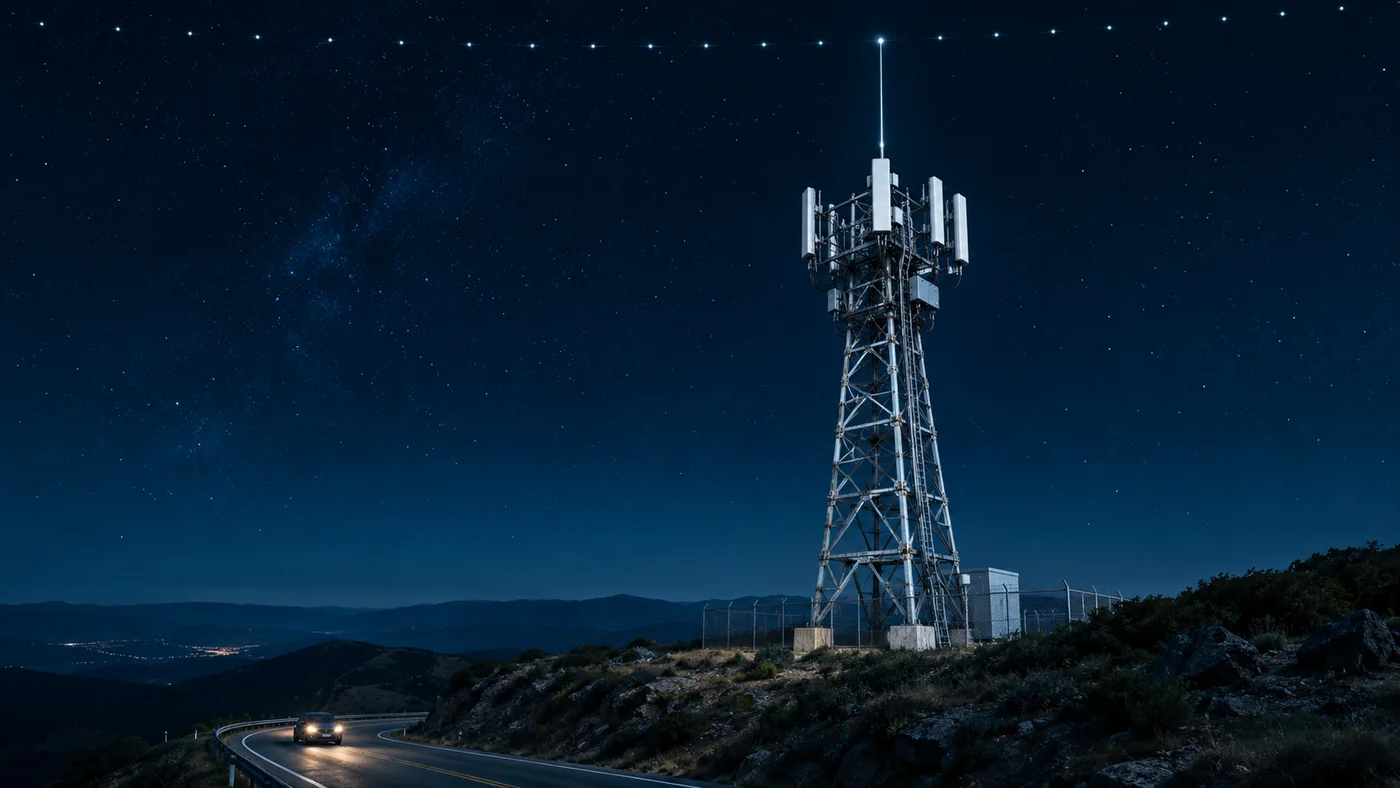
SpaceX says Starlink Mobile, its own US phone service, will switch on in early 2028, a few months later than the end of 2027 it named in August. Verizon’s chief executive says he sees no benefit in renting network space to any satellite company, and the Washington Post reported that AT&T and T-Mobile also told SpaceX no.
The short answer. SpaceX’s own date for its US carrier service is early 2028, and Verizon sees no reason to lend it network space in the meantime. That matters to anyone with a phone bill, because a new carrier with its own airwaves would compete with the phone companies people pay today. SpaceX’s president put the three big carriers’ sales at about $600 billion a year; their own reports add up to $362 billion, and all of Starlink took in $16 billion.
SpaceX's phone plan at a glance

Show the data
| Date | Event |
|---|---|
| Aug 4, 2026 | SpaceX says service starts at the end of 2027 (since moved) |
| Oct 8, 2026 | Deal to buy 800 MHz airwaves that reach indoors |
| Oct 20, 2026 | SpaceX now says service starts in early 2028 |
| Nov 4, 2026 | Qualcomm picked for the ground radios |
| 2027 | SpaceX plans to fly new phone satellites and start ground sites |
| By June 2027 | 800 MHz deal expected to close |
| Nov 30, 2027 | EchoStar airwaves expected to pass to SpaceX |
| Early 2028 | SpaceX's date to switch on Starlink Mobile |
Every company reporting the same week, with its date and time, is in StockTitan's Earnings Calendar for the Week of November 9, 2026.
On this page
- When will Starlink Mobile phone service start?
- How will Starlink Mobile’s phone network work?
- What the big phone carriers have that SpaceX lacks
- Did Verizon, AT&T and T-Mobile refuse SpaceX?
- Is SpaceX buying Boost Mobile?
- What phone company stocks did after SpaceX’s airwaves deal
- What Starlink Mobile could mean for your phone bill
- Frequently asked questions
When will Starlink Mobile phone service start?
SpaceX’s own date is early 2028. The Starlink Mobile name already covers satellite service sold through other carriers; what starts in 2028 is SpaceX as the carrier itself.
The date comes from SpaceX’s president, Gwynne Shotwell, on the company’s results call of October 20, 2026. She said: “Our near-term priority remains flying the Mobile V2 constellation through next year and integrating our spectrum purchases to turn on service in early 2028.” Spectrum is the radio airwaves a phone network uses.
On the call of August 4, 2026, Shotwell had given an earlier date: “We will start to fly the satellites next year, and we will start providing service end of next year.” In October she said the priority “remains” the same. Only the start date is later, by a few months. The company did not say why.
Several pieces have to land first. SpaceX plans to start launching its new phone satellites, called Mobile V2, on its Starship rocket in 2027. The Federal Communications Commission (FCC), the US telecom regulator, has approved up to 15,000 of them, Shotwell said.
The airwaves come next. SpaceX is buying a large block from EchoStar, the owner of Boost Mobile. The FCC approved that sale on May 12, 2026. The licenses are now held by a trust, a separate legal holder, until the sale is completed, EchoStar’s quarterly report says. SpaceX’s quarterly report assumes “an expected closing date of November 30, 2027.” EchoStar’s report gives the same target date, if the deal’s remaining conditions are met or waived.
A second deal, signed October 8, 2026, adds low airwaves in the 800 MHz band, a spot low on the radio dial. SpaceX expects it to close in the first half of 2027, if regulators approve. Ground radios are due to start going up in 2027, under a deal with Qualcomm announced November 4.
How will Starlink Mobile’s phone network work?
It would mix satellites with SpaceX’s own radios on the ground. A phone could get its signal from the sky in empty places and from a nearby radio in towns and indoors.
- Airwaves from EchoStar Up to 65 MHz of room How much radio room the EchoStar licenses give SpaceX: 50 MHz plus up to 15 MHz more
- Low airwaves for indoors The 800 MHz band A spot low on the radio dial that passes through walls, to reach phones indoors
- Radios on the ground Tens of thousands Qualcomm-powered sites over several years from 2027, plus small radios on Starlink dishes
The airwaves are the base of any phone network. From EchoStar, SpaceX gets licenses for up to 65 MHz of airwaves, a measure of how much radio room a network has to carry calls and data. The satellite service SpaceX ran in August used about 5 MHz, through local carriers, Shotwell said.
The EchoStar deal is worth about $19.6 billion, mostly paid in SpaceX shares, SpaceX’s quarterly report (its 10-Q) says.
The 800 MHz airwaves add reach. Low airwaves travel farther and pass through walls. Shotwell explained it on the October call: “you need the low-band spectrum, the 800 megahertz spectrum, to basically penetrate buildings.” SpaceX plans to use those airwaves to reach phones indoors. She expects higher airwaves, which she called “the S-band spectrum,” to carry most of the traffic.
The ground radios are new. Qualcomm says SpaceX picked its equipment for a “U.S. nationwide terrestrial 5G network,” meaning a network on the ground. SpaceX plans tens of thousands of sites over a deal of several years, with the rollout starting in 2027, Qualcomm’s release says. SpaceX also plans small radios on the gear that already holds Starlink internet dishes on homes and businesses, Shotwell and Elon Musk said in August.
What the big phone carriers have that SpaceX lacks
The carriers have networks already built and far more money coming in. In the four quarters to September 30, 2026, the three took in $362 billion. All of Starlink, home internet included, took in $16 billion.

Show the data
| Category | Value |
|---|---|
| Verizon | $139.4B |
| AT&T | $128.9B |
| T-Mobile | $93.8B |
| SpaceX Starlink (all of it) | $16.0B |
Shotwell compared SpaceX’s chance with the three carriers’ yearly sales on the August call: “The Big Three in the United States, AT&T, Verizon and T-Mobile, roughly between them $600 billion a year.” The three reported revenue of about $362 billion for the four quarters to September 30, 2026, close to 60% of her figure. That is their whole business, not phone service alone. StockTitan’s articles on Verizon’s and AT&T’s third quarter results cover their phone customers.
Starlink’s whole business, which SpaceX reports as Connectivity, brought in about $16 billion over the same four quarters. That covers home internet, airlines, governments and phones together. Verizon alone took in almost nine times as much. StockTitan’s guide to how SpaceX makes money breaks down where Starlink’s sales come from.
One gap is the network on the ground. Verizon’s chief executive, Dan Schulman, said on October 26 that a full rival network would need “65,000 to 80,000 macro sites,” the large cell towers people see along roads. He said building it would take at least four to six years and cost $300 billion to $500 billion over most of a decade. Qualcomm’s release speaks of tens of thousands of SpaceX sites over several years.
Did Verizon, AT&T and T-Mobile refuse SpaceX?
Verizon’s refusal is on the record. AT&T’s and T-Mobile’s come from a Washington Post report that the companies did not confirm.
The fastest way into the phone business is to rent space on a carrier’s network. Many smaller phone brands work this way. They are called MVNOs, mobile virtual network operators.
On Verizon’s results call of October 26, 2026, Schulman was asked whether Verizon would offer such a deal to Starlink. He said: “I see absolutely no benefit whatsoever to extending an MVNO deal to any satellite provider.” He added that “there are no back doors to any of our MVNO agreements.”
The Washington Post reported on November 2, 2026 that Musk had asked the top people at the carriers for access, and that “Verizon, T-Mobile and AT&T all told SpaceX no.” The Post said Verizon and EchoStar declined to comment, while AT&T, T-Mobile, SpaceX and Musk did not respond.
The carriers are also pushing back at the FCC. On October 29, the FCC voted to seek comment on letting satellites reach phones over up to 482 MHz more of the airwaves carriers hold. CTIA, the carriers’ trade group, had urged the FCC to leave out two bands “given their significant role in the 5G networks on which millions of Americans rely,” the FCC’s proposal records. The FCC kept both bands in the question.
Is SpaceX buying Boost Mobile?
No deal has been announced or filed. The Washington Post reported talks between SpaceX and EchoStar, Boost Mobile’s owner, and neither company has confirmed them.
The Post reported on November 2 that SpaceX “has held talks with Boost’s parent company EchoStar in recent months.” SpaceX’s and EchoStar’s latest quarterly reports do not mention such talks.
EchoStar’s report shows why Boost could look like a shortcut, and why it may not be a simple one. Boost and Gen Mobile had 7.193 million phone customers on September 30, 2026.
Those phones ride on other companies’ networks: “we depend on T-Mobile and AT&T to provide network services to our Wireless subscribers,” the report says. Since November 2025, Boost’s traffic runs mainly on AT&T’s network, it adds.
The two companies are already linked. The airwaves sale gives Boost a promise of future deals so its customers can use Starlink’s satellite text, voice and data service, EchoStar says.
What phone company stocks did after SpaceX’s airwaves deal
On October 9, 2026, the three carriers lost about $57 billion of share value in one day, after taking out the dividends that came off two of them. SpaceX’s own shares rose.
SpaceX signed the 800 MHz deal on October 8. On the next trading day, October 9, T-Mobile fell 13.27%, AT&T 9.81% and Verizon 8.75%. For Verizon it was the worst day since July 22, 2002.
AT&T and Verizon shares also went ex-dividend that day, so new buyers no longer got the next quarterly cash payment; those two falls leave that payment out.
SpaceX’s shares rose 1.2% that day. AST SpaceMobile, which sells its satellite service through the carriers, fell 10.5%.
No company said why the shares fell. Each side has spoken about the rivalry itself. Shotwell said in August that she expects SpaceX “to be able to acquire quite a few of their customers.” On October 26, Schulman said Verizon will be “ferociously competitive” once a rival arrives. By November 6, Verizon and T-Mobile shares had won back much of the drop, while AT&T’s had not.
What Starlink Mobile could mean for your phone bill
For now, nothing changes. SpaceX has not announced a price, a plan or a list of phones, and its own start date is early 2028.
What SpaceX has said is about coverage. In the Qualcomm release, Starlink’s Michael Nicolls said phone calls should no longer drop at home or on the move. He said Starlink is building “the first fully-integrated nationwide satellite and terrestrial network.” Shotwell said in August: “We will eliminate dead zones, leveraging the satellites in orbit.”
Today, the closest thing is satellite service sold through a carrier, which already works with ordinary phones. Starlink Mobile passed 22 million monthly users worldwide at the end of September, Shotwell said. In the United States, SpaceX partners with “major wireless carriers like T-Mobile,” its June 2026 prospectus for its stock market listing says. AST SpaceMobile also sells its satellite service through carriers, as StockTitan’s article on its plan explains.
Verizon does not expect a quick change. Schulman said SpaceX could become “the sixth, not the fourth, the sixth competitor in the market” sometime over the next four to six years.
What to watch
- FCC approval and closing of the 800 MHz deal: SpaceX expects it in the first half of 2027, reported in its filings.
- The EchoStar airwaves passing to SpaceX: targeted for November 30, 2027, in both companies’ quarterly reports.
- Comments on the FCC’s plan to open more carrier airwaves to satellites: due 60 days after the plan appears in the Federal Register, the government’s daily journal of rules.
- Any Boost Mobile deal: an EchoStar or SpaceX current report to the SEC (an 8-K), if one is filed.
- SpaceX’s first annual report (its 10-K) for 2026, for an update on Starlink Mobile.
Our numbers
These figures are our calculations from the sources linked in this article. The share figures cover one trading day.
- The October 9, 2026 falls: each carrier’s close against its October 8 close less any dividend that came off that day.
- About $57 billion of share value lost: each carrier’s fall on that basis, in dollars per share, times the shares on its latest quarterly report.
- Verizon’s worst day since July 22, 2002: its October 9 fall ranked against every daily close in StockTitan’s price history since then.
- $362 billion: AT&T, Verizon and T-Mobile revenue for the four quarters to September 30, 2026, added up from their quarterly reports. That is close to 60% of the $600 billion SpaceX’s president named.
- $16 billion: SpaceX Connectivity revenue for the same four quarters, its 2025 total less the first nine months of 2025, plus the first nine months of 2026. Verizon’s revenue was almost nine times that.
Frequently asked questions
Is SpaceX becoming a phone carrier?
SpaceX says it is. On its call of October 20, 2026, finance chief Bret Johnsen said SpaceX will use its new airwaves to “become a major mobile carrier” in the United States. Its president, Gwynne Shotwell, said the same.
When will Starlink Mobile be available in the US?
SpaceX plans to turn on its own US service in early 2028. In August it had said the end of 2027. No price or plan has been announced.
Is SpaceX buying Verizon?
No deal has been announced, and Verizon says it sees no benefit in renting SpaceX network space. Musk spoke at an investor conference on November 6, 2026. He said SpaceX could buy an older phone company if it could use that company’s airwaves far better, 24/7 Wall St reported on November 7. He named no company.
Will SpaceX buy Boost Mobile?
No deal has been announced. The Washington Post reported on November 2, 2026 that SpaceX had held talks with EchoStar, Boost’s owner, and the companies did not confirm it.
Does Starlink work with T-Mobile?
Yes. SpaceX’s prospectus of June 2026 names T-Mobile among its carrier partners in the United States, and says the service is “initially focused on messaging” where cell coverage is limited or absent. That partnership is separate from SpaceX’s plan for its own Starlink Mobile carrier service.
Where can I read SpaceX’s SEC filings?
StockTitan’s SpaceX (SPCX) SEC filings page lists each new report, the financials page holds its reported results, and the overview shows the price and news.
Sources
- StockTitan: SpaceX (SPCX) overview
- StockTitan: SpaceX (SPCX) financials
- StockTitan: Verizon (VZ) overview and price history
- StockTitan: AT&T (T) overview and price history
- StockTitan: T-Mobile (TMUS) overview and price history
- StockTitan: AST SpaceMobile (ASTS) overview and price history
- Qualcomm: SpaceX Selects Qualcomm to Accelerate Starlink Mobile’s Nationwide 5G Network, November 4, 2026
- Verizon: quarterly dividend declaration, September 9, 2026
- AT&T: dividend declaration, September 24, 2026
- T-Mobile: quarterly dividend declaration, September 24, 2026
- SpaceX third quarter 2026 results release, October 20, 2026
- SpaceX Form 10-Q for the quarter ended September 30, 2026
- SpaceX IPO prospectus, June 2026
- SpaceX third quarter 2026 webcast transcript, October 20, 2026
- SpaceX second quarter 2026 webcast transcript, August 4, 2026
- EchoStar Form 10-Q for the quarter ended September 30, 2026
- Verizon third quarter 2026 earnings call transcript, October 26, 2026
- FCC Notice of Proposed Rulemaking FCC 26-71, adopted October 29, 2026
The information provided in this article is for educational and informational purposes only. It does not constitute financial advice, investment recommendation, or an endorsement of any particular investment strategy. Past performance does not guarantee future results. Investors should conduct their own research and consult with a qualified financial advisor before making investment decisions.