
ADP Research: Only 22% of Workers Confident Their Job is Safe from Elimination, Underscoring the Importance of Talent Strategies that Prepare Employees for the Future
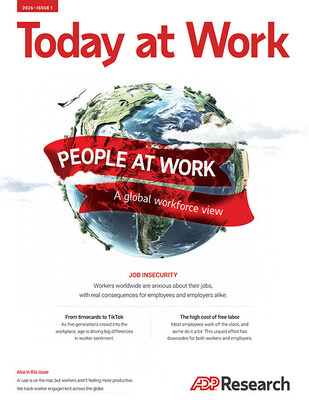
ADP (ADP) published Today at Work 2026, Issue 1 on March 25, 2026, reporting global workforce sentiment from a survey of more than 39,000 workers in 36 markets.
Rhea-AI Summary
ADP (ADP) published Today at Work 2026, Issue 1 on March 25, 2026, reporting global workforce sentiment from a survey of more than 39,000 workers in 36 markets. Key findings: only 22% of workers strongly agree their job is safe; full engagement remains 19%; AI use varies by frequency and age, and unpaid hours are widespread.
The report highlights gaps in skills confidence across generations, correlations between employer investment and engagement, and talent recommendations including skills development, mentorship, and clearer expectations.
Positive
- Daily AI users show higher engagement: 30% fully engaged versus 14% for non-users
- Workers who felt their job safe were 6x more likely to be fully engaged
Negative
- Only 22% of global workers strongly agree their job is safe
- Full employee engagement remained low at 19%, unchanged from prior year
- Skills confidence declines with age: 18–19% of workers 55+ strongly agree they have skills to advance
Details
News Market Reaction – ADP
In the Mar 25 session, ADP declined 1.36%, reflecting a mild negative market reaction.
Data tracked by StockTitan Argus on the day of publication.
Key Figures
- Job security confidence
- 22%
- Workers strongly agreeing their job is safe from elimination
- Survey sample size
- 39,000 workers
- Global Workforce Survey 2025 respondents across 36 markets
- Markets covered
- 36 markets
- Geographic scope of Global Workforce Survey
- Fully engaged workers
- 19%
- Share of workers reporting full engagement on the job in 2025
- Daily AI users
- 20%
- Workers saying they use AI nearly every day
- Engagement among daily AI users
- 30%
- Daily AI users who are fully engaged at work
- Workers with ≤5 unpaid hours
- 62%
- Workers putting in up to five unpaid work hours weekly
- Workers with ≥6 unpaid hours
- 38%
- Workers putting in six or more unpaid work hours weekly
Historical Context
-
Preliminary NER Pulse showed slower U.S. private job additions versus prior weeks.
-
NER Pulse showed steady private job gains; shares moved lower despite stable hiring.
-
Private employment rose 63,000 and median pay grew 4.5% year over year.
-
Launch of AI agents in ADP Marketplace to automate HR and payroll workflows.
-
NER Pulse showed 12,750 average weekly private payroll gains with continued strengthening.
24h Move is the share-price change in the day after each event; other market factors may also have contributed.
Key Terms
artificial intelligence technical
AI-generated analysis. How Rhea-AI works. Not financial advice.




Latest issue of Today at Work captures the pulse of global workforce sentiment to uncover how AI advances and changing demographics offer new challenges and opportunities for workers and employers alike
- Workforce Insights from Engagement to Artificial Intelligence: ADP Research's most recent issue of Today at Work reveals the global state of worker engagement, job security, AI sentiment, skills confidence, and work-life balance.
- Informing Talent Strategies: Turning insight into action, Today at Work helps businesses understand current worker sentiment to drive engagement, productivity, and retention through data-driven talent strategies.
- Global Reach, Local Expertise: Today at Work 2026, Issue 1 is built on ADP Research's Global Workforce Survey, which captures responses from over 39,000 workers in 36 markets to understand the world of work at large and gauge worker sentiment.
"Despite three years of historically low global unemployment and steady economic growth, our data reveals widespread job insecurity expressed by workers worldwide," said Dr. Nela Richardson, chief economist, ADP. "For employers, the worker sentiment findings from Today at Work can help inform new talent management practices rooted in powering skills development, building trust, leveraging cross-generational mentorship, and nurturing employee engagement."
This issue of Today at Work takes a global approach and features survey findings derived from ADP Research's annual Global Workforce Survey of more than 39,000 working adults in 36 markets. The findings reveal key insights into how workers really feel about AI, current workforce engagement levels, the challenges and opportunities a multi-generational workforce offers, and trends in unpaid hours.
"Today at Work meets this moment of structural change with data-driven insights that leaders can leverage to craft a modern talent strategy," said Jay Caldwell, chief talent officer, ADP. "Workers who clearly see the role their existing skillsets will play in an organization's future and investment by their employers in helping them develop skills of the future will be more engaged, productive and have the confidence to thrive in this next era of work."
Clarity is Key: Workers worldwide are anxious about their jobs. Even with worldwide unemployment at its lowest level in decades, fewer than 1 in 4 workers (
- Workers who felt their jobs were safe were six times more likely to be fully engaged on the job, 3.3 times more likely to say they were highly productive, and two times more likely to say they have no intention of leaving.
- Breaking it down further by job level,
18% of individual contributors and21% of frontline managers strongly agreed their job was safe from elimination, though that confidence increases as employees rise through the ranks of middle managers (23% ), upper managers (31% ), and C-suite executives (35% ). - Talent Takeaway: As the world of work changes at breakneck pace, bringing clarity to workers via consistent communication is essential. Remove ambiguity and help workers visualize how their role can flourish in the future of work, including how AI will be a teammate that augments their work.
Integrating AI at Work: Workers who use AI frequently were more likely to say with confidence their job was safe from elimination. Today at Work also found
- Unchanged from last year, the report found
19% of workers reported full engagement on the job in 2025, indicating over80% of workers aren't giving it their all at work. - Workers who find meaning in their jobs are 12.5 times more likely to be fully engaged than workers who don't.
- Talent Takeaway: Engagement increases dramatically when workers trust their leaders. Specific investment in AI skills development will help workers see their future role at the organization, as well as help boost engagement.
Capitalize on a Multi-Generational Workforce: For the first time ever, five generations are working together in the workplace, from teenagers to great-grandparents. Today at Work found only
12% of workers aged 55 to 64 and 65+ strongly agreed their employer invests in the skills they need compared to21% of workers aged 18 to 26 and aged 27 to 39.- One fifth (
20% ) of workers aged 18 to 26 strongly agree AI will positively impact their job in the next year. That sentiment decreases as workers get older, with15% of workers aged 40 to 54, and10% of workers aged 55 to 64 reporting AI will positively impact their job in the next year. - Despite their poor sentiment when it comes to career development and on-the-job support, people aged 55 and older are just as likely as those in other age groups to find meaning in their work. They're just as likely to be fully engaged on the job and they're the least likely of any group, by far, with plans to quit.
- Talent Takeaway: Leverage this multi-generational workforce to facilitate cross-generational mentorship opportunities where skills and knowledge flow in both directions. Organizations can pair AI-native, tech-savvy junior workers with the judgement and experience of senior workers to produce responsible AI inputs and outputs that drive impactful business outcomes. Connecting enthusiasm with experience can yield big results.
Redefining Productivity in the Age of AI: Today at Work found daily users of AI were four times more likely than non-users to say they were feeling less productive than they could be. Understanding how AI changes the nature of work and feelings of productivity will be essential for organizations looking to accurately gauge worker outcomes in the future of work.
20% of workers say they use AI nearly every day, while30% use it multiple times a week, and15% of workers have never used it.30% of workers who use AI daily in their work were fully engaged, compared to only14% of those who never use AI.- Only
11% of daily AI users reported feeling overloaded, or experiencing negative work stress, compared to23% of non-adopters. - Talent Takeaway: As more checklist work is delegated to AI and workers transition to longer-term, strategic projects, reevaluating how productivity is tracked at work will be required. Rather than measuring the completion of tasks quickly and efficiently, productivity will shift to judgement, creativity, and long-term impact. Measuring outcomes over inputs and decision quality over task volume are examples for shifting how organizations measure productivity.
Setting Clear Expectations to Drive Efficiency: ADP Research's new analysis found
- Workers who reported the highest amount of unpaid work – 16 hours or more – were the most likely to be fully engaged and to say they find meaning in their jobs, a pattern that held across all job levels within the organization.
- These same workers who put in 16 or more unpaid hours were more likely to report feeling unproductive at work, and more likely to admit they are actively looking or interviewing for a new job.
- Talent Takeaway: Provide clear expectations. Respondents who indicated they put in five or fewer unpaid hours each week were more likely than heavy off-the-clock users to say they clearly understood what's expected of them. Knowing the key priorities that need to be accomplished can help workers be more efficient and productive with their time.
"From job security to engagement and artificial intelligence, Issue 1 of Today at Work 2026 captures the pulse of global workforce sentiment," said Dr. Mary Hayes, director of people and performance, ADP Research. "Our Global Workforce Survey takes these sentiment trends layers deeper to understand how they vary according to industry, education, work type, work environment, and seniority level. This level of granularity can help employers of all sizes around the world better understand what makes workers tick and how slight tweaks in strategy can lead to big performance optimizations."
Global Workforce Survey Methodology
Today at Work 2026, Issue 1 features survey findings derived from ADP Research's annual Global Workforce Survey of more than 39,000 working adults in 36 markets to uncover global workforce sentiment, an examination of how people are navigating the complexities of a changing world. The report presents worker sentiment data sifted by geography, job type, and other dimensions, providing employers with a fine-tuned and granular view of the global workforce that can be used to better understand their workforce and drive growth through data-driven talent decisions.
The 2025 Global Workforce Survey collected responses between July 21 and August 4, 2025, from a random sample, stratified by age and gender, of more than 39,000 working adults in 36 markets, to provide regional and market comparisons of worker sentiment. Respondents come from a wide variety of industries, educational backgrounds, on-site and remote work environments, work types, and skill sets. They represent a range of management and individual contributor roles, working for employers of all sizes.
To view the latest Today at Work 2026 Issue 1, in addition to previous versions, visit here: https://www.adpresearch.com/today-at-work/
About ADP Research
The mission of ADP Research is to make the future of work more productive through data-driven discovery. Companies, workers, and policy makers rely on our finely tuned data and unique perspective to make informed decisions that impact workplaces around the world. To subscribe to monthly email alerts or obtain additional information about ADP Research, including employment and pay data, methodology, and a calendar of release dates, please visit https://www.adpresearch.com.
About ADP (NASDAQ: ADP)
ADP has been shaping the world of work with innovation and expertise for more than 75 years. As a global leader in HR and payroll solutions, ADP continuously works to solve business challenges for our clients and their workers, from simple, easy-to-use tools for small businesses to fully integrated platforms for global enterprises – and everything in between. Always Designing for People means we're focused on just that – people. We use our unmatched AI-driven insights and proven expertise to design innovative solutions that help people achieve greater success at work. More than 1.1 million clients across 140+ countries rely on ADP's exceptional service to support their people and drive their business forward. HR, Talent, Time Management, Benefits, Compliance, and Payroll. Learn more at ADP.com.
ADP, the ADP logo, and Always Designing for People, ADP National Employment Report, and ADP Research are registered trademarks of ADP, Inc. All other marks are the property of their respective owners.
Copyright © 2026 ADP, Inc. All rights reserved.

 View original content to download multimedia:https://www.prnewswire.com/news-releases/adp-research-only-22-of-workers-confident-their-job-is-safe-from-elimination-underscoring-the-importance-of-talent-strategies-that-prepare-employees-for-the-future-302724112.html
SOURCE ADP, Inc.
FAQ
AI-generated questions and answers. How Rhea-AI works. Not financial advice.