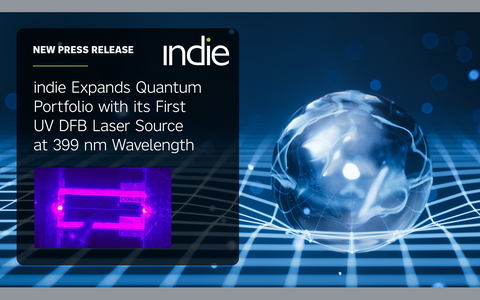
indie Expands Quantum Portfolio with its First UV DFB Laser Source at 399 nm Wavelength
indie Expands Quantum Portfolio with its First UV DFB Laser Source at 399 nm Wavelength
indie (Nasdaq: INDI) launched its first Ultraviolet Distributed Feedback (DFB) 399 nm single-frequency laser diode, the ELA350028, optimized for cooled ytterbium atom quantum computing.
Rhea-AI Sentiment reads the wording of the document, how positive or negative its language is on a 1 to 5 scale. The balance of points shown with the takes weighs what the document actually discloses, so the two can disagree, for example when a trial that missed its main goal is described in upbeat language.
ALISO VIEJO, Calif.--(BUSINESS WIRE)--
indie (Nasdaq: INDI), an automotive solutions innovator, has released its first Ultraviolet (UV) Visible Distributed Feedback (DFB) 399 nm single-frequency laser diode optimized for quantum computing systems based on cooled Ytterbium atoms. With the addition of this new device in the UV spectrum, indie is expanding on its previously announced LXM-U and narrow-linewidth visible DFB lasers, furthering our capabilities and strengthening our photonics portfolio, which is enabling advanced quantum technologies. Our photonics division continues to gain momentum as part of our strategic expansion into adjacent markets outside automotive, including quantum and humanoids, as demonstrated by our increasing customer traction and expanding product portfolio.
indie Expands Quantum Portfolio with its First UV DFB Laser Source at 399 nm Wavelength
Photonics plays a foundational role in emerging quantum technologies primed to reshape multiple markets in the coming decade — from secure communications and advanced sensing to computing platforms that accelerate discovery and decision-making. Quantum computers based upon cold-atom and trapped-ion architectures require multiple lasers for cooling, trapping, pumping and entanglement operations. To advance these platforms, there is a need for compact, cost-effective semiconductor laser sources, which are tailored to specific atom or ion transitions, especially in the visible and UV spectral range.
The ELA350028 is the Company’s first commercially available DFB semiconductor laser source in the UV spectral range with narrow-linewidth output at 398.9 nm, engineered to specifically address the Ytterbium transition for atom cooling, while delivering the stability, compactness, and scalability required for next-generation quantum systems. The device provides a single spatial mode (TEM₀₀) and stable single-frequency output with optical power levels up to 30 mW in a TO-56 package. Higher output power levels of a few 100 mW could be realized with a DFB-MOPA architecture featuring a monolithically integrated amplifier section.
“Highly stable laser sources without mode hopping are a critical building block for atom‑cooled and trapped‑ion quantum computing platforms,” said Philipp Vorreau, VP & General Manager, SLEDs Photonics Division. “By extending our visible DFB technology into the UV region, we are enabling system developers working with ytterbium atoms to access this key transition with a compact, scalable semiconductor solution. Our novel, patent‑pending DFB laser architecture supports high‑volume manufacturing with predictable, repeatable performance while maintaining the spectral precision required for quantum technologies.”
Building on indie’s visible DFB architecture, the laser operates in a single longitudinal mode with sub-MHz linewidth, eliminating the need for external cavity gratings or frequency-doubling schemes traditionally used to reach this wavelength. The design also achieves high side-mode suppression and low-noise operation, key requirements for precision quantum experiments and scalable computing platforms. It offers inherent mode-hop-free performance across a wide current and temperature range.
indie is currently sampling ELA350028 with customers.
Headquartered in Aliso Viejo, CA, indie is empowering the automotive revolution with next-generation semiconductors, photonics, and perception software platforms. We focus on developing innovative, high-performance, and energy-efficient mixed-signal SoCs and system solutions for ADAS and adjacent industrial applications, including humanoid robotics, and quantum technology. Our sensors span all major modalities (Radar, Computer Vision, LiDAR, and Ultrasound), accelerating the proliferation of automated vehicle safety and sensing features. As a global innovator, we are an approved vendor to Tier 1 partners, and our solutions can be found in marquee automotive OEMs worldwide.
Distributed feedback (DFB) is a design for a semiconductor laser that uses a built-in microscopic grating to force the light to emit at a single, stable color or wavelength. For investors, DFB devices matter because they are a key component in high-speed fiber optics, sensors, and precision instruments; their performance, cost and availability can directly affect the competitiveness and revenue potential of companies that make or rely on optical communications and sensing equipment.
quantum computing systemstechnical
Quantum computing systems are a new type of computer that use quantum bits, or qubits, which can hold and process multiple possibilities at once instead of one clear on/off state, letting them solve some complex problems far faster than ordinary computers. For investors, they matter because they can enable breakthroughs in drug discovery, materials, cryptography and logistics that could transform industries, but they also require heavy upfront investment and carry long technical and commercialization risk — think of them as experimental race cars with high potential payoff but uncertain timelines.
cold-atomtechnical
Cold-atom refers to atoms that have been chilled to temperatures near absolute zero so their motion slows and quantum properties become easy to control; think of them as microscopic billiard balls frozen in place so their subtle behaviors can be measured and manipulated. For investors, cold-atom technologies matter because they power ultra-precise sensors, clocks and elements of quantum computing and communications—products that can create new markets or give companies durable technical advantages, but typically require long development times and significant capital.
trapped-iontechnical
Trapped-ion refers to a technology that holds charged atoms (ions) in place with electric and magnetic fields and uses their controllable quantum states to store and process information for quantum computing. Think of it as suspending tiny charged beads in a fixed pattern and using their behavior to perform calculations that classical computers struggle with. Investors care because trapped-ion systems are a leading approach to building powerful next‑generation computers, with trade‑offs in speed, accuracy, and scalability that affect commercial viability.
single longitudinal modetechnical
A single longitudinal mode describes a light source, typically a laser, that emits at one precise color or frequency rather than many at once; think of it like a radio locked to a single station instead of picking up several stations together. For investors, this matters because devices that need consistent, high-precision light—such as fiber-optic communications, high-resolution sensors, and measurement instruments—command higher margins and can open premium markets, affecting a maker’s product value and competitive edge.
sub-mhz linewidthtechnical
Sub-MHz linewidth describes a signal or light source whose frequency spread is less than one megahertz, meaning the output is extremely pure and stable. For investors this is a technical measure of quality: narrower linewidths improve precision in applications like high-speed communications, sensing, and quantum devices, much like a finely tuned radio station that reduces static—higher precision can translate into better performance and stronger commercial value.
side-mode suppressiontechnical
Side-mode suppression is a measure of how well a light source, like a laser or optical transmitter, emits a single, clean color of light rather than multiple unwanted “side” colors or frequencies. For investors, strong suppression means more reliable, precise performance for products in telecommunications, sensing, or medical devices—similar to tuning a radio so you get one clear station instead of static and overlapping channels, which can improve product quality, regulatory acceptance, and market competitiveness.
mode-hop-freetechnical
Mode-hop-free describes a device—typically a laser—able to change its output wavelength or frequency smoothly and continuously without sudden jumps between internal resonant states. For investors, this matters because such stability and precision make products more reliable for sensitive applications like communications, sensing, and manufacturing, improving commercial value and lowering return or warranty risks; think of a radio dial that moves smoothly rather than snapping between stations.