
indie Selected for Space-Qualified Satellite Program, Expanding Presence in High-Reliability Photonics Markets
indie sees the qualification as supporting its strategy to expand into high-reliability markets beyond automotive.
Sentiment and the balance of points
Rhea-AI Sentiment reads the wording of the document, how positive or negative its language is on a 1 to 5 scale. The balance of points shown with the takes weighs what the document actually discloses, so the two can disagree, for example when a trial that missed its main goal is described in upbeat language.


indie Semiconductor (Nasdaq: INDI), an automotive solutions innovator, today announced that superluminescent light-emitting diodes (SLEDs) from its photonics portfolio have completed final space qualification testing and have been selected for use in the Copernicus Hyperspectral Imaging Mission for the Environment (CHIME). The selection builds on indie Photonics' existing work in space programs, where optical component qualification requirements are among the most stringent in any industry. The qualification also strengthens confidence in the company’s portfolio and supports its strategy to expand into a broader range of high-reliability markets beyond automotive.
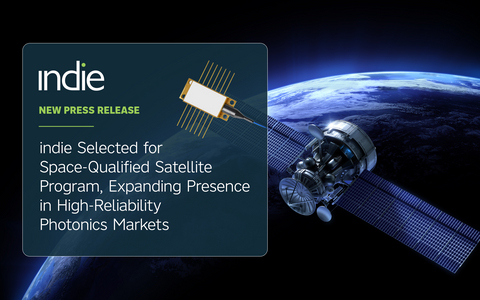
indie Selected for Space-Qualified Satellite Program, Expanding Presence in High-Reliability Photonics Markets
CHIME is a key expansion of Copernicus,
indie's broadband SLEDs at a wavelength of 1550 nm will serve as highly stable onboard optical reference sources to calibrate the mission's hyperspectral imaging instrument throughout its operational life. Maintaining this calibration is critical to ensuring the long-term accuracy and consistency of the environmental data collected from orbit.
The selected SLED platform combines high optical power, broad spectral output, and exceptional long-term stability, making it ideally suited for precision sensing and instrumentation applications operating in demanding environments. Beyond Earth observation systems, indie’s broadband 1550nm SLED devices are widely used as light sources in fiber optic gyroscopes (FOGs), enabling highly accurate navigation, guidance, and stabilization in aerospace and defense systems. FOG-based solutions are deployed across a broad range of applications, including unmanned vehicles (UAVs), commercial and military aircraft, helicopters, drones, autonomous platforms, and space systems, building on indie Photonics' growing heritage in space-qualified optical technologies.
"Being selected for CHIME is a proud moment for our Photonics team and a strong endorsement of our SLED technology," said Philipp Vorreau, VP & General Manager, SLEDs Photonics Division. "Space missions demand exceptional performance and reliability, with little margin for error. This award reflects years of engineering excellence and validates our ability to deliver high-performance optical components for some of the world’s most demanding applications. We see significant opportunities to expand our presence in space and other high-reliability markets where photonic performance and quality are mission-critical."
The SLEDs will be deployed aboard multiple CHIME satellites, currently scheduled for launch in 2028 and 2030.
About indie
Headquartered in Aliso Viejo, CA, indie is accelerating ADAS intelligence across automotive, quantum, and Physical AI applications through next-generation hardware, system solutions, and perception software technologies. Developing high-performance, energy-efficient semiconductors, photonic, and software solutions, we are enabling machines to perceive, understand, and interact with the physical world. Spanning radar, computer vision, LiDAR, and ultrasound, our platforms power advanced safety, automation, positioning, and automated capabilities for leading automotive OEMs, intelligent machines, and emerging AI-driven systems worldwide.
Please visit us at www.indie.inc to learn more.
#indieSemi_Product
View source version on businesswire.com: https://www.businesswire.com/news/home/20261021415025/en/
Media Inquiries
media@indie.inc
Investor Relations
IR@indie.inc
Source: indie Semiconductor