
Leidos autonomy earns its place at RIMPAC and with carrier strike group
Leidos highlights growing real-world use of its LAVA-powered unmanned surface vessels in large Navy exercises and carrier strike group operations.
Sentiment and the balance of points
Rhea-AI Sentiment reads the wording of the document, how positive or negative its language is on a 1 to 5 scale. The balance of points shown with the takes weighs what the document actually discloses, so the two can disagree, for example when a trial that missed its main goal is described in upbeat language.
Rhea-AI Summary
Leidos (LDOS) reports two new milestones for its maritime autonomy technology with Sea Hunter at RIMPAC 2026 and Seahawk operating with the USS Theodore Roosevelt Carrier Strike Group.
Sea Hunter, the only Medium Unmanned Surface Vessel at RIMPAC, used Leidos Autonomous Vessel Architecture (LAVA) to autonomously sail over 2,000 nautical miles between Pearl Harbor and San Diego, conduct surveillance, and perform manned-unmanned teaming. Seahawk is described as the first MUSV to deploy operationally with a carrier strike group, demonstrating autonomous navigation, COLREGs-compliant collision avoidance, keep-out zone avoidance, communications failover with remote control, and GPS-denied navigation. Leidos states its autonomous maritime portfolio has logged over 200,000 autonomous nautical miles and 14,000 hours of safe autonomous operation over more than a decade.
Details
News Market Reaction – LDOS
On Sep 8, the day this news came out, LDOS closed 2.86% below the previous close.
Data tracked by StockTitan Argus for the Sep 8 session.
Key Figures
- Autonomous transit
- More than 2,000 nautical miles
- Sea Hunter operation from Pearl Harbor to San Diego
- Autonomous operation
- Over 200,000 nautical miles
- Leidos autonomous maritime portfolio
- Safe autonomous operation
- 14,000 hours
- Leidos autonomous maritime portfolio
- Development experience
- More than a decade
- Autonomous maritime development and operations
Key Terms
medium unmanned surface vessel technical
colregs regulatory
manned-unmanned teaming technical
AI-generated analysis. How Rhea-AI works. Not financial advice.




Why it matters: The milestones reinforce the growing role of autonomous vessels and mark a milestone in moving these systems from experimentation to the
At RIMPAC 2026
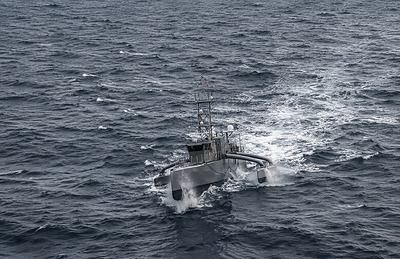
Sea Hunter, originally developed by Leidos, participated in RIMPAC as the exercise's only Medium Unmanned Surface Vessel (MUSV).
Powered by the Leidos Autonomous Vessel Architecture (LAVA), Sea Hunter:
- Operated autonomously more than 2,000 nautical miles from
Pearl Harbor, Hawaii , toSan Diego, California - Demonstrated autonomous surveillance
- Demonstrated manned-unmanned teaming, operating as part of a larger naval force as well as a stand-alone platform
With the USS Theodore Roosevelt Carrier Strike Group
Seahawk is operating alongside crewed naval forces as the first MUSV to deploy operationally with a carrier strike group.
Operating within the strike group's communications, command-and-control and operational framework, Seahawk's capabilities include:
- Autonomous navigation and perception
- Collision avoidance: Compliance with International Regulations for Preventing Collisions at Sea (COLREGs) and hazard avoidance
- Keep Out Zone avoidance: Automatically navigates around designated restricted areas
- Communications failover and remote control: Maintains control through alternate communications paths
- GPS-denied navigation: Followed commanded waypoints without GPS and reintegrated GPS while remaining on track
Expert perspective
"Sea Hunter and Seahawk show what more than a decade of operating autonomy at sea brings to the mission," said Mike Rickels, Leidos senior vice president for Maritime. "Real-world operations validate performance while providing lessons that further refine autonomy for future missions."
The technology
Sea Hunter and Seahawk are powered by LAVA, the modular software that enables autonomous navigation, mission execution, obstacle avoidance and other critical functions. It also provides a common autonomy foundation that can support different vessels and mission requirements.
By the numbers
Across its autonomous maritime portfolio, Leidos vessels and autonomy software have accumulated:
- Over 200,000 nautical miles of autonomous operation
- 14,000 hours of safe autonomous operation
- More than a decade of autonomous maritime development and operational experience
The big picture
Leidos' experience extends beyond autonomous navigation. In 2021, the Leidos-built MUSV Ranger, operating with LAVA, test-fired an SM-6 Standard Missile from a modular launch system as part of the Navy's Ghost Fleet Overlord program.
Together, Sea Hunter, Seahawk and Ranger demonstrate the breadth of Leidos maritime autonomy across vessels, missions and operating environments.
About Leidos
Leidos is an industry and technology leader serving government and commercial customers with smarter, more efficient digital and mission innovations. Headquartered in Reston, Virginia, with approximately 50,000 global employees, Leidos reported annual revenues of approximately
Certain statements in this announcement constitute "forward-looking statements" within the meaning of the rules and regulations of the U.S. Securities and Exchange Commission (SEC). These statements are based on management's current beliefs and expectations and are subject to significant risks and uncertainties. These statements are not guarantees of future results or occurrences. A number of factors could cause our actual results, performance, achievements, or industry results to be different from the results, performance, or achievements expressed or implied by such forward-looking statements. These factors include, but are not limited to, the "Risk Factors" set forth in Leidos' Annual Report on Form 10-K for the fiscal year ended January 2, 2026, and other such filings that Leidos makes with the SEC from time to time. Readers are cautioned not to place undue reliance on such forward-looking statements, which speak only as of the date hereof. Leidos does not undertake to update forward-looking statements to reflect the impact of circumstances or events that arise after the date the forward-looking statements were made.
Media Contact:
Brandon Ver Velde
brandon.p.vervelde@leidos.com
(571) 526-6257
 View original content to download multimedia:https://www.prnewswire.com/news-releases/leidos-autonomy-earns-its-place-at-rimpac-and-with-carrier-strike-group-302872671.html
SOURCE Leidos Holdings, Inc.
FAQ
AI-generated questions and answers. How Rhea-AI works. Not financial advice.
What role did Sea Hunter play during RIMPAC 2026?
Sea Hunter participated in RIMPAC 2026 as the exercise's only Medium Unmanned Surface Vessel (MUSV). Powered by the Leidos Autonomous Vessel Architecture (LAVA), it operated autonomously for more than 2,000 nautical miles between Pearl Harbor, Hawaii, and San Diego, California, demonstrated autonomous surveillance, and conducted manned-unmanned teaming both within a larger naval force and as a stand-alone platform.
How is Seahawk being used with the USS Theodore Roosevelt Carrier Strike Group?
Seahawk is operating alongside crewed naval forces as the first MUSV to deploy operationally with a carrier strike group. Within the group's communications, command-and-control and operational framework, its capabilities include autonomous navigation and perception, collision avoidance compliant with COLREGs, keep-out zone avoidance, communications failover with remote control, and GPS-denied navigation with reintegration of GPS while remaining on track.
What is the Leidos Autonomous Vessel Architecture (LAVA)?
LAVA is the modular software that powers Sea Hunter, Seahawk and other Leidos autonomous vessels. It enables autonomous navigation, mission execution, obstacle avoidance and other critical functions, and provides a common autonomy foundation that can support different vessels and mission requirements.
What operational experience has Leidos accumulated in autonomous maritime systems?
Across its autonomous maritime portfolio, Leidos reports that its vessels and autonomy software have accumulated over 200,000 nautical miles of autonomous operation, 14,000 hours of safe autonomous operation, and more than a decade of autonomous maritime development and operational experience.
How does the MUSV Ranger fit into Leidos' maritime autonomy portfolio?
Leidos notes that in 2021 the Leidos-built MUSV Ranger, operating with LAVA, test-fired an SM-6 Standard Missile from a modular launch system as part of the U.S. Navy's Ghost Fleet Overlord program, illustrating the use of its autonomy technology in weapons-related testing.