
Perpetua Announces New Gold Discovery at Stibnite Gold Project & Continued High Grades from Clark Tunnel Fault Zone
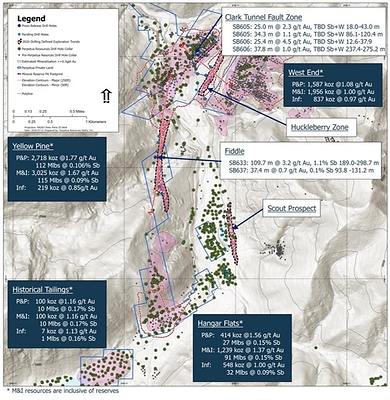
Fiddle drilling has traced the mineralized structure along approximately 600 meters of strike and more than 300 meters vertically.
Sentiment and the balance of points
Rhea-AI Sentiment reads the wording of the document, how positive or negative its language is on a 1 to 5 scale. The balance of points shown with the takes weighs what the document actually discloses, so the two can disagree, for example when a trial that missed its main goal is described in upbeat language.
Rhea-AI Summary
Perpetua Resources (PPTA) reported a new gold-antimony discovery at Fiddle and additional gold drill results from Stibnite’s Clark Tunnel Fault Zone. Fiddle hole SB633 returned 109.7 meters grading 3.2 grams per tonne gold and 1.1% antimony, beginning 189 meters downhole. Fiddle lies approximately 750 meters south of the permitted Yellow Pine pit; hole SB637 extended mineralization 110 meters north.
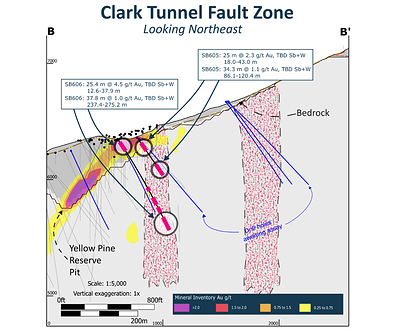
At the Clark Tunnel Fault Zone, SB606 returned 25.4 meters grading 4.5 grams per tonne gold from 12.6 meters downhole, while SB605 returned 25.0 meters grading 2.3 grams per tonne from 18 meters. Antimony and tungsten assays remain pending. Perpetua sees potential for this zone, partly within the permitted pit, to supplement early production. The completed 2026 program exceeded 16,000 meters of core drilling, with further results expected over the coming months.
Positive
- Minor pointFiddle SB633 returned 109.7 meters at 3.2 g/t gold and 1.1% antimony from 189 meters downhole.
- Minor pointClark Tunnel SB606 returned 25.4 meters at 4.5 g/t gold from 12.6 meters downhole.
- Minor pointClark Tunnel SB605 returned 25.0 meters at 2.3 g/t gold from 18 meters downhole.
- Minor pointFiddle SB637 extended mineralization 110 meters north, returning 37.4 meters at 0.7 g/t gold and 0.1% antimony.
- Minor pointFiddle SB643 returned 7.2 meters at 1.7 g/t gold and 0.5% antimony from 96.7 meters downhole.
10 minor points
- Minor pointFiddle SB646 returned 6.0 meters at 0.3 g/t gold and 0.1% antimony from 141.0 meters downhole.
- Minor pointClark Tunnel SB605 also returned 34.3 meters at 1.1 g/t gold from 86.1 meters downhole.
- Minor pointClark Tunnel SB606 also returned 37.8 meters at 1.0 g/t gold from 237.4 meters downhole.
- Minor pointClark Tunnel SB606 returned 9.5 meters at 0.5 g/t gold from 150.2 meters downhole.
- Minor pointClark Tunnel SB606 returned 21.0 meters at 0.5 g/t gold from 180.1 meters downhole.
- Minor pointClark Tunnel SB606 returned 16.5 meters at 0.4 g/t gold from 207.5 meters downhole.
- Minor pointFiddle drilling traced mineralization along approximately 600 meters of strike and more than 300 meters vertically.
- Minor pointClark Tunnel drilling defined the zone over 200 meters of strike and down to 50 meters depth.
- Minor point. Forward-looking: it has not happened yet and may not happen.Perpetua sees potential to supplement early Yellow Pine production with Clark Tunnel mineralization.
- Minor pointThe 2026 exploration program completed over 16,000 meters of core drilling.
Negative
- Minor pointClark Tunnel antimony and tungsten assays remain pending; an additional four holes also await assays.
- Minor pointFiddle holes SB665 and SB671 await assays; visual mineralization observations are not substitutes for measured results.
Details
Market Reaction – PPTA
On Nov 4, the day this news came out, the latest delayed price for PPTA is 0.24% above the previous close. Our momentum scanner has recorded 25 alerts for this stock so far that day. The latest delayed price is $16.39. Relative volume is very high at 4.3x what this stock usually trades by this time of day.
Data tracked by StockTitan Argus (15 min delayed). Upgrade to Gold for real-time data.
Key Figures
- Exploration drilling completed
- Over 16,000 meters
- 2026 Exploration Drilling Program
- Fiddle discovery hole SB633
- 109.7 meters grading 3.2 g/t gold and 1.1% antimony
- Initial assay results
- CTFZ hole SB606
- 25.4 meters grading 4.5 g/t gold
- Follow-up drilling
- CTFZ hole SB605
- 25.0 meters grading 2.3 g/t gold
- Follow-up drilling
Historical Context
-
Earlier CTFZ drilling reported high-grade gold-antimony and gold-tungsten intercepts, providing direct follow-up context.
24h Move is the share-price change in the day after each event; other market factors may also have contributed.
Key Terms
stibnite technical
scheelite technical
xrf technical
ni 43-101 regulatory
AI-generated analysis. How Rhea-AI works. Not financial advice.


First drill hole at the Fiddle prospect returns 109.7 m of 3.2 g/t Au and
Clark Tunnel Fault Zone drilling returns 25.4 m of 4.5 g/t Au and 25.0 m of 2.3 g/t Au
Initial assays from the Fiddle target returned 109.7 meters grading 3.2 g/t gold,
Follow-up drilling from the Clark Tunnel Fault Zone ("CTFZ") continued to demonstrate near-surface, high grades including 25.4 meters of 4.5 g/t gold from 13 meters downhole (SB606) and 25.0 meters of 2.3 g/t gold from 18 meters downhole (SB605). Antimony and tungsten assay results for these holes are currently pending. Recently identified high-grade Au-Sb mineralization in the CTFZ is partly within the permitted
"Given their close proximity to the permitted
Fiddle Discovery
Fiddle's discovery hole, SB633, returned 109.7 meters grading 3.2 g/t gold and
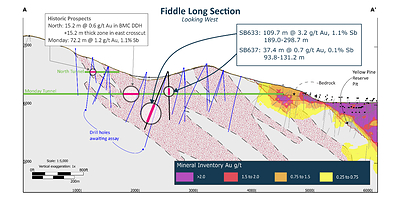
Holes SB643 and SB646 were drilled from a pad located approximately 200 meters to the north of SB633 and in an easterly orientation to better define the geometry of the MCFZ. Assays from this drilling included 7.2 meters grading 1.7 g/t gold,
An additional 21 holes totaling 6,188 meters were subsequently drilled on strike to the north and south of SB633. Two subsequent holes, SB665 and SB671, were collared from pads south of SB633 and oriented west to target the core of the interpreted Fiddle structure. Core logging identified similar style mineralization to those logged in hole SB633, including abundant stibnite and sulfides within the mineralized zones. While these visual and structural observations are encouraging, they are not a substitute for assay results, and there can be no assurance that subsequent holes will return grades or widths comparable to SB633. With significant drilling completed this season, Company staff continues to process and log core ahead of assaying with a significant quantity of new results expected over the coming months.
Fiddle was among the key targets identified for testing under the Company's 2026 exploration program. Combining historical drilling and sampling data from underground workings, Perpetua identified the Fiddle prospect as a highly prospective corridor with the potential to host stacked mineralized lenses akin to those defined at the Hangar Flats deposit on trend to the south. Located along the MCFZ, drilling to date has traced the mineralized structure along approximately 600 meters of strike length and across more than 300 meters of vertical extent, north and south of and beneath Fiddle.
Clark Tunnel Fault Zone (CTFZ) Follow-Up Drilling
The
New results from the CTFZ continued to demonstrate near-surface, high-grade gold including 25.4 meters of 4.5 g/t from 13 meters downhole (SB606) and 25.0 meters of 2.3 g/t from 18 meters downhole (SB605). Both stibnite and scheelite, a tungsten-bearing mineral, were observed during core logging. Antimony and tungsten assay results for these holes are currently pending and will be reported once received. These high-grade results follow Perpetua's first holes in this zone which were announced in August 2026. Those included SB580 returning 6.4 meters of 16.2 g/t gold and
Website: www.perpetuaresources.com
About Perpetua Resources and the Stibnite Gold Project
Perpetua Resources Corp., through its wholly owned subsidiaries, is focused on the exploration, site restoration, and redevelopment of gold-antimony-tungsten deposits in the Stibnite-Yellow Pine district of central Idaho. The Stibnite Gold Project is one of the highest-grade, open-pit gold deposits in the United States and holds the only identified domestic reserve of the critical mineral antimony, which is essential to the defense, energy, and manufacturing sectors. The Project is designed to apply a modern, responsible mining approach to restore a historic mine site and provide uplift to water quality, improve fish habitat access, and invest in river restoration while supporting local economic development in rural Idaho.
Cautionary Statement Regarding Technical Information
The technical information in this news release has been prepared in accordance with the mining property disclosure rules specified in Regulation S-K subpart 1300 ("S-K 1300") promulgated by the Securities and Exchange Commission and Canadian regulatory requirements set out in National Instrument 43-101 and has been reviewed and approved by Christopher Dail, CPG, Director Exploration, and a Qualified Person. Mr. Dail is not independent of the issuer.
There can be no assurance that exploration activities will result in the discovery of additional resources or reserves, and isolated exploration results may not be indicative of the occurrence of a mineral deposit. Such results do not provide assurance that further work will establish sufficient grade, continuity, metallurgical characteristics, and economic potential to be classified as a mineral resource. Exploration results are inherently uncertain and subject to numerous risks and uncertainties, including geological factors, market conditions, and regulatory changes. Any development of additional resources or reserves discovered would be subject to applicable NEPA and permitting requirements.
Quality Assurance
The exploration activities at the Stibnite Gold Project site were carried out under the supervision of Christopher Morgan, CPG, and Christopher Dail, CPG, both Qualified Persons as defined in NI 43-101 and in S-K 1300.
Samples were handled and shipped via Chain of Custody Procedures. Analyses were carried out by ALS Global Laboratories in their Reno and Elko, Nevada and Vancouver, British Columbia laboratories and by MSA Laboratories in Elko, Nevada and Langley, British Columbia.
All gold assays were determined using photon assay techniques which include a 0.015 g/t lower reporting limit. Antimony assays were determined using pressed pellet XRF and include a lower reporting limit of
Umpire samples are routinely submitted to third-party labs and blank and standard samples are inserted at appropriate intervals for quality assurance and quality control. A review of the results of analyses of blanks, standards and duplicates by the Company's Qualified Person indicates values are within normal and acceptable ranges.
See the Company's press release issued on August 6, 2026, for technical information and quality assurance regarding the previously reported results of the drill program.
Forward-Looking Information
Statements contained in this news release that are not historical facts are "forward-looking information" or "forward-looking statements" (collectively, "Forward-Looking Information") within the meaning of applicable Canadian securities legislation and the United States Private Securities Litigation Reform Act of 1995. In certain cases, Forward-Looking Information can be identified by the use of words and phrases or variations of such words and phrases or statements such as "anticipate", "expect", "plan", "likely", "believe", "intend", "forecast", "project", "estimate", "potential", "could", "may", "will", "would" or "should". Forward-Looking Information includes, but is not limited to, ongoing exploration and development for the project; the expected outcomes and benefits of the Project, including production rates and mineral reserves and mineral resources; the interpretation of drill results; the potential to supplement or expand existing mine plans; and the potential for future permitting or regulatory approvals related to areas outside the currently permitted Project scope with respect to any such additional resources and reserves. In preparing the Forward-Looking Information in this news release, Perpetua Resources has applied several material assumptions, including, but not limited to, that the current exploration, development, environmental and other objectives concerning the Project can be achieved and that the Company's other corporate activities will proceed as expected; that general business and economic conditions will not change in a materially adverse manner and that permitting, construction and operations costs will not materially increase; that the Company will satisfy or will continue to satisfy the requirements of applicable permits and the requirements of various governmental approvals; and assumptions made in the interpretation of drill results, the geology, grade and continuity of mineral deposits. Forward-Looking Information involves known and unknown risks, uncertainties and other factors which may cause the actual results, performance or achievements of Perpetua Resources to be materially different from any future results, performance or achievements expressed or implied by the Forward-Looking Information. Such risks and other factors include, among other things, risks that exploration results may not support the conversion of mineralization into resources or reserves; that additional environmental review or permitting may be required for activities outside the currently permitted Project scope; risks related to unforeseen delays in the review and permitting process, including as a result of legal challenges to the Record of Decision or other permits; risks related to increased or unexpected costs in development, construction, operations or the permitting process; risks that necessary financing will be unavailable when needed on acceptable terms, or at all, as well as those factors discussed in Perpetua Resources' public filings with the U.S. Securities and Exchange Commission (the "SEC") and its Canadian disclosure record. Although the Company has attempted to identify important factors that could affect the Company and may cause actual actions, events or results to differ materially from those described in Forward-Looking Information, there may be other factors that cause actions, events or results not to be as anticipated, estimated or intended. Because it is not possible to predict or identify all such factors, this list cannot be considered a complete set of all potential risks or uncertainties. Accordingly, readers should not place undue reliance on Forward-Looking Information. For further information on these and other risks and uncertainties that may affect the Company's business and liquidity, see the "Risk Factors" and "Management's Discussion and Analysis of Financial Condition and Results of Operations" sections of the Company's filings with the SEC, which are available at www.sec.gov and with the Canadian securities regulators, which are available at www.sedarplus.ca. Except as required by law, the Company expressly disclaims any obligation to update the Forward-Looking Information herein.
APPENDIX
|
Perpetua Resources - Appendix - Interval Data |
|
|
|
|
|||||||
|
Hole ID |
NAD83 UTM Zone 11N |
Orientation |
Interval (m) |
Grade |
|
||||||
|
Easting |
Northing |
Azimuth |
Dip |
From |
To |
Width |
Au |
Sb |
W |
||
|
Clark Tunnel Fault Zone (CTFZ) |
|
|
|
|
|
|
|
|
|||
|
SB605 |
631741 |
4976649 |
135 |
55 |
18.0 |
43.0 |
25.0 |
2.3 |
AA |
AA |
|
|
SB605 |
|
|
|
|
86.1 |
120.4 |
34.3 |
1.1 |
AA |
AA |
|
|
SB606 |
631671 |
4976644 |
129 |
60 |
12.6 |
37.9 |
25.4 |
4.5 |
AA |
AA |
|
|
|
|
|
including |
|
25.9 |
33.7 |
7.8 |
11.0 |
AA |
AA |
|
|
SB606 |
|
|
|
|
150.2 |
159.8 |
9.5 |
0.5 |
AA |
AA |
|
|
SB606 |
|
|
|
|
180.1 |
201.1 |
21.0 |
0.5 |
AA |
AA |
|
|
SB606 |
|
|
|
|
207.5 |
224.0 |
16.5 |
0.4 |
AA |
AA |
|
|
SB606 |
|
|
|
|
237.4 |
275.2 |
37.8 |
1.0 |
AA |
AA |
|
|
Fiddle Prospect |
|
|
|
|
|
|
|
|
|
||
|
SB633 |
631179 |
4975239 |
161 |
66 |
189.0 |
298.7 |
109.7 |
3.2 |
1.1 |
AA |
|
|
|
|
|
including |
|
218.9 |
220.9 |
2.0 |
10.5 |
0.2 |
AA |
|
|
SB637 |
631180 |
4975242 |
93 |
62 |
93.8 |
131.2 |
37.4 |
0.7 |
0.1 |
AA |
|
|
SB643 |
631209 |
4975442 |
87 |
63 |
96.7 |
103.8 |
7.2 |
1.7 |
0.5 |
AA |
|
|
SB646 |
631209 |
4975442 |
93 |
76 |
141.0 |
147.0 |
6.0 |
0.3 |
0.1 |
AA |
|
|
|
|
|
|
|
|
|
|
|
|
|
|
|
*AA - awaiting antimony and tungsten assays |
|
|
|
|
|
|
|||||
|
Note: Some intervals may not add or subtract correctly due to rounding, but differences are deemed insignificant |
|
||||||||||

 View original content to download multimedia:https://www.prnewswire.com/news-releases/perpetua-announces-new-gold-discovery-at-stibnite-gold-project--continued-high-grades-from-clark-tunnel-fault-zone-302929850.html
SOURCE Perpetua Resources Corp.
FAQ
AI-generated questions and answers. How Rhea-AI works. Not financial advice.
What did Perpetua Resources discover at the Fiddle prospect?
Fiddle hole SB633 intersected 109.7 meters grading 3.2 grams per tonne gold and 1.1% antimony, beginning 189 meters downhole. The prospect is approximately 750 meters south of the permitted Yellow Pine pit at the Stibnite Gold Project.
What were Perpetua Resources’ latest Clark Tunnel Fault Zone gold results?
Hole SB606 returned 25.4 meters grading 4.5 grams per tonne gold from 12.6 meters downhole, and SB605 returned 25.0 meters grading 2.3 grams per tonne gold from 18 meters downhole. Antimony and tungsten assays for these holes remain pending.
How much additional drilling did Perpetua Resources complete around the Fiddle discovery?
Perpetua drilled an additional 21 holes totaling 6,188 meters along strike north and south of SB633. Holes SB665 and SB671 were drilled from pads south of SB633 and oriented west to target the core of the interpreted Fiddle structure; both await assay results.