
Perpetua Resources Reports New High-Grade Gold and Antimony Discoveries and a New Gold-Tungsten Zone at Stibnite
Perpetua Resources (Nasdaq/TSX: PPTA) reported first exploratory drilling in nearly a decade at its Stibnite district in Idaho, confirming multiple high‑grade gold, antimony and tungsten intercepts at Yellow Pine and Hangar Flats.
Rhea-AI Summary
Perpetua Resources (Nasdaq/TSX: PPTA) reported first exploratory drilling in nearly a decade at its Stibnite district in Idaho, confirming multiple high‑grade gold, antimony and tungsten intercepts at Yellow Pine and Hangar Flats. New results include 21.3 meters grading 3.2 g/t gold and 0.9% tungsten at the Clark Tunnel Fault Zone and 6.4 meters grading 16.2 g/t gold and 1.7% antimony near surface, plus 3.0 meters of 14.5 g/t gold at Hangar Flats.
Hangar Flats antimony‑tungsten holes returned up to 22.9 meters at 3.2% antimony and 1.2% tungsten, supporting tungsten as a new exploration focus and potential second critical mineral. A minimum 10,000‑meter 2026 core program is planned, with about 5,800 meters already drilled. The company highlights 3.1 million ounces of indicated and inferred gold and 99.8 million pounds of antimony located outside current reserves and has submitted U.S. grant proposals to fund tungsten‑focused drilling, sampling and metallurgical work.
Positive
- High-grade CTFZ intercepts up to 21.3m @ 3.2 g/t Au, 0.9% W
- Shallow Yellow Pine gold-antimony up to 6.4m @ 16.2 g/t Au, 1.7% Sb
- Hangar Flats antimony-tungsten up to 22.9m @ 3.2% Sb, 1.2% W
- Large 2026 drilling plan minimum 10,000 meters with four rigs
- Substantial resources outside reserves 3.1Moz Au and 99.8M lbs Sb
- U.S. grant proposals submitted for tungsten drilling and metallurgical work
Negative
- No assurance of receiving U.S. tungsten exploration grant funding
- Economically accessible tungsten quantities not yet demonstrated
- New target areas require additional environmental review and permitting before mining
News Explained
Tungsten becomes an exploration path, not a funded or permitted addition to Perpetua’s current mine plan.
Perpetua Resources reports that exploration drilling is underway and presents new gold, antimony and tungsten results, but the disclosure advances exploration rather than changing the currently permitted mining status.
The company characterizes tungsten as a potential second critical mineral, while stating that its grant proposal is not funded, economically accessible quantities have not been established, and any tungsten development would require separate environmental review and permitting.
The release places 3.1 million ounces of indicated and inferred gold resources and 99.8 million pounds of antimony resources outside current reserves and says the work could grow the resource base; it does not report an increase to reserves or the approved mine plan.
The specific follow-up is whether U.S. agencies fund the submitted proposal and whether subsequent drilling, sampling and metallurgical work establishes economically accessible tungsten quantities.
Details
News Market Reaction – PPTA
In the Aug 7 session, PPTA gained 8.28%, reflecting a notable positive market reaction. Argus tracked a peak move of +3.9% during that session. Our momentum scanner triggered 33 alerts that day, indicating elevated trading interest and price volatility. Trading volume was above average at 1.5x the daily average, suggesting increased trading activity.
Data tracked by StockTitan Argus on the day of publication.
Key Figures
- Gold-tungsten intercept
- 21.3 meters @ 3.2 g/t gold and 0.9% tungsten
- Yellow Pine CTFZ, Hole SB597
- Gold-antimony intercept
- 6.4 meters @ 16.2 g/t gold and 1.7% antimony
- Yellow Pine, Hole SB580
- Gold intercept
- 3.0 meters @ 14.5 g/t gold
- Hangar Flats NDMEA zone, Hole SB584
- Antimony-tungsten intercept
- 22.9 meters @ 3.2% antimony and 1.2% tungsten
- Hangar Flats, Hole SB519
- 2026 drilling plan
- 10,000 meters
- Minimum planned core drilling using 4 drill rigs
- Completed drilling
- 5,800 meters
- 2026 core drilling completed and in preparation for assay
- Gold resources outside reserves
- 3.1 million ounces
- Indicated and inferred resources outside current reserves
- Tungsten APT price increase
- more than 500%
- Increase from 2024 lows
Historical Context
-
Pilot plant launch advanced domestic antimony processing collaboration with U.S. agencies
-
Report detailed environmental, safety, financial assurance, and Idaho economic contributions
-
Shareholders elected directors and approved the equity incentive plan
-
Field-season construction advanced after court denial of preliminary injunction
-
EXIM Bank unanimously approved a $2.9 billion senior secured project loan
24h Move is the share-price change in the day after each event; other market factors may also have contributed.
Key Terms
scheelite technical
portable xrf technical
ni 43-101 regulatory
ammonium paratungstate technical
AI-generated analysis. How Rhea-AI works. Not financial advice.




First exploratory drilling in nearly a decade at Perpetua's
New gold-tungsten intercepts, alongside historic tungsten drill results and past production at Stibnite, establish tungsten as a new exploration focus and a potential second critical mineral at the Project
Company submits tungsten exploration funding proposal to
"Our focus is on drilling areas that align with our currently planned mining sequence with potential to directly add value," said Jon Cherry, President and CEO of Perpetua. "Our priority is testing higher-grade gold and antimony targets within our three permitted pits that could supplement our existing Stibnite Gold Project (the "Project") mine plan with the aim of sustaining or exceeding our estimated annual average production level of 463,0001 gold ounces beyond our first four years of production. We have also identified gold and antimony exploration targets with the potential to allow for extensions of the existing permitted pits within the Project and are evaluating opportunities to expand our overall resource base beyond the existing Project scope. This includes identifying potential sources of tungsten that could enhance the value of Perpetua's broader land package. These targets are based on previous drilling, historic mining activities and recently defined prospects across the broader, highly prospective land package. Any activity outside the scope of the currently permitted project may require additional regulatory review."
Recent drilling between the currently permitted
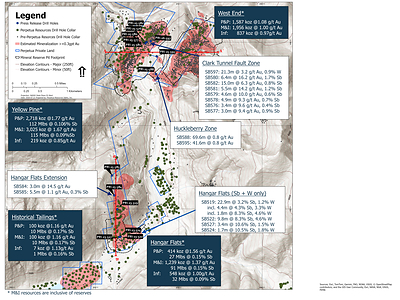
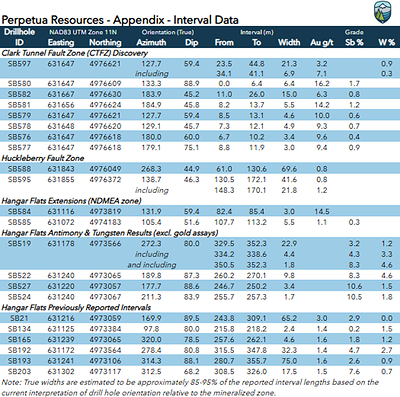
Exploration drilling is currently underway with 4 rigs and approximately 5,800 meters of new drilling complete to date. The results presented below are from recently completed drill programs totaling 8,340 meters, which was split between geotechnical drilling and exploration. Notable new intercepts include:
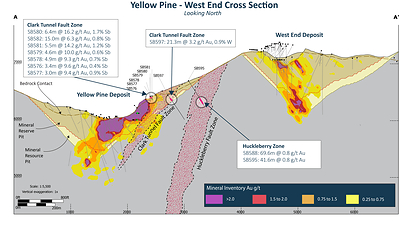
Yellow Pine Clark Tunnel Fault Zone (CTFZ) Discovery2
- Hole SB597: 21.3 meters of 3.2 g/t gold and
0.9% tungsten from 24 meter depth, incl. 7.0 meters grading 7.1 g/t gold and0.3% tungsten from 34 meter depth - Hole SB580: 6.4 meters of 16.2 g/t gold and
1.7% antimony from surface - Hole SB582: 15.0 meters of 6.3 g/t gold and
0.8% antimony from 11 meter depth - Hole SB581: 5.5 meters of 14.2 g/t gold and
1.2% antimony from 8 meter depth - Hole SB579: 4.6 meters of 10.0 g/t gold and
0.6% antimony from 9 meter depth - Hole SB578: 4.9 meters of 9.3 g/t gold and
0.7% antimony from 7 meter depth - Hole SB576: 3.4 meters of 9.6 g/t gold and
0.4% antimony from 7 meter depth - Hole SB577: 3.0 meters of 9.4 g/t gold and
0.9% antimony from 9 meter depth
Yellow Pine Huckleberry Fault Zone (HFZ)2
- Hole SB588: 69.6 meters of 0.8 g/t gold from 61 meter depth (Lower Huckleberry)
- Hole SB595: 41.6 meters of 0.8 g/t gold from 131 meter depth (Upper Huckleberry), including 21.8 meters of 1.2 g/t gold from 148 meters depth
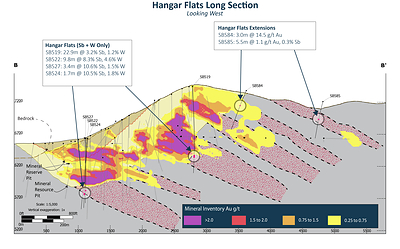
Hangar Flats Extensions (NDMEA zone)2
- Hole SB584: 3.0 meters of 14.5 g/t gold from 82 meter depth
- Hole SB585: 5.5 meters of 1.1 g/t gold and
0.3% antimony from 108 meter depth
Hangar Flats Antimony and Tungsten Results (excluding gold assays)2,3
- Hole SB519: 22.9 meters of
3.2% antimony and1.2% tungsten from 330 meter depth, incl. 4.4 meters of4.3% antimony and3.3% tungsten from 334 meter depth and 1.8 meters of8.3% antimony and4.6% tungsten from 351 meter depth - Hole SB522: 9.8 meters of
8.3% antimony and4.6% tungsten from 260 meter depth - Hole SB527: 3.4 meters of
10.6% antimony and1.5% tungsten from 247 meter depth - Hole SB524: 1.7 meters of
10.5% antimony and1.8% tungsten from 256 meter depth
2026 Drilling Program Highlights:
- A minimum of 10,000 meters of core drilling is planned for 2026 using 4 drill rigs with the ability to expand the program if warranted, based on results. Perpetua estimates approximately 5,800 meters of the 2026 core drilling program have been completed and are in preparation for assay.
- Initial drilling was planned for potential expansion of the gold and antimony pits in the currently approved mine plan will test along strike and at depth within the
Yellow Pine and Hangar Flats deposits. This includes follow-up drilling on the Clark Tunnel Fault Zone and Huckleberry Fault Zone - Definition drilling within existing approved footprints is planned with the goal of upgrading inferred resources to measured and indicated categories. Additional testing is also planned for several known high-grade targets near the current pits and located close to planned future milling infrastructure
- Any future development of target exploration areas that are not approved for mining in the current plan of operations will require additional environmental review and permitting to be completed before mining could commence in these areas
Tungsten Emerges as Additional Strategic Opportunity at Stibnite
During the first half of 2026, Perpetua became aware of
In its grant proposal, Perpetua proposed to embark on a program focused on drilling and metallurgical sampling beneath the Hangar Flats pit. This work would serve a dual strategic purpose of enabling drilling to test known high-grade antimony-tungsten mineralization at depth while simultaneously providing additional testing of significant gold and antimony resources previously identified but not included in Perpetua's current mine plan. Previously reported drill holes (listed below) indicate the promising potential for recovery of tungsten near areas in the existing mine plan.
Hangar Flats Previously Released Gold, Antimony and Tungsten Intercepts
- Hole SB21: 65.2 meters of 3.0 g/t gold,
2.9% antimony,0.04% tungsten from 244 meter depth - Hole SB134: 2.4 meters of 1.4 g/t gold,
0.2% antimony,1.52% tungsten from 216 meter depth - Hole SB165: 4.6 meters of 1.6 g/t gold,
1.8% antimony,1.17% tungsten from 258 meter depth - Hole SB192: 32.3 meters of 1.4 g/t gold,
4.7% antimony,2.66% tungsten from 316 meter depth - Hole SB193: 75.0 meters of 1.6 g/t gold,
2.6% antimony,0.88% tungsten from 281 meter depth - Hole SB203: 17.5 meters of 1.5 g/t gold,
7.6% antimony,0.71% tungsten from 309 meter depth
Global Export Restrictions Have Made Tungsten High Priority Once Again
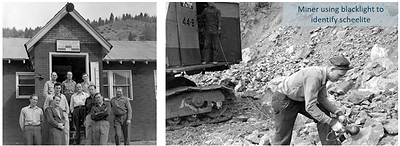
Historically, the Stibnite district was not only a major producer of antimony, but also one of America's most significant historical tungsten-producing regions. Following the discovery of tungsten at
Following the war, the
Website: www.perpetuaresources.com
About Perpetua Resources and the Stibnite Gold Project
Perpetua Resources Corp., through its wholly owned subsidiaries, is focused on the exploration, site restoration, and redevelopment of gold-antimony-silver deposits in the Stibnite-Yellow Pine district of central Idaho. The Stibnite Gold Project is one of the highest grade, open pit gold deposits in the United States and holds the only identified domestic reserve of the critical mineral antimony, which is essential to the defense, energy, and manufacturing sectors. The Project is designed to apply a modern, responsible mining approach to restore an abandoned mine site and provide uplift to water quality, improve fish habitat access, and invest in river restoration while supporting local economic development in rural Idaho.
Cautionary Statement Regarding Technical Information
The technical information in this news release has been prepared in accordance with the mining property disclosure rules specified in Regulation S-K subpart 1300 ("S-K 1300") promulgated by the Securities and Exchange Commission and Canadian regulatory requirements set out in National Instrument 43-101 ("NI 43-101"), and has been reviewed and approved by Christopher Dail, CPG, Director, Exploration, and a Qualified Person as defined in NI 43-101 and in S-K 1300. Mr. Dail is not independent of the issuer.
Except for the exploration results presented herein, the technical and reserves information in respect of the Stibnite Gold Project in this news release is based upon information contained in the technical report titled "Stibnite Gold Project, S-K 1300 Technical Report Summary, Valley County, Idaho, USA," dated as of December 31, 2025 (the "TRS"), developed for the Stibnite Gold Project in accordance with S-K 1300 and published on March 31, 2026. Such information is as of December 31, 2025 and is subject to the assumptions, exclusions and qualifications set forth in the TRS. For additional information regarding the TRS, investors are encouraged to refer to the Company's Annual Report on Form 10-K for the year ended December 31, 2025, filed with the SEC on March 31, 2026.
There can be no assurance that exploration activities will result in the discovery of additional resources or reserves and isolated exploration results may not be indicative of the occurrence of a mineral deposit. Such results do not provide assurance that further work will establish sufficient grade, continuity, metallurgical characteristics and economic potential to be classed as a category of mineral resource. Exploration results are inherently uncertain and subject to numerous risks and uncertainties, including geological factors, market conditions, and regulatory changes. Furthermore, development of any additional resources and reserves discovered would be subject to any applicable NEPA and permitting requirements.
Data regarding domestic antimony and tungsten reserves are based on U.S. Geological Survey, Mineral Commodity Summaries, dated as of January 2026.
Quality Assurance
The exploration activities at the Stibnite Gold Project site were carried out under the supervision of Richard Moses, C.P.G., Christopher Dail, C.P.G., Austin Zinsser, SME-R.M., and Kent Turner, SME-R.M., all Qualified Persons as defined in NI 43-101 and in S-K 1300.
All gold assays are by a 30g Fire Assay charge followed by an atomic absorption finish (with a 0.005g/t lower reporting limit). Samples reporting values > 6g/t gold are re-analyzed using a 30g Fire Assay charge followed by a gravimetric finish. Silver is analyzed via a 4-acid digestion followed by an ICP finish (with a 0.5g/t lower reporting limit). Samples reporting values > 10g/t silver are reanalyzed using a 50g Fire Assay charge followed by a gravimetric finish. Antimony is analyzed via a 4-Acid digestion with ICP finish with a 5g/t lower reporting limit. Samples reporting values >500g/t antimony are reanalyzed using XRF fusion. Some intervals may not add or subtract correctly due to rounding, but differences are deemed insignificant.
Samples were handled, shipped via Chain of Custody Procedures. Analyses were carried out by ALS Global Laboratories in their Reno and Elko, Nevada and Vancouver, British Columbia laboratories. Umpire samples are routinely submitted to third party labs and blank and standard samples are inserted at appropriate intervals for quality assurance and quality control. A review of the results of analyses of blanks, standards and duplicates by the Company's Qualified Person indicates values are within normal and acceptable ranges.
Antimony and tungsten analysis for Hangar Flats drill holes SB519-SB527 were performed with a Vanta Portable XRF in the field. Multiple readings were collected and averaged. The XRF protocol entailed analysis of reference standards and a blank sample throughout the use of the instrument. Overall, 99 non-duplicate analyses with appropriate data formatting were collected from QA/QC samples, representing approximately
Forward-Looking Information
Investors should be aware that no funding has been committed in connection with the Company's application for grant funding for tungsten exploration. There is no assurance that the application will be successful and, if successful, whether any funding awarded will be sufficient to conduct the proposed exploration activities or that such exploration will produce positive results.
Statements contained in this news release that are not historical facts are "forward-looking information" or "forward-looking statements" (collectively, "Forward-Looking Information") within the meaning of applicable Canadian securities legislation and the United States Private Securities Litigation Reform Act of 1995. In certain cases, Forward-Looking Information can be identified by the use of words and phrases or variations of such words and phrases or statements such as "anticipate", "expect", "plan", "likely", "believe", "intend", "forecast", "project", "estimate", "potential", "could", "may", "will", "would" or "should". Forward-Looking Information includes, but is not limited to, planned exploration and development for the project, including with respect to antimony and tungsten; the Company's application for a grant related to tungsten exploration; the expected outcomes and benefits of the Project, including production rates and mineral reserves and mineral resources; and the potential for development of any additional resources and reserves and the permitting requirements with respect to any such additional resources and reserves. In preparing the Forward-Looking Information in this news release, Perpetua Resources has applied several material assumptions, including, but not limited to, that the current exploration, development, environmental and other objectives concerning the Project can be achieved and that the Company's other corporate activities will proceed as expected; that general business and economic conditions will not change in a materially adverse manner and that permitting, construction and operations costs will not materially increase; that the Company will satisfy or will continue to satisfy the requirements of applicable permits and the requirements of various governmental approvals; and assumptions made in the interpretation of drill results, the geology, grade and continuity of mineral deposits. Forward-Looking Information involve known and unknown risks, uncertainties and other factors which may cause the actual results, performance or achievements of Perpetua Resources to be materially different from any future results, performance or achievements expressed or implied by the Forward-Looking Information. Such risks and other factors include, among other things, risks related to unforeseen delays in the review and permitting process, including as a result of legal challenges to the ROD or other permits; risks related to increased or unexpected costs in development, construction, operations or the permitting process; risks that necessary financing will be unavailable when needed on acceptable terms, or at all, as well as those factors discussed in Perpetua Resources' public filings with the U.S. Securities and Exchange Commission (the "SEC") and its Canadian disclosure record. Although the Company has attempted to identify important factors that could affect the Company and may cause actual actions, events or results to differ materially from those described in Forward-Looking Information, there may be other factors that cause actions, events or results not to be as anticipated, estimated or intended. Because it is not possible to predict or identify all such factors, this list cannot be considered a complete set of all potential risks or uncertainties. Accordingly, readers should not place undue reliance on Forward-Looking Information. For further information on these and other risks and uncertainties that may affect the Company's business and liquidity, see the "Risk Factors" and "Management's Discussion and Analysis of Financial Condition and Results of Operations" sections of the Company's filings with the SEC, which are available at www.sec.gov and with the Canadian securities regulators, which are available at www.sedarplus.ca. Except as required by law, the Company expressly disclaims any obligation to update the Forward-Looking Information herein.
__________________________________ |
1 Based on average annual recovered gold for Years 1-4 as reported in the Technical Report Summary for the Project, dated as of December 31, 2025. See "Cautionary Statement Regarding Technical Information" below. |
2 True widths are estimated to be approximately 85 |
3 Antimony and tungsten drilling in the Hangar Flats deposit was designed to collect bulk samples for metallurgical testing. Drill core was analyzed on-site using portable XRF equipment, after which samples were composited and submitted to SVL Analytical ( |
4 "Stibnite Historic District," National Register of Historic Places Nomination Form, NPS Ref. No. 87001186 (listed July 19, 1987). |

 View original content to download multimedia:https://www.prnewswire.com/news-releases/perpetua-resources-reports-new-high-grade-gold-and-antimony-discoveries-and-a-new-gold-tungsten-zone-at-stibnite-302845507.html
SOURCE Perpetua Resources Corp.
FAQ
AI-generated questions and answers. How Rhea-AI works. Not financial advice.