
Stellantis Reports Q4 2025 Estimated Consolidated Shipments of 1.5 Million Units, +9% y-o-y
Stellantis (NYSE: STLA) estimated consolidated Q4 2025 shipments of 1.5 million units, a 9% year-over-year increase driven mainly by North America and growth across other regions.
Sentiment and the balance of points
Rhea-AI Sentiment reads the wording of the document, how positive or negative its language is on a 1 to 5 scale. The balance of points shown with the takes weighs what the document actually discloses, so the two can disagree, for example when a trial that missed its main goal is described in upbeat language.
Rhea-AI Summary
Stellantis (NYSE: STLA) estimated consolidated Q4 2025 shipments of 1.5 million units, a 9% year-over-year increase driven mainly by North America and growth across other regions.
North America shipments rose ~127,000 units (+43% y-o-y). Smart Car platform volumes increased by 61,000 units (+127% y-o-y). China, India & Asia Pacific grew ~3,000 units (+20% y-o-y). Enlarged Europe declined ~26,000 units (-4% y-o-y). Volumes are unaudited and may be adjusted.
Positive
- North America shipments +43% y-o-y (~127,000 units)
- Consolidated Q4 2025 shipments of 1.5 million units (+9% y-o-y)
- Smart Car platform volumes +127% y-o-y (+61,000 units)
- China, India & Asia Pacific shipments +20% y-o-y
Negative
- None.
Details
News Market Reaction – STLA
On Feb 6, the day this news came out, STLA closed 23.69% below the previous close.
Data tracked by StockTitan Argus for the Feb 6 session.
Key Figures
- Q4 2025 consolidated shipments
- 1.5 million units
- Three months ended Dec 31, 2025; estimated, unaudited
- Q4 shipment growth
- 9% y-o-y
- Consolidated shipments vs Q4 2024
- North America shipment increase
- 127 thousand units
- Q4 2025 vs Q4 2024; 43% y-o-y
- North America shipment growth
- 43% y-o-y
- Q4 2025 shipments vs prior-year quarter
- Q4 2025 orders growth NA
- 150% y-o-y
- Q4 2025 orders up nearly 150% vs Q4 2024
- Enlarged Europe shipment decline
- 26 thousand units
- Approximate decrease; 4% y-o-y down
- Smart Car platform increase
- 61 thousand units
- Additional units; 127% y-o-y growth in Enlarged Europe
- Other regions net growth
- 24 thousand units
- Aggregate increase across South America, MEA, China/India/APAC; 6% y-o-y
Historical Context
-
Launch marketing for 2026 Jeep Cherokee hybrid with pricing and efficiency details.
-
Dodge livery reveal and NHRA partnership visibility with Tony Stewart Racing.
-
New paid customization options for SIXPACK-powered 2026 Dodge Charger models.
-
Announcement of May 21, 2026 Investor Day to outline strategic plan.
-
Jeep becoming Global Automotive Partner of The Snow League in multi-season deal.
24h Move is the share-price change in the day after each event; other market factors may also have contributed.
Key Terms
phev technical
bev technical
mhev technical
ice technical
lcv technical
form 20-f regulatory
form 6-k regulatory
AI-generated analysis. How Rhea-AI works. Not financial advice.




Stellantis Reports Q4 2025 Estimated Consolidated Shipments of 1.5 Million Units, +
- North America Shipments Up
43% , with South America, Middle East & Africa and China and India & Asia Pacific Also Reporting Growth
AMSTERDAM, February 6, 2026 – Stellantis N.V. today released its consolidated shipment estimates. The term “shipments” describes the volume of vehicles delivered to dealers, distributors, or directly from the Company to retail and fleet customers, which drive revenue recognition.
Consolidated shipments for the three months ending December 31, 2025, were an estimated 1.5 million units, a
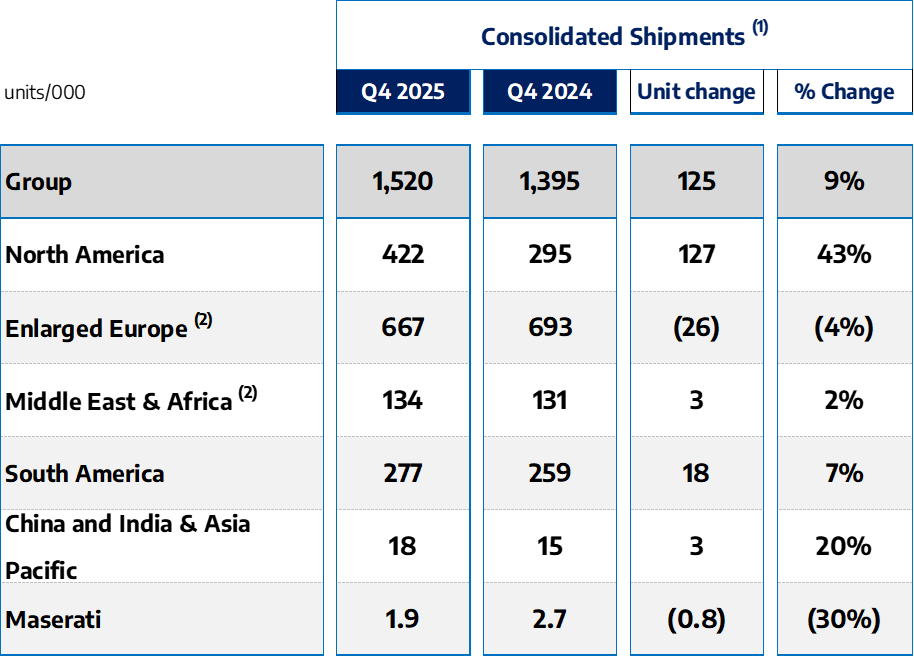
- In North America, Q4 shipments grew by approximately 127 thousand units compared to the same period in 2024, representing a
43% y-o-y increase. This significant improvement reflects the benefits of normalized inventory dynamics, in comparison to the prior year’s inventory reduction initiative, as well as increased momentum in the region with Q4 ’25 orders up nearly150% y-o-y, driven largely by new and refreshed offerings from Jeep®, Ram and Dodge brands. Shipments of the refreshed Jeep® Grand Cherokee and Ram LD HEMI® V8 accounted for over30% of y-o-y growth, partially offset by a decrease in PHEV shipments. - Enlarged Europe reported a decrease of approximately 26 thousand units, or
4% y-o-y. PC and LCV shipments each contracted. Increased shipments of the four Smart Car platform nameplates (Citroën C3, C3 Aircross, Opel Frontera, Fiat Grande Panda), rose 61 thousand additional units, or127% y-o-y, due to progress rolling out each of the products, in an expanding range of BEV, MHEV, and ICE powertrain variants. This was not sufficient to reverse an overall drop of 21 thousand units in PCs, or4% y-o-y, primarily driven by Peugeot, whose shipments were down approximately 30 thousand units, due to declining volumes of Peugeot 208 and of Peugeot 308, ahead of its recent MCA. In addition, LCV volumes were down by 5 thousand units, or3% y-o-y, against a market context of7% y-o-y industry volume decline. - Across Stellantis’ other regions, shipments grew 24 thousand units net in aggregate, representing a
6% increase y-o-y, mainly driven by an 18 thousand units increase in South America (+7% y-o-y), and an increase of three thousand units each in both Middle East & Africa (+2% y-o-y) as well as China, India & Asia Pacific (+20% y-o-y). Stellantis maintained its leadership in South America, with a7% increase y-o-y supported by solid demand in Brazil. Growth in the Middle East & Africa was primarily driven by positive developments in Türkiye, and to a lesser extent, by both the ramp‑up of local production in Algeria, and continued growth in Morocco.
NOTES
(1) Consolidated shipments only include shipments by Company’s consolidated subsidiaries, which represent new vehicles invoiced to third party (dealers/importers or final customers). Consolidated shipment volumes for Q4 2025 presented here are unaudited and may be adjusted.
(2) Middle East & Africa exclude Iran, Sudan and Syria. From 2025, this excludes Israel and Palestine (prior periods have not been restated). Enlarged Europe: From 2025, this includes Israel and Palestine (prior periods have not been restated).
# # #
About Stellantis
Stellantis N.V. (NYSE: STLA / Euronext Milan: STLAM / Euronext Paris: STLAP) is a leading global automaker, dedicated to giving its customers the freedom to choose the way they move, embracing the latest technologies and creating value for all its stakeholders. Its unique portfolio of iconic and innovative brands includes Abarth, Alfa Romeo, Chrysler, Citroën, Dodge, DS Automobiles, FIAT, Jeep®, Lancia, Maserati, Opel, Peugeot, Ram, Vauxhall, Free2move and Leasys. For more information, visit www.stellantis.com
 | @Stellantis |  | Stellantis |  | Stellantis |  | Stellantis | |
| For more information, contact: investor.relations@stellantis.com Fernão SILVEIRA +31 6 43 25 43 41 – fernao.silveira@stellantis.com communications@stellantis.com www.stellantis.com | ||||||||
Stellantis Forward Looking Statements
This communication contains forward-looking statements. In particular, statements regarding future events and anticipated results of operations, business strategies, the anticipated benefits of the proposed transaction, future financial and operating results, the anticipated closing date for the proposed transaction and other anticipated aspects of our operations or operating results are forward-looking statements. These statements may include terms such as “may”, “will”, “expect”, “could”, “should”, “intend”, “estimate”, “anticipate”, “believe”, “remain”, “on track”, “design”, “target”, “objective”, “goal”, “forecast”, “projection”, “outlook”, “prospects”, “plan”, or similar terms. Forward-looking statements are not guarantees of future performance. Rather, they are based on Stellantis’ current state of knowledge, future expectations and projections about future events and are by their nature, subject to inherent risks and uncertainties. They relate to events and depend on circumstances that may or may not occur or exist in the future and, as such, undue reliance should not be placed on them.
Actual results may differ materially from those expressed in forward-looking statements as a result of a variety of factors, including: the ability of Stellantis to launch new products successfully and to maintain vehicle shipment volumes; changes in the global financial markets, general economic environment and changes in demand for automotive products, which is subject to cyclicality; Stellantis’ ability to successfully manage the industry-wide transition from internal combustion engines to full electrification; Stellantis’ ability to offer innovative, attractive products and to develop, manufacture and sell vehicles with advanced features including enhanced electrification, connectivity and autonomous-driving characteristics; Stellantis’ ability to produce or procure electric batteries with competitive performance, cost and at required volumes; Stellantis’ ability to successfully launch new businesses and integrate acquisitions; a significant malfunction, disruption or security breach compromising information technology systems or the electronic control systems contained in Stellantis’ vehicles; exchange rate fluctuations, interest rate changes, credit risk and other market risks; increases in costs, disruptions of supply or shortages of raw materials, parts, components and systems used in Stellantis’ vehicles; changes in local economic and political conditions; changes in trade policy, the imposition of global and regional tariffs or tariffs targeted to the automotive industry, the enactment of tax reforms or other changes in tax laws and regulations; the level of governmental economic incentives available to support the adoption of battery electric vehicles; the impact of increasingly stringent regulations regarding fuel efficiency requirements and reduced greenhouse gas and tailpipe emissions; various types of claims, lawsuits, governmental investigations and other contingencies, including product liability and warranty claims and environmental claims, investigations and lawsuits; material operating expenditures in relation to compliance with environmental, health and safety regulations; the level of competition in the automotive industry, which may increase due to consolidation and new entrants; Stellantis’ ability to attract and retain experienced management and employees; exposure to shortfalls in the funding of Stellantis’ defined benefit pension plans; Stellantis’ ability to provide or arrange for access to adequate financing for dealers and retail customers and associated risks related to the operations of financial services companies; Stellantis’ ability to access funding to execute its business plan; Stellantis’ ability to realize anticipated benefits from joint venture arrangements; disruptions arising from political, social and economic instability; risks associated with Stellantis’ relationships with employees, dealers and suppliers; Stellantis’ ability to maintain effective internal controls over financial reporting; developments in labor and industrial relations and developments in applicable labor laws; earthquakes or other disasters; risks and other items described in Stellantis’ Annual Report on Form 20-F for the year ended December 31, 2024 and Current Reports on Form 6-K and amendments thereto filed with the SEC; and other risks and uncertainties.
Any forward-looking statements contained in this communication speak only as of the date of this document and Stellantis disclaims any obligation to update or revise publicly forward-looking statements. Further information concerning Stellantis and its businesses, including factors that could materially affect Stellantis’ financial results, is included in Stellantis’ reports and filings with the U.S. Securities and Exchange Commission and AFM.
Attachment

FAQ
AI-generated questions and answers. How Rhea-AI works. Not financial advice.