LONDON--(BUSINESS WIRE)--
Global semiconductor revenue surpassed $425bn in 2Q26 reaching another all-time high as the market grew a record 31.4% quarter-over-quarter (QoQ) , according to new research from Omdia.AI demand and strong memory prices continued to be the leading market dynamics, taking total semiconductor revenue for the first half of 2026 to $752 billion.The 31.4% QoQ increase surpassed the previous sequential growth record of 29.2% in 1Q26. Since Omdia began tracking the semiconductor market in 1Q02, only 10 out of 97 quarters have recorded sequential revenue growth above 10%. The last four quarters beginning in 3Q25, have all recorded double-digit sequential growth, with 3Q26 expected to follow the same trend.
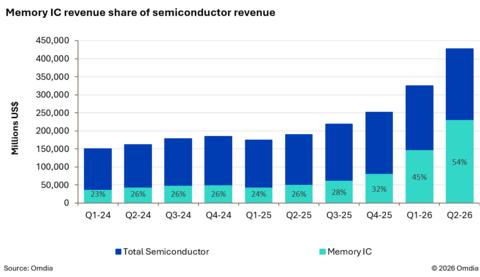
Memory IC revenue share of semiconductor revenue
Memory continues to be the primary driver of growth, while other semiconductor components are growing above seasonal patterns and contributing to the robust market.
Memory market reaches another new record high
The memory market, led by dynamic random-access memory (DRAM) and NAND flash memory, continues to record unprecedented growth as AI-demand reshapes memory suppliers’ production priorities.
These production shifts are affecting supply-demand balances, resulting in higher average selling prices (ASPs) and revenue. Memory ICs alone accounted for more than half of all semiconductor revenue in 2Q26.
The record memory share of semiconductor revenue reflects record growth across multiple types of memory chips. DRAM, NAND, and NOR chips each recorded their highest sequential growth for a second quarter since Omdia began tracking the market. All three components reached their highest recorded quarterly revenue in 2Q26.
AI demand lifting non-memory components
Excluding memory chips, the wider semiconductor market also performed strongly in 2Q26. The significant influence of memory is skewing top-line semiconductor market trends towards the performance of DRAM and NAND. Removing revenue associated with these chips provides a clearer picture of the market as experienced by most semiconductor firms.
The non-memory chip semiconductor market grew by over 10% QoQ, significantly above seasonal patterns. Based on Omdia data from 2002 through 2025, typical second quarter sequential growth for non-memory semiconductors is just over 3%.
Other components are also benefiting from their inclusion in AI infrastructure. Microprocessor (MPU) revenue grew 16% QoQ in 2Q26 as these components play an increasing role in AI, well above their seasonal growth of 1%.
Semiconductor revenue forecast to surpass $500bn in 3Q26
Semiconductor revenue surpassed $750 bn in the first half of 2026, already exceeding the full-year revenue recorded in every year except 2025.
Omdia forecasts semiconductor revenue will surpass $500 bn in 3Q26, taking total revenue for the first three quarters of 2026 above $1.25 tn. This would be 50% higher than total semiconductor revenue for the whole of 2025.
The strong market conditions and record quarterly revenue levels are expected to continue.
ABOUT OMDIA
Omdia, part of TechTarget, Inc. d/b/a Informa TechTarget (Nasdaq: TTGT), is a technology research and advisory group. Our deep knowledge of tech markets grounded in real conversations with industry leaders and hundreds of thousands of data points, make our market intelligence our clients’ strategic advantage. From R&D to ROI, we identify the greatest opportunities and move the industry forward.
A type of semiconductor memory that stores each bit as an electrical charge in tiny capacitors and must be refreshed regularly to keep data. It acts like a computer’s short-term workspace—holding the data a processor is actively using—and is the dominant form of main memory in PCs, servers, and many mobile devices. DRAM matters to investors because demand, supply capacity, and pricing for this commodity-like component drive revenues and profit cycles for chipmakers and hardware makers, creating pronounced industry volatility.
nand flash memorytechnical
NAND flash memory is a type of electronic storage that holds data even when power is off, used in solid‑state drives, smartphones, USB drives and many other devices. Think of it as a bookshelf that keeps your books in place without needing electricity; it lets devices store photos, apps and operating systems compactly and quickly. Investors watch NAND markets because its supply, demand, pricing and manufacturing costs strongly influence revenue, margins and cash flow for chipmakers and consumer‑electronics companies.
average selling prices (asps)financial
Average selling prices (ASPs) measure the mean price at which a company’s products or services sell over a period, calculated as total revenue divided by units sold (or weighted by product mix). Think of it like the average ticket price at a movie theater that summarizes how much customers pay on average. Investors watch ASPs to track pricing power, product mix shifts, discounting, and trends that affect revenue and profitability.
microprocessor (mpu)technical
A microprocessor (MPU) is a single integrated circuit that performs the basic computing tasks and controls the operation of electronic devices by executing software instructions — in everyday terms, it acts like the device’s brain. It matters to investors because microprocessors are a key part of many products and industries: their performance, cost, availability, and energy use affect product capabilities, manufacturing margins, supply chains, and revenue potential across technology, automotive, and consumer sectors.