
U.S. P&C Insurers Post Strong 92.4 Combined Ratio as Premium Growth Slows Sharply
Verisk (Nasdaq: VRSK) and APCIA report that U.S. P&C insurers posted a Q1 2026 combined ratio of 92.4 and an estimated $15.8 billion underwriting gain, versus a loss in 2025.
Rhea-AI Summary
Verisk (Nasdaq: VRSK) and APCIA report that U.S. P&C insurers posted a Q1 2026 combined ratio of 92.4 and an estimated $15.8 billion underwriting gain, versus a loss in 2025.
Net income rose to $40.9 billion, while net written premium growth slowed sharply to 2.9% and $6.2 billion was returned to policyholders via dividends.
Positive
- Underwriting swung to a $15.8 billion gain from an $864 million loss in Q1 2025
- Combined ratio improved to 92.4% from 99.2% year over year
- Net income after taxes rose to $40.9 billion from $19.4 billion
- Policyholders’ surplus increased to $1.24 trillion from $1.09 trillion
- Realized capital gains grew to $8.8 billion from $3.7 billion
- Incurred losses and loss adjustment expenses decreased by 9.6% after a 15.5% increase in Q1 2025
Negative
- Net written premium growth slowed sharply to 2.9%, down from 6.8% in Q1 2025
- Written premiums effectively declined in 2026 after inflation and $6.2 billion in dividends
- Casualty lines and other non-auto segments continue to face pressure
- Industry faces exposure to potential catastrophe losses in the 2026 hurricane season
- Recovery is described as uneven across lines despite personal auto improvements
Details
News Market Reaction – VRSK
In the Jun 23 session, VRSK gained 3.41%, reflecting a moderate positive market reaction.
Data tracked by StockTitan Argus on the day of publication.
Key Figures
- Underwriting gain
- $15.8 billion
- Estimated net underwriting gain, Q1 2026
- Combined ratio
- 92.4 percent
- Q1 2026, improved from 99.2 percent in Q1 2025
- Net income
- $40.9 billion
- Net income after taxes, Q1 2026 vs. $19.4 billion in Q1 2025
- Net written premium growth
- 2.9 percent
- Q1 2026, down from 6.8 percent in Q1 2025 and 9.6 percent in Q1 2024
- Net earned premium growth
- 3.8 percent
- Q1 2026, compared to 7.8 percent in Q1 2025
- Incurred losses and LAE
- 9.6 percent decrease
- Change in incurred losses and loss adjustment expenses, Q1 2026 vs. Q1 2025
- Policyholders’ surplus
- $1.24 trillion
- Policyholders’ surplus in Q1 2026 vs. $1.09 trillion in Q1 2025
- Returned to policyholders
- $6.2 billion
- Dividends returned to policyholders in Q1 2026
Historical Context
-
Launch of reengineered U.S. tropical cyclone model on Synergy Studio platform.
-
Release of 2026 U.S. Roof Report highlighting rising roof risk and costs.
-
KatRisk joining Verisk Model Exchange to broaden catastrophe modeling access.
-
Appointment of Pradip Patiath to board and retirement of another director.
-
Collaboration enabling launch of digital-first Zen Insurance in the UK.
24h Move is the share-price change in the day after each event; other market factors may also have contributed.
Key Terms
combined ratio financial
policyholders’ surplus financial
loss adjustment expenses financial
reinsurance financial
el niño technical
AI-generated analysis. How Rhea-AI works. Not financial advice.




In the first quarter of 2026, carriers returned
JERSEY CITY, N.J., June 23, 2026 (GLOBE NEWSWIRE) -- Year-over-year, the U.S. property/casualty (P&C) insurance industry’s financial performance improved through the first three months of 2026, according to Verisk (Nasdaq: VRSK), a leading strategic data analytics and technology partner to the global insurance industry, and the American Property Casualty Insurance Association (APCIA), the primary national trade association for home, auto and business insurers.
According to key financial indicators for private U.S. P&C insurers, the industry posted an estimated net underwriting gain of approximately
First-quarter results improved largely due to continued momentum in personal auto underwriting, alongside a more stable catastrophe experience relative to the prior year. Some carriers have returned personal auto premiums through elevated policyholder dividends, marking a shift from recent periods of auto rate increases. At the same time, broader market conditions are mixed and other lines of insurance continue to face pressure.
“Industry profitability improved in 2025 and the first quarter of 2026, driven largely by moderating inflation and an unusual respite from natural catastrophes over the past 12 months,” said Robert Gordon, senior vice president, policy, research and international, APCIA. “In good news for policyholders, premium increases continued to slow. Net written premium growth slowed sharply to 2.9 percent in Q1 2026, down from 9.6 percent in Q1 2024 and 6.8 percent in Q1 2025. When factoring in inflation and
“Net income bounced back in Q1 2026 following a 50 percent decline in Q1 2025. At the same time, legal system abuse and rising claims severity continue to be among the industry’s most significant headwinds. States such as Florida that have enacted meaningful legal system abuse reforms are beginning to see progress, including stabilization and reductions in auto and homeowners’ insurance rates,” Gordon concluded.
Underwriting Industry Financial Results Through Q1 2026, Post-Policyholder Dividends
- Written premiums: Net written premium growth slowed to 2.9 percent, compared to 6.8 percent during the same period in 2025.
- Earned premiums: Net earned premiums rose 3.8 percent, compared to 7.8 percent during the same period in 2025.
- Underwriting gain: The U.S. P&C insurance industry posted an estimated net underwriting gain of
$15.8 billion , an improvement from the$864 million underwriting loss through the first three months of 2025. - Incurred losses and loss adjustment expenses: Incurred losses and loss adjustment expenses decreased by 9.6 percent, compared to a 15.5 percent increase in Q1 2025. The combined ratio improved to 92.4 percent, down from 99.2 percent in the same period last year.
- Surplus: Policyholders’ surplus increased to
$1.24 trillion from$1.09 trillion during the same period in 2025. - Realized capital gains: Realized capital gains increased to
$8.8 billion , compared to$3.7 billion in Q1 2025. - Net income: Net income after taxes increased to
$40.9 billion from$19.4 billion in Q1 2025.
“First-quarter results reflected meaningful improvements, most notably in personal auto, but slower premium growth and continued pressure in casualty underscore an uneven recovery across the market,” said Saurabh Khemka, president of Verisk Underwriting Solutions. “Heading into the 2026 hurricane season, a critical focus for the industry is the potential for catastrophic activity to impact full-year performance. Profitability will need to hold through historically more active second and third quarters, as even in otherwise calm El Niño years, a single event can materially shift outcomes.”
Khemka added, “In today’s market, underwriting performance is increasingly defined by the quality and consistency of individual decisions. Carriers are using more granular data and AI to improve insight into how specific risks are selected, priced and managed across their portfolios, bringing greater discipline to underwriting at scale. That level of precision is critical not only for protecting margins, but for sustaining performance in the year ahead as conditions evolve.”
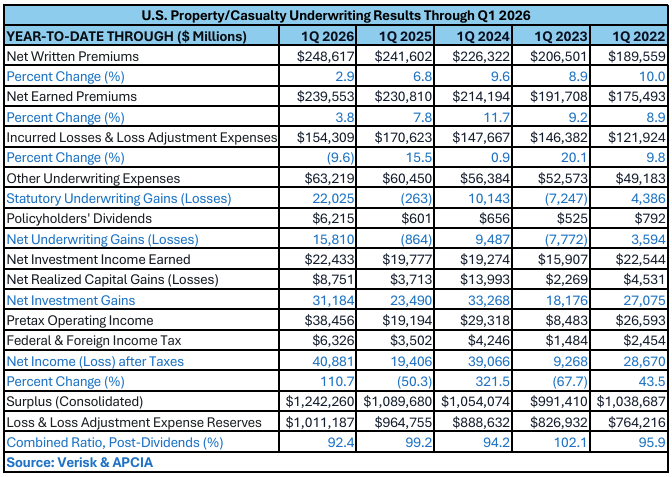
Note: The results above are based on quarterly statements filed with insurance regulators by private property/casualty insurers domiciled in the United States, including reinsurers, excess and surplus insurers, and domestic insurers owned by foreign parents, and excluding state funds for workers' compensation and other residual market insurers, the National Flood Insurance Program, and foreign insurers. The figures are consolidated estimates based on reports accounting for about 98 percent of all business written by U.S. property/casualty insurers. All figures are net of reinsurance unless otherwise noted and occasionally may not balance due to rounding. Net investment results displayed are post-tax.
About Verisk
Verisk (Nasdaq: VRSK) is a leading strategic data analytics and technology partner to the global insurance industry. It empowers clients to strengthen operating efficiency, improve underwriting and claims outcomes, combat fraud and make informed decisions about global risks, including climate change, catastrophic events, sustainability and political issues. Through advanced data analytics, software, scientific research and deep industry knowledge, Verisk helps build global resilience for individuals, communities and businesses. With teams across more than 20 countries, Verisk consistently earns certification by Great Place to Work. For more, visit Verisk.com and the Verisk Newsroom.

Morgan Hurley
Verisk
551-655-7858
morgan.hurley@verisk.com
FAQ
AI-generated questions and answers. How Rhea-AI works. Not financial advice.