
Intel Classiq Deal: Intel to Buy Quantum Software as Rivals Fund Chip Plants


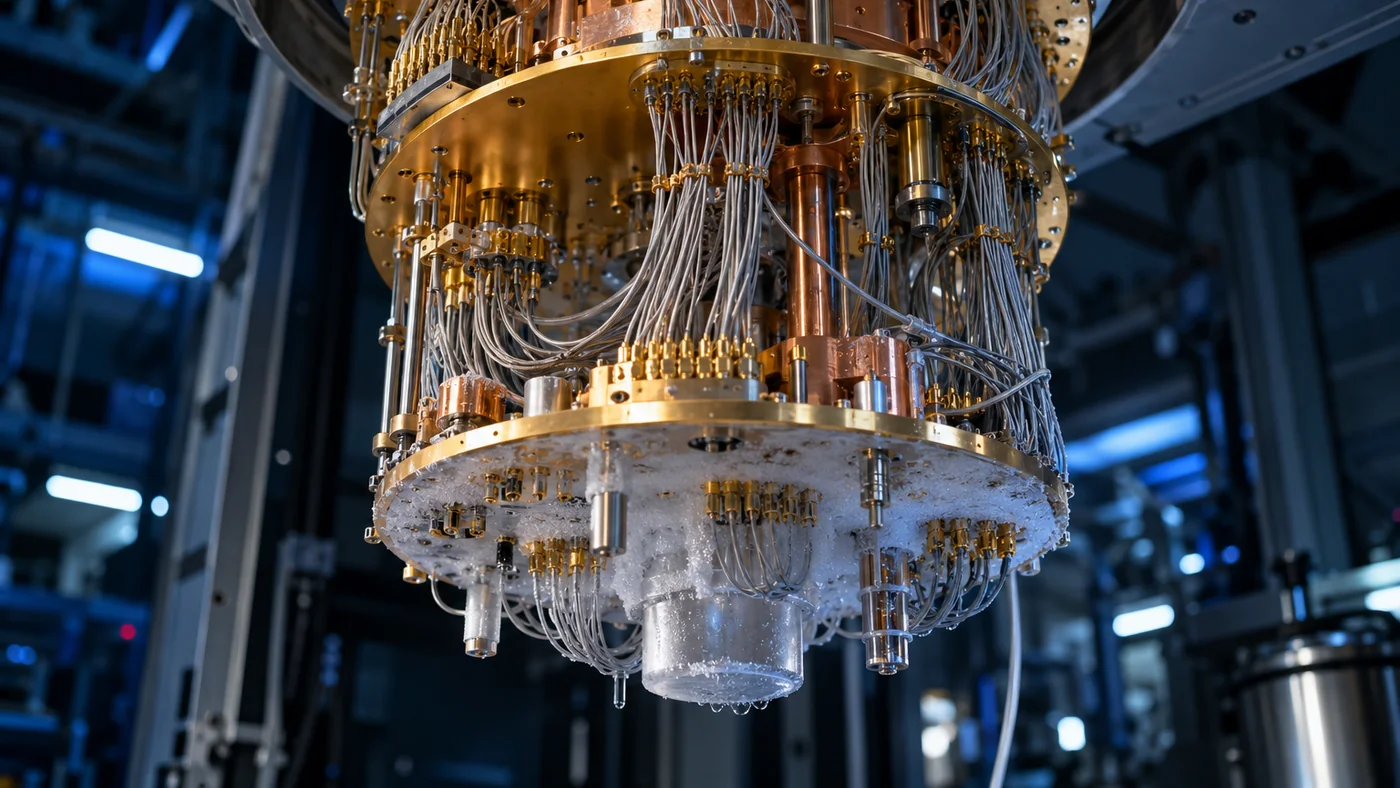
Intel agreed on October 26, 2026 to buy Classiq, an Israeli maker of software that writes programs for many makers’ quantum computers, its rivals’ included, and gave no price. Set beside this year’s other quantum deals, it runs the other way: IonQ bought a chip factory and IBM is putting $1 billion into its own quantum chip plant.
The short answer. Intel agreed to buy Classiq, whose software turns a problem into instructions for quantum computers from IBM, IonQ and others. It also works with Intel’s simulator, a program that imitates a quantum computer. It matters beyond Intel’s shareholders because the companies racing to build these machines are choosing which part of the business to own. Intel, which owns chip factories, picked the software end. We lined the deal up against the year’s other quantum purchases and read six years of Intel’s annual reports. They never once discuss its quantum chips, which shows what the reports stress, not that the work stopped.
Three numbers behind Intel’s Classiq deal
What we calculated
- Intel’s annual reports for fiscal 2020 through 2025 use the word “quantum” twice, both in one 2022 sentence about encryption: our count in each 10-K’s text.
- 908 days passed between Intel’s last quantum press release in StockTitan’s news archive (May 1, 2024) and the Classiq announcement: our count of Intel releases with quantum in the title.
On this page
What does Classiq do?
Classiq makes software that lets a programmer describe what a quantum program should do, then builds the detailed instructions for a chosen machine. Intel compares it to the design software that let engineers draw ever bigger ordinary chips.
A quantum computer works with qubits, the quantum version of the 0s and 1s in an ordinary computer. Programs for these machines are still often written close to the hardware, one operation at a time. Intel’s release calls the result “custom hand-crafted circuits.” It is slow work, and only specialists can do it.
Classiq, an Israeli company founded in 2020, automates that step. Intel’s announcement says Classiq “plays a similar role in quantum computing” to the chip design software of forty years ago. Intel calls it “agnostic to the underlying qubit modality and hardware”, meaning it does not care which kind of quantum machine runs the result.
- Describe the problem The programmer writes what the program should do in Classiq’s high-level modeling language.
- Build the quantum program Classiq’s software turns that description into a detailed quantum circuit, the list of operations the machine performs.
- Fit it to a machine The circuit is optimized for the quantum computer or simulator the user picks.
- Run it The program runs on that machine, directly or through a cloud service, and the results come back.
The customers Classiq names in its May 2025 funding announcement are big companies trying the technology early: BMW, Citi, Deloitte, Rolls-Royce, Mizuho and Toshiba. That round raised $110 million, and a November 2025 round took Classiq’s total funding to over $200 million. Classiq has not published its revenue, and neither company has given a headcount.
Intel already had quantum software of its own. Its Quantum SDK, released in February 2023, is a toolkit for writing quantum programs in C++ and testing them on a simulated machine. Classiq works a level higher, building the circuit from a description of the goal, and it already reaches many makers’ machines.
Why is Intel buying Classiq?
Intel says the deal makes it a full-stack quantum business, one that offers the chips and the software together. This year IonQ bought a chip factory and IBM put money into a quantum chip plant. Intel, which says it already makes qubits with ordinary chipmaking tools, agreed to buy software.
IonQ, a company built around quantum computing, completed its purchase of SkyWater Technology on July 31, 2026. SkyWater is a contract chip factory, and IonQ’s January announcement valued the deal at about $1.8 billion. In its completion release IonQ said owning it “unlocks IonQ’s semiconductor-based approach to manufacturing new generations of our quantum computers.” IonQ is also one of Classiq’s investors.
IBM went two ways at once. In May it announced Anderon, a factory in Albany, New York, for quantum wafers, the silicon discs chips are cut from. IBM is putting in $1 billion of cash, and in September the Commerce Department finalized a $1 billion federal chips award for it. In August it completed the purchase of HRL Laboratories, a lab known for silicon spin qubits, the same kind of qubit Intel builds.
| Classiq | SkyWater | HRL Laboratories | Anderon | |
|---|---|---|---|---|
| Buyer | Intel | IonQ | IBM | IBM |
| What it is | Quantum software company | Contract chip factory | Silicon spin qubit lab | New quantum wafer factory |
| Money stated | Not disclosed | About $1.8 billion deal value | Not disclosed | $1 billion of IBM cash put in |
| Federal support stated | None stated | None stated | None stated | $1 billion award finalized Sept 2026 |
| Status on October 26, 2026 | Close expected in first half of 2027 | Completed July 31, 2026 | Completed August 26, 2026 | Announced May 21, 2026 |
Intel starts from the factory side. Its release says it is “the only company capable of producing qubit chips and complex cryogenic control electronics at-scale, using equipment and processes common to conventional silicon-based semiconductor manufacturing.” Cryogenic means built to work in the extreme cold quantum chips need. That is Intel’s own claim, and no outside party has tested it in anything we read.
Read side by side, each buyer added the piece its own announcement said it was missing. IonQ wanted a chip supply it controls. IBM wanted spin qubit know-how next to its main design. Intel, by its own account, had the chips and wanted the layer that makes them usable, and its chief executive Lip-Bu Tan said the deal “transforms Intel’s Quantum Computing Group into a full-stack quantum computing business.” That reading is ours; none of the three said anything about the others.
What is Intel doing in quantum computing?
Intel builds qubits out of silicon, each one much like a transistor, and has shared research chips with university and government labs. The research chip it released in 2023 holds 12 qubits, and its annual reports leave the work out.
Intel says it has invested in quantum computing since 2015. Its best known chip is Tunnel Falls, announced in June 2023, which stores information in the spin of single electrons. Intel said each qubit measures about 50 by 50 nanometers, up to a million times smaller than other kinds.
Tunnel Falls went to research labs, including Sandia National Laboratories and the University of Wisconsin-Madison, so they could run experiments without building their own devices. In May 2024 Intel reported 99.9% gate fidelity, a measure of how often a qubit’s basic operations come out right, in a paper published in Nature.
Other makers describe their machines in other units, so the numbers do not line up. Google’s Willow chip, announced in December 2024, has 105 physical qubits, the individual devices on the chip. IBM plans a machine called Starling by 2029 with 200 logical qubits, each built from many physical qubits working together to catch errors. One is a chip that exists and the other a target, and neither says where Intel stands against them.

Show the data
| Date | Event |
|---|---|
| 2015 | Intel says its investment in quantum computing began in 2015. |
| Dec 2020 | Intel introduces Horse Ridge II, a chip that controls quantum systems at very low temperatures. |
| Oct 2022 | Intel reports a manufacturing milestone for silicon quantum devices. |
| Feb 2023 | Intel releases Quantum SDK 1.0, a software toolkit for simulating quantum computers. |
| Jun 2023 | Intel releases Tunnel Falls, a silicon research chip with 12 qubits, to research labs. |
| May 2024 | Intel reports 99.9% gate fidelity on qubits made on its 300-millimeter wafers, in a paper in Nature. |
| Oct 2026 | Intel agrees to buy Classiq, with the close expected in the first half of 2027. |
The Tunnel Falls release said a next chip was “expected to be released in 2024.” No Intel release in StockTitan’s data has announced it, and the May 2024 paper was Intel’s last quantum press release in StockTitan’s news archive until today.
Intel’s reports to shareholders say even less. We searched the six annual reports Intel filed for fiscal 2020 through 2025 for the word “quantum”. It appears twice, both times in one 2022 sentence about encryption, and never about Intel’s own quantum chips. The annual report, filed with the SEC as a Form 10-K, is the company’s main yearly account to shareholders, and the 2025 one has no quantum section. This shows what the reports emphasize. It does not show that Intel set quantum aside, since its releases show the lab work went on into 2024 and today’s deal adds to it.
Will Classiq still work with IBM, IonQ and Nvidia?
Intel says it intends to keep Classiq’s existing links to other makers’ machines. As of May 2025 Classiq listed quantum computers from IBM, IonQ, Quantinuum and others, and AMD, Qualcomm and IonQ put money into it last year.
The release says that after closing Intel “intends to continue to support Classiq’s existing multi-platform integrations and ensure a modality- and hardware-agnostic software solution”. Classiq’s May 2025 announcement lists direct links to machines from IBM, IonQ, QuEra, Quantinuum, OQC, AQT, Alice & Bob and Rigetti. It adds simulators from Nvidia and Intel, programs that imitate a quantum computer on ordinary chips. It also runs through Amazon’s, Microsoft’s and Google’s clouds.

Show the data
- Intel to Classiq quantum software: Buying it.
- AMD Ventures to Classiq quantum software: Invested, Nov 2025.
- Qualcomm Ventures to Classiq quantum software: Invested, Nov 2025.
- IonQ to Classiq quantum software: Invested, Nov 2025.
- Classiq quantum software to IBM and IonQ quantum computers: Runs on.
- Classiq quantum software to Quantinuum and Rigetti computers: Runs on.
- Classiq quantum software to NVIDIA and Intel simulators: Runs on.
Three of its investors are chip or quantum companies. AMD’s venture arm, Qualcomm’s venture arm and IonQ joined Classiq’s November 2025 funding round. In February 2026 Classiq, Comcast and AMD reported a trial of a quantum method for internet routing, simulated on AMD’s graphics chips. Neither Intel nor Classiq has said what those investors receive in the sale, or whether the partnerships carry on unchanged.
How much is Intel paying for Classiq?
Intel has not said. Its announcement gives no price and no form of payment, and no SEC filing about the deal had appeared by the evening of October 26.
The deal still needs regulatory approvals and other routine conditions, and Intel expects it to close in the first half of 2027. Until then the two companies run separately. Intel has not disclosed the price or whether it will pay in cash, shares or both.
Has Intel’s CEO invested in Classiq?
Classiq’s own 2022 funding announcement lists a personal investment from Lip-Bu Tan, now Intel’s chief executive. Intel’s deal announcement does not mention it.
Classiq’s February 2022 release on its $33 million round says it “included personal investments from Lip-Bu Tan and Harvey Jones”. It describes Tan as executive chairman and former chief executive of Cadence Design Systems, a maker of chip design software. The same release says “Cadence and Synopsys do for electronic design what Classiq does for quantum software design”, the comparison Intel’s release makes today.
Intel’s 2026 proxy statement is the document it sends shareholders before its annual meeting. It says the audit committee, a group of board members, reviews deals above $120,000 in which a director or executive “has a direct or indirect material interest”. Executives must also tell the company of any possible conflict. Neither the release nor any Intel filing we found says whether Tan still holds Classiq shares or how this deal was reviewed.
What to watch
- The price and how Intel pays: a Form 8-K (a company’s report to the SEC on a major event) if Intel files one, or its next quarterly report.
- Whether Intel gives Classiq’s price or a plan for its quantum chips: the third-quarter results release and call on Thursday, October 29, 2026, after the market closes.
- Any interest of Intel’s chief executive in the sale: the section of Intel’s 2027 proxy statement that lists deals involving its directors and executives.
- Approvals and the close: Intel’s announcement when the deal completes, expected in the first half of 2027.
How we counted
Annual reports: we downloaded from the SEC each Form 10-K Intel filed for fiscal 2020 through 2025. We removed the page code and the hidden data section that SEC filings carry, then counted the word “quantum” in any letter case in the remaining text, exhibits not included. The only hits were two in the fiscal 2022 report, in one sentence about “quantum-resistant crypto in the quantum era.” As a check that the files read correctly, the same method finds the word “foundry” 143 times in the 2025 report.
Press releases: we searched StockTitan’s news data for Intel releases with quantum, qubit, Tunnel Falls or Horse Ridge in the title. The last one before today was dated May 1, 2024, 908 days earlier. This covers the wire releases StockTitan carries, so posts on Intel’s own blogs are not counted.
Frequently asked questions
Is Intel working on quantum computing?
Yes. Intel builds silicon spin qubits, released its 12-qubit Tunnel Falls research chip in June 2023 and reported 99.9% gate fidelity, a measure of accuracy, in May 2024. On October 26, 2026 it agreed to buy the quantum software company Classiq.
What is Classiq?
Classiq sells software that lets a programmer describe a quantum program at a high level and then builds the detailed instructions for a chosen quantum computer. It works with machines from IBM, IonQ, Quantinuum, Rigetti and others.
Did Intel say how much it is paying for Classiq?
Intel has not disclosed a price or how it will pay, and no SEC filing about the deal had appeared by the evening of October 26, 2026.
When will the Intel Classiq deal close?
Intel expects it to close in the first half of 2027, after regulatory approvals and other customary conditions. Until then Intel and Classiq operate as separate companies.
What companies are developing quantum computers?
Among them are IBM, Google, IonQ, Quantinuum, Rigetti and Intel. In 2026 IonQ bought the chip factory SkyWater and IBM announced its own quantum wafer factory, Anderon.
Where can I read Intel’s Classiq announcement on StockTitan?
The full release is on StockTitan’s Intel news page for the deal, and Intel’s figures are on its overview and financials pages.
Sources
- Intel to Acquire Classiq to Create a Full-stack Quantum Computing Platform, StockTitan, October 26, 2026
- Intel stock overview, StockTitan
- Intel financials, StockTitan
- IonQ stock overview, StockTitan
- Largest companies by market cap, StockTitan
- Intel’s New Chip to Advance Silicon Spin Qubit Research for Quantum Computing, June 15, 2023
- Intel Takes Next Step Toward Building Scalable Silicon-Based Quantum Processors, May 1, 2024
- IonQ Completes Acquisition of SkyWater Technology, July 31, 2026
- IBM and U.S. Department of Commerce Announce America’s First Purpose-Built Quantum Foundry, May 21, 2026
- IBM Completes Acquisition of HRL Laboratories, August 26, 2026
- Anderon, an IBM Company, Finalizes Agreement for a $1 Billion CHIPS Award, September 16, 2026
- Comcast, Classiq and AMD Demonstrate Quantum Algorithm, February 17, 2026
- Salesforce Agrees to Buy Braze: What Braze Holders Get and When, StockTitan
- ASML Says AI Chipmakers Want More Machines Than It Can Build, StockTitan
- IonQ and SkyWater merger announcement, Form 8-K exhibit 99.1, January 26, 2026
- Intel Form 10-K for fiscal 2025, filed January 23, 2026
- Intel Form 10-Q for the quarter ended June 27, 2026
- Intel 2026 proxy statement, filed March 23, 2026
- Classiq Series B announcement, February 17, 2022
- Classiq Series C announcement, May 12, 2025
- IonQ, AMD and Qualcomm Ventures Join Classiq Strategic Up-Round, November 13, 2025
- Google blog post introducing the Willow quantum chip, December 9, 2024
- IBM Sets the Course to Build World’s First Large-Scale, Fault-Tolerant Quantum Computer, June 10, 2025
The information provided in this article is for educational and informational purposes only. It does not constitute financial advice, investment recommendation, or an endorsement of any particular investment strategy. Past performance does not guarantee future results. Investors should conduct their own research and consult with a qualified financial advisor before making investment decisions.