
STOCK TITAN

Equifax Market Pulse Index Remains Steady But Highlights Growing Financial Divergence Among Consumers

(Neutral)
(Positive)
Tags

Equifax (NYSE: EFX) released its Q4 2025 Market Pulse Index at 61.6, signaling overall stabilization but revealing a widening K-shaped split in U.S. consumer financial health. Top-tier households rose to 10.47%, the middle tier shrank by 6.2%, and sub-50 scores grew to 21.08%.

The Index synthesizes anonymized credit, debt, income, assets, and VantageScore 4.0 data to benchmark consumer resilience by demographic and generation.

Loading...
Loading translation...

Positive

  • Market Pulse Index steady at 61.6
  • Top-tier group rose to 10.47% (+32% since Q2 2023)
  • Sub-50 population increased to 21.08% (+11% since Q2 2023)
  • Gen Z top-tier share +74% since Q2 2023

Negative

  • Middle tier share decreased by 6.2%
  • Every age group saw a slight Index decline in Q4 2025
  • Gen X consumers with Index ≤49 grew by 11%

News Market Reaction – EFX

-0.13%
-0.13% Session close to close

In the Apr 7 session, EFX declined 0.13%, reflecting a mild negative market reaction.

Data tracked by StockTitan Argus on the day of publication.

Market Context

This announcement highlights a steady Market Pulse Index at 61.6 but underscores a widening split be...
Analysis

This announcement highlights a steady Market Pulse Index at 61.6 but underscores a widening split between financially strong and stressed consumers, with only 10% labeled “Thrivers” and 20% as “Strivers.” For Equifax, it reinforces the role of analytics spanning credit, debt, income, and assets. In context of recent security, mortgage, and leadership updates, investors may watch how shifts in lower-score segments affect demand for risk management and decision-intelligence products.

Key Figures

Market Pulse Index level: 61.6 Index scale: 1–100 Thrivers share: 10% +5 more
8 metrics
Market Pulse Index level 61.6 Fourth quarter 2025 overall U.S. consumer financial health index
Index scale 1–100 Scale where 100 represents greatest financial strength
Thrivers share 10% Population experiencing high credit and financial growth
Strivers share 20% Population feeling weight of debt and limited savings
Peak resilience group growth 7.96% to 10.47% (32% increase) Share of credit-visible population with Index of 80+ since Q2 2023
Middle tier change -6.2% Change in Index 50–79 population since Q2 2023
Sub-50 index expansion 19.07% to 21.08% (11% increase) Change in lowest-index population since Q2 2023
Gen Z top-tier growth 74% increase Gen Z with Market Pulse Index of 80+ between Q2 2023 and Q4 2025

Historical Context

5 past events · Latest: Mar 18 (Positive)
Pattern 5 events
Date Event Sentiment 24h Move Catalyst
Mar 18 Security report update Positive -1.9% 2025 Security Annual Report detailing AI-driven defenses and tech investment.
Mar 09 Mortgage pricing move Positive -4.2% VantageScore 4.0 mortgage scores priced at $1 to cut industry costs.
Mar 06 Magazine feature Positive -1.6% Named a 'Stock to Study' by BetterInvesting Magazine for May 2026 issue.
Mar 03 Conference participation Positive +0.1% Planned attendance at three March 2026 investor conferences.
Feb 26 Leadership change Positive +0.5% Appointment of David Smith as President of U.S. Information Solutions.

24h Move is the share-price change in the day after each event; other market factors may also have contributed.

Pattern Detected

Recent generally positive corporate updates have often seen neutral-to-negative next-day price reactions, suggesting a tendency toward divergence between news tone and short-term moves.

Recent Company History

Over the past several weeks, Equifax has highlighted security investments, affordability initiatives, investor outreach, and leadership changes. On Feb 26, it appointed a new USIS president with extensive lending experience. Through March, it announced conference participation, supportive mortgage-pricing actions, and a 2025 security report. Despite largely constructive narratives, 24-hour price reactions around these headlines were frequently negative, framing today’s consumer-health index update against a backdrop of cautious trading.

Key Terms

vantagescore 4.0, ai/ml, credit-visible
3 terms
vantagescore 4.0 financial
"…asset data with VantageScore 4.0 insights."
VantageScore 4.0 is a consumer credit score model that summarizes a person’s creditworthiness into a single number, using up-to-date credit file information and modern statistical methods. Think of it as a quick “risk score” like a one-number weather forecast for a borrower: lenders and investors use it to decide who gets loans, at what price, and to estimate default risk in consumer lending portfolios, so shifts in average scores can affect credit availability and financial returns.
ai/ml technical
"…built using AI/ML methods leveraging proprietary Equifax wealth and asset data…"
AI/ML stands for artificial intelligence and machine learning, software systems that identify patterns in data and make predictions or automate decisions, improving performance as they process more information. Investors care because these technologies can boost revenue, cut costs and create competitive advantages — like a factory that learns to produce goods faster and with fewer mistakes — while also introducing execution, ethical and regulatory risks that can affect a company’s value.
credit-visible technical
"A granular look at the U.S. credit-visible population shows a polarized landscape…"
Credit-visible describes a situation where a company’s ability to borrow, refinance, or meet debt obligations is clear and predictable to outsiders—like having a well-lit road instead of driving in the dark. For investors, credit visibility matters because it signals how likely the firm is to secure funding and avoid default, which influences the company’s interest costs, financial flexibility, and ultimately the risk and value of its stock or bonds.

AI-generated analysis. How Rhea-AI works. Not financial advice.

See more from StockTitan in Google Search and AI answers. Adds StockTitan as a preferred source · opens Google
Add on Google

Fourth Quarter 2025 Market Pulse Index Reveals Three Distinct Groups of Financial Risk
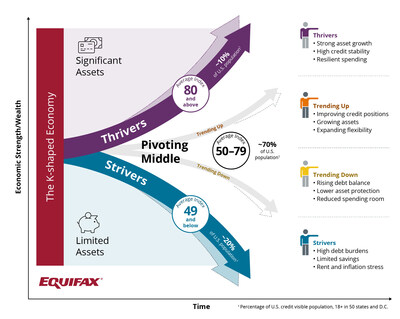
ATLANTA, April 7, 2026 /PRNewswire/ -- Equifax® (NYSE: EFX) today released its fourth quarter 2025 Market Pulse Index, which held steady at 61.6 signaling a period of stabilization of overall U.S. consumer financial health. Despite this Index remaining stable, underlying data indicates a widening K-shaped divide across consumer segments and among generations. While 10% of the population is experiencing high credit and financial growth, 20% are feeling the weight of debt and limited savings, and many of those in the middle are at a threshold between financial stability and strain.

The Equifax Market Pulse Index provides a comprehensive view of U.S. consumer financial health by synthesizing anonymized credit, debt, income, and asset data with VantageScore 4.0 insights. The Index is designed to capture the combined effects of multiple economic forces rather than focusing on a single variable. Measured on a scale of 1 to 100—where 100 represents the greatest financial strength—the Index delivers a holistic picture of consumer economic well-being, allowing for precise comparisons across diverse demographics and generations.

Tracking a Diverging Economy

While the overall Market Pulse Index suggests stability, financial risk is increasingly concentrated within specific populations. A granular look at the U.S. credit-visible population shows a polarized landscape, where top-tier credit growth is shadowed by a rapid expansion of high-risk credit segments:

  • The group with peak financial resilience (Index of 80+) grew from 7.96% to 10.47% of the total U.S. credit visible population, a 32% increase in just over two years.
  • Since the second quarter of 2023, the number of individuals in the middle tier (Index between 50 and 79) has decreased by 6.2%.
  • Index values below 50 increased from 19.07% to 21.08%, representing an 11% increase in the size of this population segment since the second quarter of 2023.

"When we look at the financial health of the country today, we see three distinct stories," said Emmaline Aliff, Advisory Leader at Equifax. "We have 'Thrivers', who make up 10% of the scorable population and who enjoy high credit and growth. At the other end, we have the 'Strivers', the 20% who are feeling the weight of debt and limited savings. But the real story is the "Pivoting Middle"—that 70% in the center. They represent the traditional middle class, and right now, they are at a crossroads between financial security and rising economic pressure."

Generational Trends: A Shared Shift and the Path to Gen Z Independence

While most age groups are still more stable today than a year ago, for the first time in two years, every age group saw a slight decline in their Market Pulse Index averages in the fourth quarter of 2025. The dip was mostly driven by rising affordability concerns and increased use of credit to cover basic needs.

The gap between "Thrivers" and "Strivers" becomes even more apparent across generations, with data indicating that different life stages and economic factors are creating a wider divide in financial stability across the country.

Gen Z

  • The number of Gen Z consumers with a Market Pulse Index of 80 or higher increased by 74% between Q2 2023 and the end of Q4 2025.
  • Top-tier credit growth suggests factors such as their transition from relying on family wealth to achieving full financial independence.

Gen X

  • The number of Gen X consumers with a Market Pulse Index of 49 and under grew by 11%, which is the largest increase across all generations.
  • Gen X consumers are balancing peak career debt, and a significant portion of this generation is affected by the "silent squeeze" of rising essential costs.

"The current economic landscape requires a more nuanced approach than single source metrics and averages can provide," added Aliff. "For lenders and retailers, there is a significant opportunity to engage high-capacity households whose financial buffers remain strong but they must also account for a rise in financial pressure for other segments and manage risk with greater precision."

The Equifax Market Pulse Index was built using AI/ML methods leveraging proprietary Equifax wealth and asset data along with data from the Equifax credit file and VantageScore 4.0 to provide a comprehensive view of consumer financial health. It distills the credit, debt, income, capacity, and assets of U.S. consumers into one benchmark number to reflect the cumulative index of both positive and negative financial factors. To learn more, read the full Market Pulse Index here.

*To view the included graphic, click here.

ABOUT EQUIFAX INC.

At Equifax (NYSE: EFX), we believe knowledge drives progress. As a global data, analytics, and technology company, we play an essential role in the global economy by helping financial institutions, companies, employers, and government agencies make critical decisions with greater confidence. Our unique blend of differentiated data, analytics, and cloud technology drives insights to power decisions to move people forward. Headquartered in Atlanta and supported by nearly 15,000 employees worldwide, Equifax operates or has investments in 24 countries in North America, Central and South America, Europe, and the Asia Pacific region. For more information, visit Equifax.com.

FOR MORE INFORMATION:
Tiffany Smith for Equifax
mediainquiries@equifax.com

Cision View original content to download multimedia:https://www.prnewswire.com/news-releases/equifax-market-pulse-index-remains-steady-but-highlights-growing-financial-divergence-among-consumers-302734717.html

SOURCE Equifax Inc.

FAQ

What does Equifax's Q4 2025 Market Pulse Index of 61.6 mean for investors in EFX?

It signals overall consumer stability but growing divergence in financial risk across segments. According to the company, the 61.6 index reflects steady aggregate consumer health while highlighting widening K-shaped splits between top-tier and vulnerable households.

How much did the top-tier consumer group grow in Equifax's Q4 2025 report for EFX?

Top-tier consumers expanded noticeably to 10.47% of the credit-visible population. According to the company, this represents a 32% increase in that high-resilience cohort versus Q2 2023, indicating concentration of financial strength among fewer households.

What changes occurred in the middle and low Market Pulse segments in Q4 2025 (EFX)?

The middle tier shrank while lower-score households grew in share. According to the company, the middle tier fell by 6.2% and sub-50 Index values rose from 19.07% to 21.08%, an 11% increase since Q2 2023.

Which generations showed the biggest shifts in Equifax's Q4 2025 Market Pulse Index for EFX?

Gen Z and Gen X showed pronounced moves in opposite directions. According to the company, Gen Z top-tier share rose 74% since Q2 2023, while Gen X consumers with Index ≤49 increased by 11%, the largest gen-level rise.

How is Equifax's Market Pulse Index constructed and why does EFX say it matters?

It combines anonymized credit, debt, income, asset, and VantageScore 4.0 data into one benchmark number. According to the company, AI/ML methods distill multiple financial signals to give lenders and investors a holistic view of consumer resilience and risk.
