Rhea-AI Sentiment reads the wording of the document, how positive or negative its language is on a 1 to 5 scale. The balance of points shown with the takes weighs what the document actually discloses, so the two can disagree, for example when a trial that missed its main goal is described in upbeat language.
LONDON--(BUSINESS WIRE)--
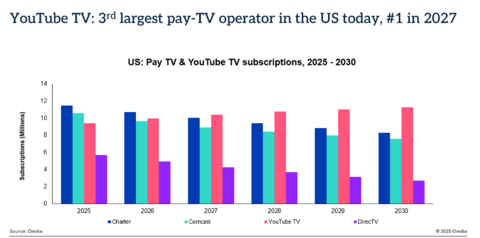
YouTube TV is set to redefine the US television landscape. According to new forecasts from Omdia, YouTube TV will surpass Charter and Comcast to become the largest pay-TV operator in the United States by 2027, marking the first time a virtual pay-TV provider will claim the top position in the market.
YouTube TV: 3rd largest pay-TV operator in the US today, #1 in 2027
Omdia’s latest analysis highlights the rapid growth trajectory of YouTube TV and its continued expansion into traditional pay-TV territory.
US Pay-TV Market Snapshot (End of 2025)
Charter: 11.4 million subscribers
Comcast: 10.6 million subscribers
YouTube TV: 9.3 million subscribers
US Pay-TV Market Forecast (2027)
YouTube TV: 10.4 million subscribers
Charter: 10.0 million subscribers
Comcast: 9.2 million subscribers
“For the first time in US television history, the largest pay-TV operator will be a virtual provider,” said Maria Rua Aguete, Head of Media and Entertainment at Omdia. “YouTube TV has evolved into a full pay-TV bundle, integrating linear channels, premium networks, and marquee sports properties such as NFL Sunday Ticket. This is not just another streaming service; it is the new face of US pay TV.”
YouTube’s Dual Strength: Global Video Giant and Rising Pay-TV Leader
Rua Aguete notes that YouTube’s influence extends far beyond its pay-TV platform. With nearly 3 billion global users, YouTube remains the largest video ecosystem in the world by a significant margin.
“Netflix may reach 300 million global subscribers, but alongside YouTube’s 3 billion users, it is not a dominant global player,” she said. “YouTube operates at a scale that no subscription service can match.”
This dual position, global video dominance plus rising pay-TV leadership, gives YouTube a unique strategic advantage in the media landscape.
US Streaming Market: Big, Fragmented, and Intensely Competitive
Omdia’s latest subscriber data highlights a highly fragmented US streaming market. Even as the largest single service, Netflix accounts for just 15.7% of total US SVOD subscriptions.
US Streaming Leaders in 2025 (Omdia forecast)
Netflix: 88.7 million subscribers
Amazon Prime Video: 64.7 million
Disney+: 55.8 million
Paramount+: 49.4 million
HBO Max: 29.7 million
“The idea of Netflix as a dominant streaming service is a misconception,” Rua Aguete noted. “Audience attention and spend are spread across a wide array of platforms.”
Omdia’s research shows a clear shift toward hybrid services that blend linear TV, premium channels, live sports, UGC, and on-demand content. With YouTube TV on course to lead US pay-TV and YouTube already commanding the world’s biggest video audience, the company exemplifies where the industry is heading.
Rua Aguete also addressed consolidation pressures, noting strong interest in Warner assets.
“Paramount and Warner remain two of the most strategically valuable assets in Hollywood,” she said. “Interest from players such as Netflix or Paramount reflects the growing need for scale, premium IP, and global distribution.”
ABOUT OMDIA
Omdia, part of Informa TechTarget, Inc. (Nasdaq: TTGT), is a technology research and advisory group. Our deep knowledge of tech markets combined with our actionable insights empower organizations to make smart growth decisions.
A virtual pay-TV provider delivers live TV channels and on-demand video over the internet instead of through traditional cable or satellite hardware, using apps, streaming boxes, or smart TVs much like a cable company that runs on the web. Investors care because subscriber numbers, how many people leave or stay, content licensing costs, and advertising or subscription pricing directly affect revenue predictability, profit margins, and the company’s growth potential.
SVODtechnical
SVOD stands for subscription video-on-demand, a service where customers pay a recurring fee to access a library of TV shows, movies or original programs on streaming platforms. For investors, SVOD matters because it creates predictable, ongoing revenue like a membership club — growth depends on gaining and keeping subscribers, how much each subscriber pays, and the cost of securing or producing content, all of which drive a streaming business’s profitability and valuation.
UGCtechnical
User-generated content (UGC) is any text, image, video, review or comment created and shared by customers or the public rather than by a company. It matters to investors because UGC acts like public word-of-mouth and can change sales, customer trust and marketing costs quickly—positive UGC can amplify growth at low cost, while negative or problematic UGC can hurt reputation, raise moderation or legal expenses, and affect valuation.
goodwill impairmentfinancial
Goodwill impairment occurs when a company’s valued reputation or brand strength, known as goodwill, is found to be worth less than previously recorded on its financial statements. This usually happens when the company's performance declines or market conditions change, signaling that the expected benefits from acquisitions or brand value are no longer as strong. It matters to investors because it can indicate that a company's assets are less valuable than initially thought, potentially affecting its overall financial health.
restricted stock unitsfinancial
Restricted stock units are a type of company reward where employees are promised shares of stock, but they only fully own these shares after meeting certain conditions, like staying with the company for a set time. They matter because they can become valuable assets and are often used to motivate employees to help the company succeed.
convertible notesfinancial
Convertible notes are a type of short-term loan that a company receives from investors, which can later be turned into company shares instead of being paid back in cash. They matter to investors because they offer a way to support a company early on while giving the potential to own a stake in its success if the company grows and later raises more funding.
revolving credit facilityfinancial
A revolving credit facility is a type of loan that a business can borrow from whenever it needs money, up to a set limit. It’s like having a credit card for companies—allowing them to borrow, pay back, and borrow again as needed, providing flexibility for managing cash flow or funding short-term expenses.
sell-to-coverfinancial
Sell-to-cover is when part of newly issued or exercised company stock is immediately sold to pay required taxes and fees, so the recipient keeps the remaining shares. For investors this matters because it reduces the number of shares insiders or employees actually hold after a grant, can create small, routine share sales that aren’t signal of cashing out, and slightly increases share supply on the market—like selling a portion of a paycheck to cover the tax bill.