
STOCK TITAN

Rockwell Automation and the Center for Automotive Research Release New White Paper on the Next Phase of Smart Manufacturing in Automotive

(Moderate)
(Neutral)
Tags

Rockwell Automation (NYSE:ROK) and the Center for Automotive Research released a white paper on smart manufacturing in automotive on June 16, 2026.

The report outlines how AI, machine learning and automation are expanding beyond body, paint and welding into electronics, validation, logistics and production coordination, delivering quantified gains in uptime, quality and throughput.

Loading...
Loading translation...

Positive

  • None.

Negative

  • None.

News Market Reaction – ROK

+0.59%
+0.59% Session close to close

In the Jun 16 session, ROK gained 0.59%, reflecting a mild positive market reaction.

Data tracked by StockTitan Argus on the day of publication.

Market Context

This announcement highlights how AI, ML and automation are driving measurable gains, including up to...
Analysis

This announcement highlights how AI, ML and automation are driving measurable gains, including up to 50% reductions in unplanned downtime and 5–7% throughput improvements in select applications. It builds on Rockwell’s broader smart manufacturing work, including its 11th State of Smart Manufacturing report released in May. Investors may watch adoption metrics, new customer wins tied to these capabilities, and subsequent operational case studies to gauge how effectively Rockwell converts this thought leadership into commercial momentum.

Key Figures

Unplanned downtime reduction: up to 50% Overall equipment effectiveness gain: approximately 5% Throughput gain range: 5% to 7% +1 more
4 metrics
Unplanned downtime reduction up to 50% Selected smart manufacturing applications in automotive
Overall equipment effectiveness gain approximately 5% Improvements from smart manufacturing deployments
Throughput gain range 5% to 7% Gains from real-time production analytics
State of Smart Manufacturing edition 11th annual Rockwell Automation State of Smart Manufacturing report

Historical Context

5 past events · Latest: Jun 09 (Positive)
Pattern 5 events
Date Event Sentiment 24h Move Catalyst
Jun 09 Capital return update Positive -4.4% New $1B buyback authorization and quarterly dividend declaration.
Jun 09 Cybersecurity expansion Positive +1.3% Expansion of SecureOT cybersecurity offerings and managed services.
May 28 Conference appearance Neutral -0.3% Presentation at Wells Fargo Industrials & Materials Conference.
May 19 Conference appearance Neutral -3.3% Participation in Baird’s 2026 Global Consumer, Technology & Services Conference.
May 19 Industry study release Positive -3.3% Release of 2026 State of Smart Manufacturing report highlighting digital adoption.

24h Move is the share-price change in the day after each event; other market factors may also have contributed.

Pattern Detected

Recent news has often led to negative or muted reactions, including a notable selloff on a large buyback/dividend announcement.

Recent Company History

Over the past month, ROK has issued several announcements spanning capital returns, cybersecurity expansion, conference appearances, and smart manufacturing research. On Jun 9, a new $1 billion repurchase authorization and dividend declaration saw a -4.43% reaction, contrasting with a +1.26% move the same day on a SecureOT cybersecurity expansion release. Multiple investor conference presentations in late May drew modest negative reactions. A May 19 smart manufacturing study also coincided with a -3.25% move, indicating that informational and strategic updates have not consistently driven positive price responses.

Key Terms

artificial intelligence (ai), machine learning (ml), predictive maintenance, overall equipment effectiveness, +2 more
6 terms
artificial intelligence (ai) technical
"detail how artificial intelligence (AI), machine learning (ML) and automation are reshaping"
Artificial intelligence (AI) is the development of computer systems that can perform tasks typically requiring human intelligence, such as understanding language, recognizing patterns, and making decisions. For investors, AI can enhance how businesses analyze data, automate processes, and innovate, potentially leading to increased efficiency and new opportunities in the market.
machine learning (ml) technical
"how artificial intelligence (AI), machine learning (ML) and automation are reshaping"
Machine learning (ML) is a way computers can automatically find patterns and make decisions based on large amounts of data, without being explicitly programmed for each task. For investors, it matters because it helps identify trends, predict future outcomes, and improve decision-making, much like how a seasoned expert might spot opportunities by recognizing subtle clues. This technology enables smarter analysis and more informed investment choices.
predictive maintenance technical
"AI and ML are improving predictive maintenance, inspection accuracy and system performance"
Predictive maintenance involves using data and technology to monitor equipment or machinery in real time, identifying potential problems before they cause failures or breakdowns. By predicting when maintenance is needed, it helps prevent costly repairs and downtime. For investors, it highlights how companies can reduce expenses, improve efficiency, and maintain reliable operations, which can positively impact financial performance.
overall equipment effectiveness technical
"approximately 5% improvements in overall equipment effectiveness and 5% to 7% gains"
Overall Equipment Effectiveness (OEE) is a single percentage that shows how well a factory’s machines are being used by combining uptime, speed, and the share of good products produced into one number. Investors use it like a health check for manufacturing: a higher OEE means fewer breakdowns, less waste and more output from the same assets, which can boost margins and reduce the need for extra capital. Think of it as a fuel-efficiency rating for a production line.
throughput technical
"overall equipment effectiveness and 5% to 7% gains in throughput from real-time"
Throughput is the amount of stuff, like products or data, that a system can handle or move through in a certain period of time. For example, a factory’s throughput is how many items it produces each hour, and it matters because higher throughput usually means things are running efficiently and meeting demand quickly.
real-time production analytics technical
"5% to 7% gains in throughput from real-time production analytics."
Real-time production analytics is the continuous collection and analysis of factory or operational data as it happens, turning sensor readings and machine outputs into immediate metrics and alerts. For investors, it shows how efficiently a company makes products, how quickly problems are spotted and fixed, and where costs or downtime might be reduced—think of it as a live dashboard or fitness tracker for a factory that helps protect revenue and margins.

AI-generated analysis. How Rhea-AI works. Not financial advice.

See more from StockTitan in Google Search and AI answers. Adds StockTitan as a preferred source · opens Google
Add on Google

Highlights where AI and automation are delivering measurable gains in uptime, quality and production performance across automotive manufacturing
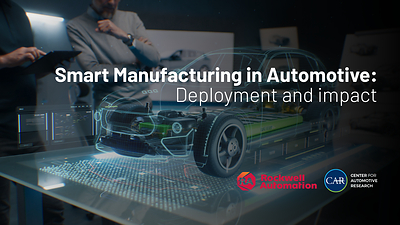
MILWAUKEE, June 16, 2026 /PRNewswire/ -- Rockwell Automation, Inc. (NYSE: ROK), the world's largest company dedicated to industrial automation and digital transformation, has partnered with the Center for Automotive Research (CAR) to release a new white paper today. The report, Smart Manufacturing in Automotive: Deployment and Impact, was authored by CAR using comprehensive data from Rockwell Automation to detail how artificial intelligence (AI), machine learning (ML) and automation are reshaping manufacturing across the automotive, tire and battery industries.

Rockwell Automation and the Center for Automotive Research release new white paper on the next phase of smart manufacturing in automotive

The research shows that the industry is entering a new phase of adoption. For manufacturers, the question is no longer whether to invest in smart manufacturing, but how quickly and where to apply it.

Automakers and suppliers already operate with advanced automation in body, paint and welding. The shift now is into areas that have been harder to automate, including electronics assembly, validation, production coordination and logistics. At the same time, AI and ML are improving predictive maintenance, inspection accuracy and system performance across existing operations.

"The industry has built a strong automation foundation. What is changing now is how manufacturers are using AI and data to manage growing complexity, improve decision-making, and create competitive advantage," said Edgar Faler, principal mobility analyst and strategy lead at CAR. "Those that move faster are starting to see measurable advantages."

The white paper combines CAR analysis with proprietary data from Rockwell Automation's 11th annual State of Smart Manufacturing report. It highlights key drivers accelerating adoption, including more complex production environments, ongoing warranty pressures, rising costs and increasing global competition. Automation is also helping enable onshoring by supporting cost-competitive production in tight labor markets.

Manufacturers are already reporting measurable results, including up to 50% reductions in unplanned downtime in select applications, approximately 5% improvements in overall equipment effectiveness and 5% to 7% gains in throughput from real-time production analytics.

"Manufacturers are being asked to do more with less while managing greater complexity," said James Glasson, VP Global Industry – Automotive, Tire & Advanced Mobility at Rockwell Automation. "The combination of automation and AI is helping teams identify issues earlier, reduce downtime and improve performance across plants. The difference now is how effectively companies scale these capabilities."

The findings also point to a growing divide across the industry. Differences in adoption are creating gaps in quality, uptime and productivity, with implications for supplier performance and long-term competitiveness.

The full white paper is available here: https://www.rockwellautomation.com/en-us/industries/automotive-tire/smart-manufacturing-automotive-whitepaper2.html

About Rockwell Automation
Rockwell Automation, Inc. (NYSE: ROK), is a global leader in industrial automation and digital transformation. We connect the imaginations of people with the potential of technology to expand what is humanly possible, making the world more productive and more sustainable. Headquartered in Milwaukee, Wisconsin, Rockwell Automation employs approximately 26,000 problem solvers dedicated to our customers in more than 100 countries. To learn more about how we are bringing the Connected Enterprise® to life across industrial enterprises, visit www.rockwellautomation.com.

About the Center for Automotive Research
The Center for Automotive Research (CAR) is a nonprofit organization based in Ann Arbor, Michigan, that produces independent research, convenes industry stakeholders, and provides insights on critical issues facing the mobility and automotive sectors. CAR's work spans manufacturing, technology, policy, and economic trends shaping the global automotive industry. For more information, visit www.cargroup.org.

Rockwell Automation logo

Cision View original content to download multimedia:https://www.prnewswire.com/news-releases/rockwell-automation-and-the-center-for-automotive-research-release-new-white-paper-on-the-next-phase-of-smart-manufacturing-in-automotive-302800997.html

SOURCE Rockwell Automation, Inc.

FAQ

What did Rockwell Automation (ROK) announce about smart manufacturing in automotive on June 16, 2026?

Rockwell Automation announced a new white paper with the Center for Automotive Research on how AI, machine learning and automation are reshaping automotive manufacturing. According to Rockwell Automation, it details deployment trends and measured gains in uptime, quality and production performance.

What performance improvements does the Rockwell Automation (ROK) automotive smart manufacturing white paper report?

The white paper reports up to 50% reductions in unplanned downtime in select applications, about 5% overall equipment effectiveness improvements, and 5%–7% throughput gains from real-time analytics. According to Rockwell Automation, these results come from manufacturers already deploying AI and automation at scale.

How are AI and automation being applied in automotive manufacturing according to Rockwell Automation (ROK)?

AI and automation are moving into electronics assembly, validation, production coordination and logistics, beyond traditional body, paint and welding. According to Rockwell Automation, AI and machine learning also enhance predictive maintenance, inspection accuracy and system performance across existing operations.

What industry challenges are accelerating smart manufacturing adoption highlighted by Rockwell Automation (ROK)?

The white paper highlights more complex production environments, warranty pressures, rising costs and global competition as key drivers. According to Rockwell Automation, automation and AI also support onshoring by enabling cost-competitive production in tight labor markets.

What competitive implications does the Rockwell Automation (ROK) smart manufacturing report describe for automakers and suppliers?

The report describes a growing divide between faster and slower adopters of smart manufacturing technologies. According to Rockwell Automation, differences in AI and automation deployment are creating gaps in quality, uptime, productivity and long-term supplier competitiveness.

Where can investors find Rockwell Automation's (ROK) new smart manufacturing in automotive white paper?

The full smart manufacturing in automotive white paper is available on Rockwell Automation’s automotive and tire industry webpage. According to Rockwell Automation, the online report combines CAR analysis with data from its 11th State of Smart Manufacturing report.
