
UL Solutions Opens Expanded Plano HVACR Testing Center to Address Heightened Customer Demand
New test chambers can accommodate systems with up to 30 tons of cooling capacity, measured in cooling power rather than weight.
Sentiment and the balance of points
Rhea-AI Sentiment reads the wording of the document, how positive or negative its language is on a 1 to 5 scale. The balance of points shown with the takes weighs what the document actually discloses, so the two can disagree, for example when a trial that missed its main goal is described in upbeat language.




The expansion increases testing capacity for energy-efficient commercial and residential equipment, next-generation refrigerants and data center cooling systems.
- The opening means the availability of additional testing capacity for large, technologically advanced heating and cooling products.
- The expanded facility supports customer demand for testing energy efficiency, AI data center cooling technology and refrigerants that enable the transition to alternatives with lower potential climate impact.
- The
Texas location advances UL Solutions’ strategy to expand testing, inspection and certification capabilities in high-demand markets.
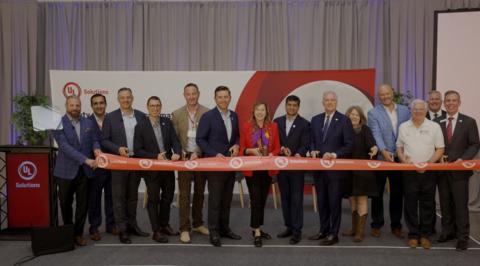
Local officials join UL Solutions leadership to celebrate the opening of the UL Solutions HVACR Center of Excellence expansion on Oct. 12 in
The HVACR Center of Excellence brings safety, performance, certification, and research and development testing together in one location. This helps manufacturers identify problems earlier, reduce testing complexity and move products more efficiently toward certification and market access in
“Heating and cooling technologies play an important role in our homes, businesses and the digital infrastructure we rely on every day,” said Jennifer Scanlon, president and CEO of UL Solutions. “Our expanded HVACR Center of Excellence strengthens our ability to help manufacturers develop safer products and bring new technologies to markets around the world.”
The expansion increases testing capacity for heat pumps, air conditioners, chillers, variable refrigerant flow systems and coolant distribution units (CDUs) used in data centers. The added capabilities help manufacturers develop more energy-efficient products, adopt refrigerants with a lower climate impact and support the rapid growth of computing infrastructure.
The facility features new test chambers capable of recreating a broad range of temperature and humidity conditions, to simulate everything from cold climates to desert environments. This helps UL Solutions replicate real-world conditions in which heating and cooling equipment may perform differently across environments. The chambers can test systems with up to 30 tons of cooling capacity, as measured in cooling power, not weight. This capacity allows UL Solutions to test larger equipment used in commercial buildings and data centers.
The HVACR Center of Excellence also offers services to measure energy use, test product controls and check how heating and cooling equipment performs as demands on the equipment change. Additional services help determine whether products meet industry requirements, including applicable standards from the Air Conditioning, Heating and Refrigeration Institute, the American Society of Heating, Refrigerating and Conditioning Engineers,
The
Learn more about the UL Solutions HVACR Center of Excellence.
About UL Solutions
A global leader in applied safety science, UL Solutions (NYSE: ULS) transforms safety, security and sustainability challenges into opportunities for customers in more than 110 countries. UL Solutions delivers testing, inspection and certification services, advisory offerings and software solutions that support customers’ product innovation and business growth. The UL Mark serves as a recognized symbol of trust in customers’ products and reflects an unwavering commitment to advancing UL Solutions’ safety mission. The company helps customers innovate, launch new products and services, navigate global markets and complex supply chains, and grow sustainably and responsibly into the future. Its science is customers’ advantage.
Source Code: ULS-IR
View source version on businesswire.com: https://www.businesswire.com/news/home/20261012047975/en/
Media:
Kathy Fieweger
Senior Vice President and Chief Corporate Communications Officer
UL Solutions
Kathy.Fieweger@ul.com
+1 312-852-5156
Investors:
Yijing Brentano
Vice President, Investor Relations
UL Solutions
IR@ul.com
+1 312-895-9873
Source: UL Solutions Inc